
Almost everyone who works across a border in this region has heard the same rule of thumb: spend 183 days somewhere and you are tax resident there.
It is close enough to be dangerous. Singapore's threshold is 183 days. Malaysia's is 182. Indonesia's is more than 183. Those differences barely matter. What matters is that all three count over different windows, so the same year of travel can put you in a different position in each country — and none of the three is checking what the others concluded.
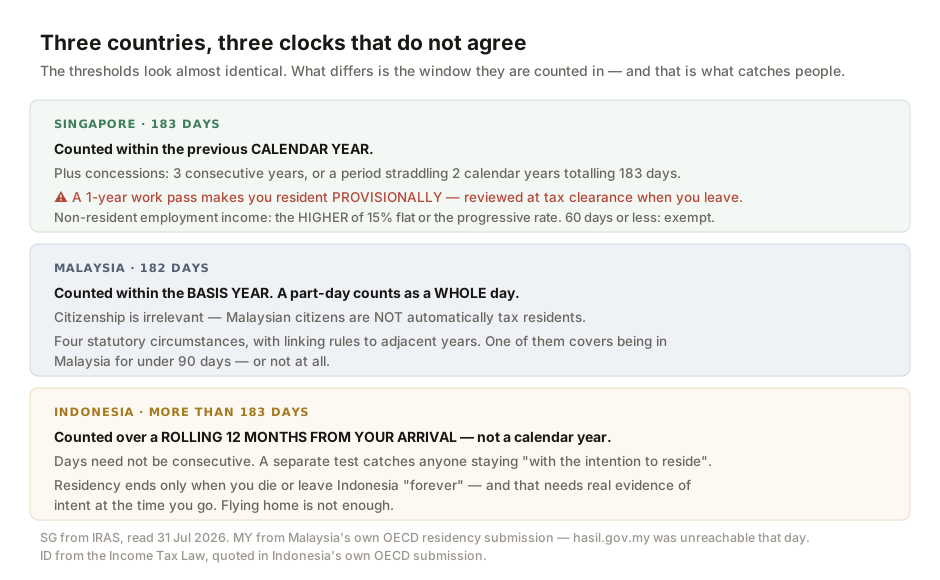
Singapore counts your calendar year. Indonesia counts from the day you arrived.
Singapore asks whether you stayed or worked there for at least 183 days in the previous calendar year. Malaysia asks about presence within a basis year, which is also a calendar year. Both reset on 1 January.
Indonesia does not. Its Income Tax Law makes you a resident tax subject if you are "staying in Indonesia for more than 183 days within 12 months period", and the elucidation is specific about what that means: the days "is not necessarily have to be consecutive, but is determined by the number of days such a person is staying in Indonesia within 12 (twelve) months period since his/her arrival."
A rolling twelve months from arrival, not a calendar year. Split a long stay across a New Year and Singapore sees two short years while Indonesia sees one long window. Nothing reconciles those two views for you.
The Singapore work pass promises less than people think
The costliest trap is written plainly on IRAS's own page.
A foreigner holding a work pass valid for at least a year is treated as a tax resident — which is why resident rates appear on your payslip from the start. But:
"your tax residency status will be reviewed at the point of tax clearance when you cease your employment based on the tax residency rules. If your stay in Singapore is less than 183 days, you will be regarded as a non-resident."
The resident treatment is provisional. Take a one-year pass, leave after five months, and the position is recalculated on the way out. Non-resident employment income is taxed at the higher of a flat 15% or the progressive resident rate, and personal reliefs disappear. The bill arrives at tax clearance, when your employer is already holding your final salary.
Two other Singapore numbers worth carrying. Employment of 60 days or less in a year is exempt from tax entirely — though not for directors, public entertainers or professionals, and not if your absences from Singapore were merely incidental to Singapore employment. Two concessions can rescue you. Three consecutive years of stay makes you resident for all three. So does a continuous employment period straddling two calendar years, if your total stay reaches 183 days.
Two Malaysian rules that catch people out
The first trap is who the rules apply to. From Malaysia's own account of its residency law: residence is determined by physical presence "and not by his nationality or citizenship", and then, explicitly, "citizens of Malaysia are not automatically tax residents." Holding the passport settles nothing.
The second matters enormously if you cross the Causeway daily:
"An individual is considered to be physically present in Malaysia for a whole day although he is present in Malaysia for part(s) of a day."
A part-day counts as a whole day. Sleep in Johor and work in Singapore, and every single one of those days is a full Malaysian day. The 182-day threshold arrives far sooner than a commuter expects.
And Malaysia's statute has four separate paths to residency, not one. Besides the obvious 182-day case, there are routes for being present fewer than 182 days, for 90 days or more, and for being in Malaysia under 90 days or not at all — each carrying linking conditions to adjacent years. You can be Malaysian tax resident in a year you barely set foot in the country.
Indonesia does not stop being interested when you fly home
Most residency tests end when the days stop. Indonesia's does not. Its law says the obligation "ends when he/she dies or leaves Indonesia forever", and the elucidation makes clear that "forever" is a factual question:
"The definition of leaving Indonesia forever must be related to real things when such an individual is leaving Indonesia. If, at the time he/she is leaving Indonesia, there is real evidence of his/her intention to leave Indonesia forever, then, at that time he/she is no longer a resident Tax Subject."
The evidence has to exist at the time you go. There is also a separate test that catches anyone staying in Indonesia during a fiscal year "having the intention to reside" there, independent of any day count. In Indonesian tax law, your intention is inferred from your circumstances, not from a statement you make later.
What happens to your CPF when you leave
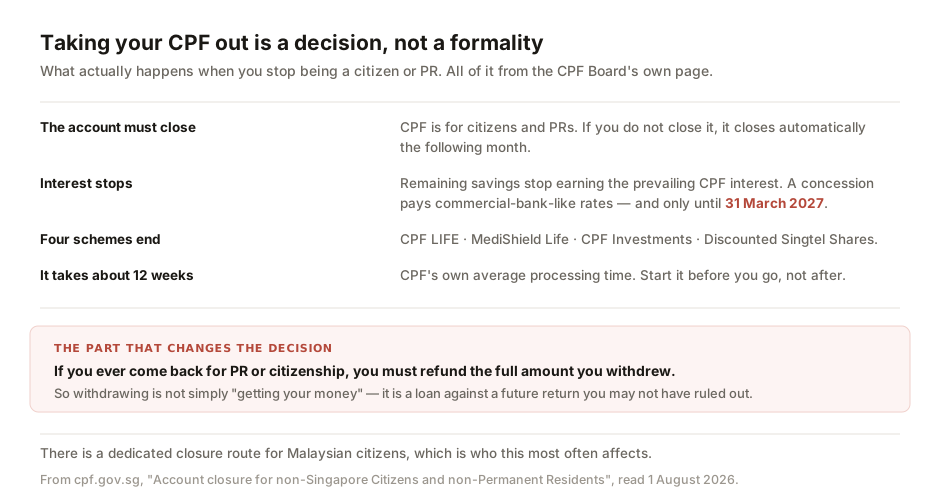
CPF exists for citizens and permanent residents, so members who are neither must close their accounts. If you do not do it yourself, the account closes automatically the following month and the remaining savings stop earning the prevailing CPF interest. A concession pays commercial-bank-like rates instead — and only until 31 March 2027. Participation in CPF LIFE, MediShield Life, CPF Investments and the discounted Singtel shares all ends.
Two practical notes. The Board's average processing time is about twelve weeks, so this belongs in your plans months before you go, not in your final week. And there is a dedicated closure route for Malaysian citizens specifically, which is the group this most often affects.
The real catch is the refund rule: an ex-citizen or ex-PR who later returns to obtain permanent residency or citizenship again must refund the full amount withdrawn. Withdrawing your CPF isn't collecting what's yours; it's a loan against a future return you may not have ruled out. People in their thirties are unusually bad at ruling that out.
Where the money actually goes when you remit
The advertised fee is the smallest part of a transfer's cost. The spread — the gap between the mid-market rate and yours — is much larger.
To feel the scale of that, consider the audit we ran for this guide: we compared our own currency converter's three-week-old offline fallback rates against the live European Central Bank feed. The median pair had drifted 0.69% in twenty-three days.
That is the drift you get from doing nothing for three weeks. A remittance spread is frequently larger than that, charged instantly, on every transfer. If you send money home monthly, the spread is the line item worth optimising and the fee is mostly theatre.
How to check: take the amount you would receive, divide by the amount you sent, and compare that rate against the mid-market rate on the day. The difference is your true cost, fee included. Do it once for each provider you are considering; it takes five minutes and rarely agrees with the marketing.
Count your days in each country using its own window — calendar year for Singapore and Malaysia, rolling twelve months from arrival for Indonesia. For Malaysian commutes, count part-days as whole days, because Malaysia does. On a Singapore work pass you might leave inside a year: budget for your residency to be recalculated at tax clearance. Before touching your CPF, weigh the refund obligation against the chance you'll return. For any remittance, calculate the effective rate yourself instead of reading the fee.
And if you are genuinely resident in two places at once, stop reading articles. Double-tax agreements have tie-breaker tests written precisely for that situation, and applying one to your circumstances is an adviser's job.
Working the numbers
Our take-home calculators run the full statutory stack for Singapore, Malaysia and Indonesia, which is the fastest way to see what a cross-border offer is actually worth once each country's deductions are applied. If you want the deductions themselves explained line by line, our guide on how to read your payslip covers CPF, EPF, SOCSO, BPJS and the rest — including the Singapore deduction you are allowed to opt out of.
A note on sourcing: this guide is built entirely on statutory rules. Singapore's figures come from IRAS's own pages and Indonesia's from its Income Tax Law, both read directly. Malaysia's tax authority website was unreachable on the day we wrote this — every residence-status path returned an error and the Public Ruling document server refused connections — so the Malaysian rules here come from Malaysia's own submission on residency to the OECD, which reproduces the statute and cites section 7 of the Income Tax Act 1967. That is the jurisdiction describing its own law rather than a commentator describing it, but it is one step further from the source than we would prefer, and you should say so when that happens.
- Singapore residency rules, the two-year and three-year concessions, the work-pass provision and its review at tax clearance, the non-resident treatment at the higher of 15% or progressive rates, and the 60-day exemption with its exclusions: IRAS, Working out my tax residency, read in full 31 July 2026.
- Malaysian residency: Malaysia's own Information on residency for tax purposes submission to the OECD, which cites section 7 and subsection 7(1B) of the Income Tax Act 1967 and Public Ruling No. 6/2011. The quoted lines on citizenship not conferring residence, and on a part-day counting as a whole day, are verbatim. Read 1 August 2026, after hasil.gov.my proved unreachable.
- Indonesian residency: Income Tax Law (Law No. 7 of 1983 as last amended by Law No. 7 of 2021), Article 2 paragraph (3) and Article 2A paragraph (1) with their elucidations, quoted verbatim in Indonesia's own OECD residency submission dated 1 December 2022. Read 1 August 2026.
- CPF account closure, the cessation of prevailing interest, the concession running to 31 March 2027, the schemes that end, the approximately twelve-week processing time and the Malaysian-citizen route: CPF Board, Account closure for non-Singapore Citizens and non-Permanent Residents, read 1 August 2026. The refund obligation on returning for PR or citizenship is from the Board's own FAQ.
- The 0.69% median currency drift over twenty-three days was measured by comparing our currency converter's offline fallback rates against the live European Central Bank feed on 1 August 2026, during the tool audit that preceded this guide. The fallbacks have since been refreshed.
General information about how residency and payroll rules are structured, not tax or immigration advice. Residency outcomes turn on facts specific to you, double-tax agreements override parts of domestic law, and every figure above has a date attached because these rules change. Anyone resident in more than one country, or unsure which they are resident in, should take professional advice rather than act on an article.

View author profile → · Editorial policy