Most people read one number on their payslip. The net figure at the bottom, the one that matches the bank alert. Everything above it is treated as weather — unpleasant, unchangeable, not worth studying.
Some of it is. But not all, and the exceptions are where you have some control. One line on a Singapore payslip is a default rather than a legal obligation, and the CPF Board says so in writing on its own website. Most of the people paying it have never been told.
This guide goes line by line through payslips in Singapore, Malaysia and Indonesia. What each deduction is, who pays it, what it is capped at, and which ones you can actually do something about.
A disclosure first, because it affects how much you should trust the numbers below. Before writing this I audited our own payroll tools, since a guide that cites a calculator ought to have read its source. I found a defect — in our tool, not someone else's — and I have described it near the end, because the way it hid is instructive for anyone relying on any payroll calculator, including ours.
Singapore: the line that is not compulsory
Start with the one almost nobody understands, because knowing about it gives you a choice.
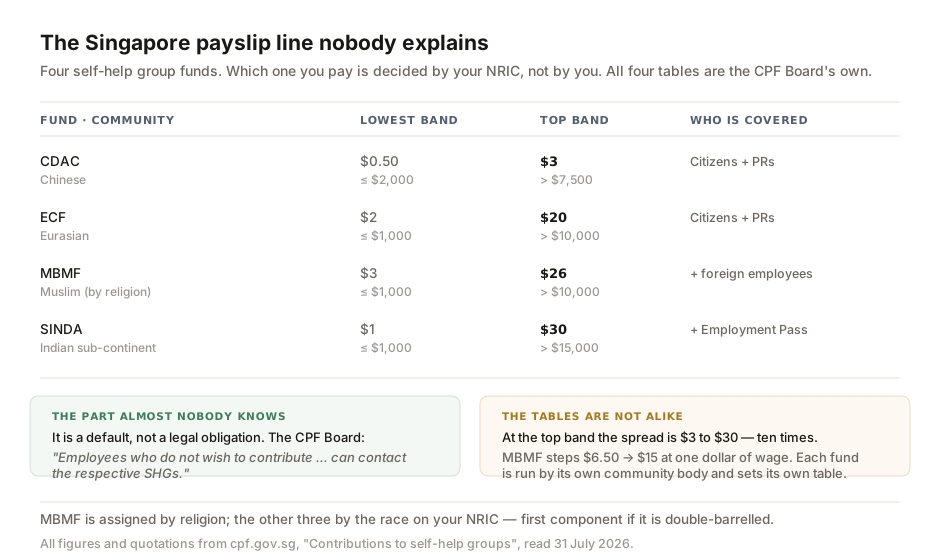
If you work in Singapore, your payslip carries a small deduction to a self-help group fund: CDAC, the Eurasian Community Fund, the Mosque Building and Mendaki Fund, or SINDA. It is usually a few dollars. It is easy to miss entirely.
Three details about these funds matter.
You did not choose your fund. The CPF Board's rule is explicit: "Contributions to the MBMF are based on the employee's religion. Contributions to other SHGs are based on the employee's race indicated on the NRIC." If your NRIC shows a double-barrelled race, the first component decides it.
The coverage is not symmetric. CDAC and the ECF apply to citizens and permanent residents only. MBMF also applies to foreign employees. SINDA also applies to Employment Pass holders. So a foreign Muslim worker contributes to MBMF, while a foreign Chinese worker contributes to nothing. That is on the government's own page, and I have not seen it remarked on anywhere.
And you can stop it. The CPF Board's wording is:
"Employees who do not wish to contribute or wish to contribute a different amount can contact the respective SHGs for more information."
It is a default, not a duty. You can opt out, or pay more, or pay less. Your employer cannot do it for you and cannot do it to you — you deal with the fund directly. Whether you should opt out is your business; these funds do real work and the sums are small. You are making a choice, not obeying a rule—a distinction most contributors have never been told.
The four tables also differ far more than you would expect. At the top band a SINDA contributor pays $30 a month and a CDAC contributor pays $3 — ten times as much. MBMF steps from $6.50 to $15 the moment monthly wages cross $3,000, a 131% jump for one dollar. Each fund is administered by its own community organisation and sets its own table, so this is design rather than accident, but it is rarely laid side by side.
Singapore: CPF, and the month it behaves differently
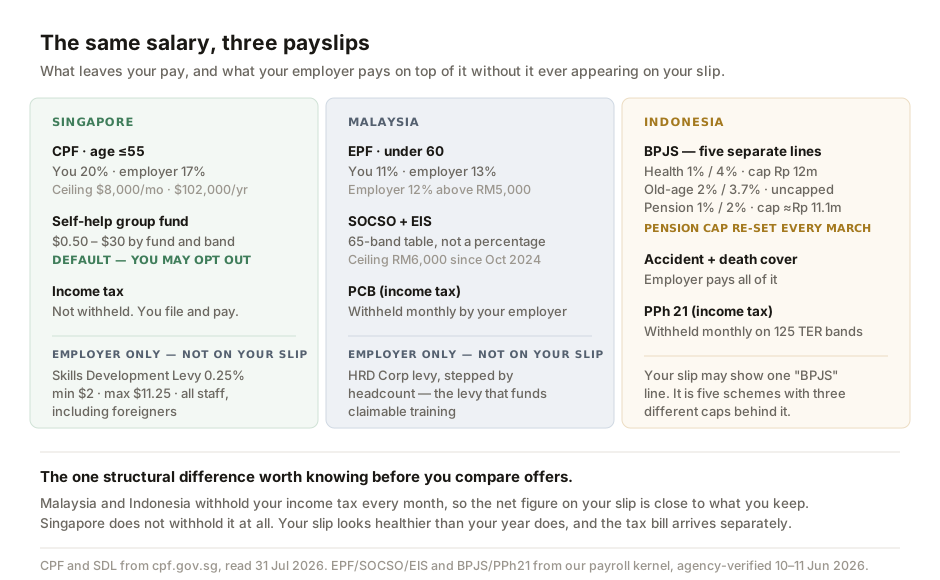
The big deduction is CPF. If you are 55 or under, 20% of your wages goes in from you and 17% from your employer — a total of 37%. The employee share falls as you age: 18% up to 60, 12.5% up to 65, 7.5% up to 70, 5% after that.
It is governed by two ceilings. The Ordinary Wage ceiling stops CPF accruing on monthly salary above $8,000. The annual ceiling is $102,000, and it covers everything — salary and bonus together.
That annual ceiling explains the strange-looking payslip in your bonus month. Bonuses are treated as Additional Wages; the portion subject to CPF is whatever headroom is left under the $102,000 annual cap. Earn $8,000 a month and your ordinary wages consume $96,000 of the $102,000, leaving only $6,000 of bonus that attracts CPF. Earn $4,000 a month and $54,000 of headroom remains. Same bonus, very different deduction, and nothing on the payslip explains why.
One caution if you are reading rate tables online: a CPF increase for the 55-to-65 bands has been announced for 2027. Anything showing those higher rates is describing next year, not this one.
And the structural quirk that catches everyone arriving from elsewhere: Singapore does not withhold your income tax. There is no PAYE line. You file, and you pay separately. Your monthly slip looks healthier than your year actually is.
The same salary, three payslips
Malaysia
EPF takes 11% from you and 13% from your employer if you are under 60 and earning RM5,000 or less; above RM5,000 the employer share drops to 12%. From 60 to under 75 the employee share falls to zero while the employer still pays 4%. Foreign workers have contributed 2% each since October 2025.
A detail that trips up anyone reconciling their own slip: for wages up to RM20,000 the official EPF amount comes from the Third Schedule bands, not from multiplying by 11%. The two agree closely but not always exactly, so a few ringgit of difference between your arithmetic and your payslip is normal rather than an error.
SOCSO and EIS are not percentages at all. They come from a 65-row band table with a ceiling of RM6,000, raised in October 2024. Your contribution is a fixed cents-and-ringgit amount for whichever band your wage falls in, which is why the figure looks arbitrary — it is a lookup, not a calculation.
PCB is your income tax, and unlike Singapore it is withheld monthly.
Indonesia
An Indonesian payslip often shows one line marked BPJS, which bundles five separate schemes with three different caps.
What your employer pays that never reaches your payslip
Every country here has a levy the employer pays on your existence, which you will never see on a slip and which is nevertheless part of what you cost.
In Singapore it is the Skills Development Levy: 0.25% of monthly wages, minimum $2, maximum $11.25, and — in the CPF Board's own words — payable "for all your employees working in Singapore, including foreign employees." It funds the Skills Development Fund, which pays for the subsidised courses many readers of this site have taken. If you have ever done a heavily discounted professional course in Singapore, this line on somebody's payroll is part of why it was cheap.
In Malaysia the equivalent is the HRD Corp levy, which steps by headcount and funds claimable training. In Indonesia the employer carries JKK and JKM outright.
Remember when comparing offers that two jobs with the same gross figure can cost employers materially different amounts. In a negotiation, the number the employer is weighing is the loaded one, not the one on your contract.
Singapore takes the largest employee bite — 20% to CPF under 55 — but withholds no income tax, so your slip flatters your year. Malaysia and Indonesia both withhold tax monthly, so their net figure is closer to the truth.
Caps matter more than rates once you earn well: CPF stops at $8,000 a month, SOCSO and EIS at RM6,000, Indonesian health cover at Rp 12 million, while Indonesian old-age contributions never stop at all.
And the Singapore self-help group deduction is a default you may opt out of, vary, or increase, by contacting the fund yourself. The amounts are small, but the choice should be a conscious one.
Checking your own slip, and a warning about calculators
You can verify most of this in a few minutes. Our Singapore, Malaysia and Indonesia take-home calculators run the full statutory stack for each country, and the CPF contribution calculator handles the age bands and the bonus-month ceiling that trips people up.
Now the disclosure I promised.
Before writing this I read the source of every payroll tool the guide was going to cite, because citing a calculator without reading it is how errors get laundered into articles. Five tools. Four were correct. The fifth — our own employer-cost calculator — had the United States Social Security wage base hardcoded at $168,600 in a variable named for 2026. That is the 2024 figure. The real progression was $168,600, then $176,100, then $184,500 for 2026, so employer tax was understated by up to $985.80 per employee per year, always in the direction of making a hire look cheaper. It is fixed.
The error was less instructive than its camouflage. That tool displayed a freshness stamp reading "last reviewed 23 May 2026" — while the number inside it was two years stale on the day it was stamped. A review date certifies that somebody looked. It cannot certify that they checked.
The one cluster of our tools that audited clean is the ASEAN payroll engine behind the calculators linked above, and the reason is visible in its source: every constant carries a verification date and the agency URL it came from, and the one value nobody could confirm was written down as a watch item rather than guessed. Hold any payroll calculator to that standard, ours included. If a tool tells you what your CPF contribution is but not when anyone last checked the rate against the CPF Board, treat the answer as a starting point.
Statutory rates move every year, and several of the figures above have known change dates: CPF rates step up for two age bands in 2027, Indonesia's pension cap is re-indexed every March, and Malaysia revised the SOCSO ceiling as recently as October 2024. Everything here was verified against the issuing agency in June and July 2026. If you are reading this much later, the shape of your payslip will still be right and some of the numbers will not.
- Singapore self-help group funds — CPF Board, Contributions to self-help groups, read in full 31 July 2026. All four rate tables, the race and religion assignment rule, the coverage differences between funds, and the quoted opt-out wording are taken from that page.
- Skills Development Levy — CPF Board, Skills Development Levy, read 31 July 2026. The 0.25% rate, the $2 minimum and $11.25 maximum, and the quoted line about foreign employees are from that page.
- CPF contribution rates, the $8,000 Ordinary Wage ceiling, the $102,000 annual ceiling and the Additional Wage mechanism are from cpf.gov.sg's 2026 contribution and allocation rate tables, verified 10 June 2026 and carried in our payroll engine with those dates recorded. The 2027 step-up for the 55–65 bands is announced and is flagged as not yet in force.
- Malaysia EPF rates (kwsp.gov.my, as at October 2025) and the SOCSO and EIS 65-row band table with its RM6,000 ceiling (perkeso.gov.my, in force since 1 October 2024) were verified 10–11 June 2026. The Third Schedule rounding caveat is stated in the engine's own source.
- Indonesia BPJS rates and caps, and the PPh 21 TER tables under PP 58/2023, verified 11 June 2026. The JP cap of Rp 11,086,300 is effective March 2026 and is re-indexed annually each March.
- The US Social Security wage base progression (2024 $168,600 · 2025 $176,100 · 2026 $184,500) was verified 31 July 2026 and appears here only in the account of the defect we fixed in our own tool.
General information about how payslips are structured, not personal tax, legal or financial advice. Your own entitlements depend on your residency status, age, contract and employer, and on rules that change annually. Where a figure matters to a decision, check it against the issuing agency on the day you need it.
Working through your own payslip line by line? The Payslip Decoder covers the same three countries: what each line is, whose money it is, whether you can opt out of it, and what the statutory amounts should come to on your wage — every rule quoted from the agency that sets it, with the date it was read.

View author profile → · Editorial policy