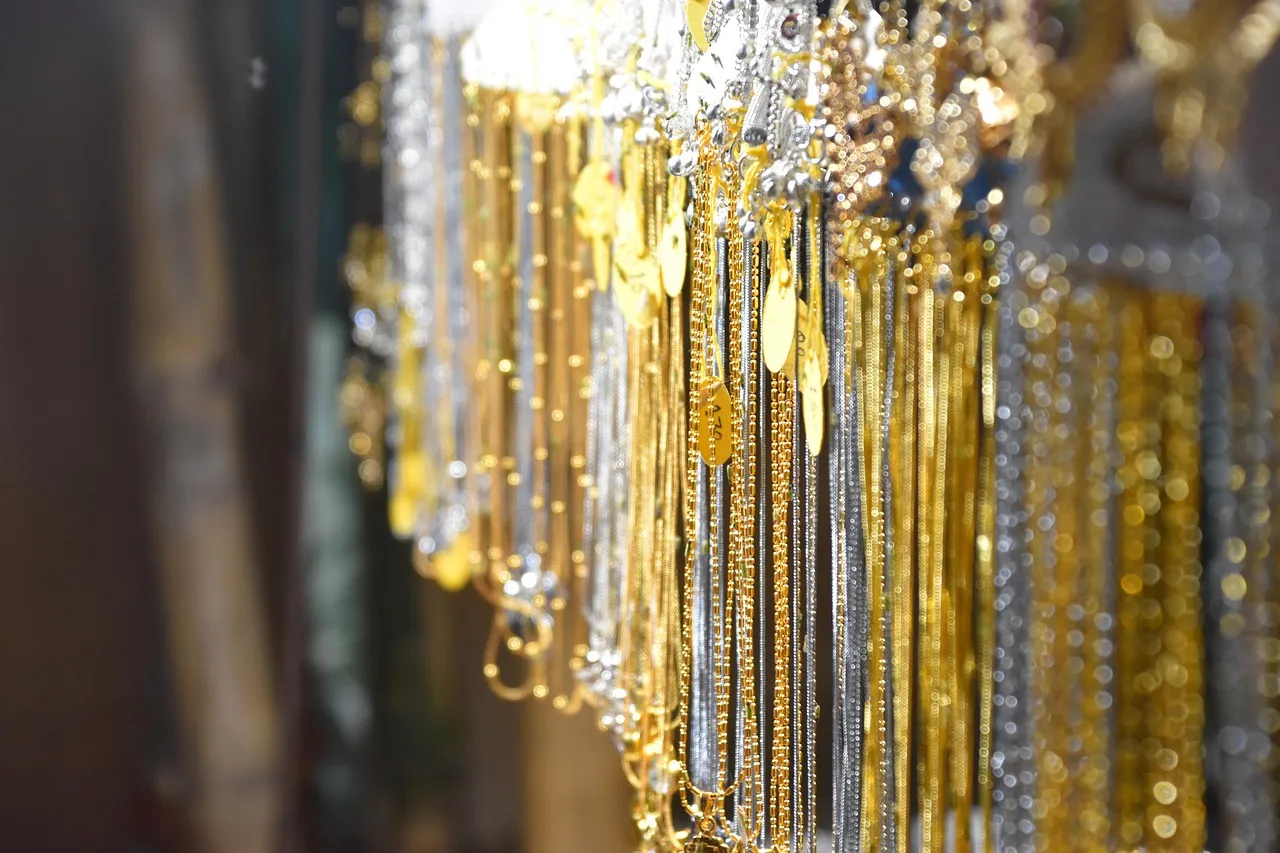
Gold jewellery across the region is sold by fineness rather than by karat: 916, 835, 375. The number is parts of gold per thousand, so 916 is 22 karat, and shops in Kuala Lumpur and Singapore display it the same way.
In Malaysia that number is a legal standard and the stamp is compulsory. In Singapore neither the stamp nor the assay behind it is required by law at all. Same metal, same notation, two entirely different guarantees.
Why the stamp reads 916 and not 917
Twenty-two parts in twenty-four is 91.666 recurring, so rounding could plausibly go either way. Malaysian regulations settle it twice over. The schedule of recognised gold standards lists the figure as 916.6, and a separate provision then commands how it must appear — an article of that standard "shall be marked as 916 only".
A general rule sits behind that one: an article finer than a listed standard but short of the next takes the nearest lower standard. Below 375 it may not be called gold. So 917 is not merely unconventional in Malaysia; it is unlawful, and the penalty for mis-marking runs to RM25,000 for a company.
The recognised list is also longer than the internet's version. Alongside 999, 916, 750, 585 and 375 it includes 950, 875 and 835 — three standards most secondary summaries drop.
Only two of these numbers are exact karat fractions
Work the divisions and something odd appears. Eighteen karat is 18/24, exactly 750. Nine karat is 9/24, exactly 375. The rest are not: 22/24 is 916.6, 20/24 is 833.3, 14/24 is 583.3.
This puts 835 and 585 fineness marginally above the karat value they are usually equated with, not below. Metal at a true 14/24 would fall short of 585 and, under the round-down rule, drop to the next lower standard. The fineness system is not a translation of the karat system; it is a separate ladder that mostly lines up.
Compulsory in one country, voluntary in the other
Malaysian regulations require every precious metal article supplied in trade to be marked clearly and indelibly, in Arabic numerals, with its fineness — with a practical exemption for pieces under 1.5 grams too small to mark. Third-party hallmarking by the national standards body exists on top of that, and it is voluntary. So the common claim that Malaysia does not require hallmarking is true of the assay and false of the stamp.
Singapore requires neither. Its assay office describes its own scheme as voluntary, and notes that Singapore and Japan are the only Asian countries to have established voluntary hallmarking alongside a national fineness standard. That standard is a published specification rather than legislation, and the assay office is a subsidiary of an engineering group rather than a statutory body.
Singapore's only precious-metals statute is about money laundering. It regulates the dealers — registration, customer checks, reporting cash transactions above a threshold — and contains no mention of hallmarking, fineness, assay or purity anywhere in its text. The distinction is clean. Malaysia regulates the gold itself; Singapore regulates the person selling it.
You can see the difference on a price board. A Singapore retailer may post 22K as 916.67. A Malaysian one may not.
The central bank publishes the spread
The workmanship charge that does not come back on resale is usually discussed as a rumour about jewellers. Malaysia's central bank demonstrates the mechanism on plain bullion, publishing daily buying and selling prices for its own gold coin:
| Coin | Sold to you, per gram | Bought back, per gram |
|---|---|---|
| 1 oz | RM607 | RM584 |
| 1/2 oz | RM619 | RM584 |
| 1/4 oz | RM630 | RM584 |
The buy-back is flat across all three sizes while the selling price per gram climbs as the coin gets smaller. The fabrication cost is charged on the way in and valued at nothing on the way out. This is on coins from a central bank, before any jeweller's markup even enters the picture.
Retail buy-back policies say the same thing in their own words. One Singapore chain offers 95% of the gross weight's gold value on trade-in, explicitly valuing the gold content rather than the price paid, and does not offer cash buy-back on 18K at all. A Malaysian chain publishes a formula subtracting 30% from weight times market price. The two numbers are not comparable. One is a trade-in credit, the other a cash quote, and neither should be taken as a regional average.
Malaysian law anticipates exactly this confusion. The seller must give a receipt itemising the price of the metal per gram, the weight, the price of the article, and the manufacturing cost separately. The two components are prised apart on the paperwork at the moment of sale. Both chains mentioned above require that original receipt to process a sale back.
A troy ounce is not an ounce
Gold is quoted per troy ounce, which is 31.1034768 grams. The ordinary ounce is 28.349523125 grams. The troy ounce is 9.714% heavier.
Using the wrong ounce to convert a dollar quote overstates the gold price by 9.714%. On a twenty-gram chain, that error creates more than a thousand ringgit of phantom gold. The order of operations for a per-gram price of 916 metal: divide the quote by 31.1034768 for fine gold per gram, apply the exchange rate, then multiply by 0.9166667 for the metal's gold content.
The tax line runs through purity and through shape
Singapore exempts investment precious metals from GST, and the criteria are strict in a way that catches people out. Gold must be at least 99.5% pure, and must take the form of a bar, ingot, wafer or coin. Jewellery is named in the guidance as an example of what does not qualify.
So a 916 chain fails twice over — on purity and on form — while a 999.9 bar is exempt. At the prevailing rate that is the whole of the tax on the purchase.
The form requirement is stricter than it sounds. Bars with a hole or hanger for wearing as a pendant are excluded, as are novelty shapes. Punch a hole in an exempt bar so it can be worn and it becomes taxable, with its purity unchanged. Wearability is the taxable event.
As a practical matter, Malaysia's Kijang Emas appears on Singapore's list of prescribed exempt coins, allowing the coin whose spread is tabulated above to cross the border tax-free.
Hardness is not why the region buys 916
The usual explanation is that 916 is chosen for durability. The metallurgy runs the other way: more gold makes a softer alloy. Pure gold measures around 20 on the Vickers scale annealed, 22 karat around 52, and 18 karat around 150.
So 916 is harder than 999 and markedly softer than 750. If durability were the driver the region would wear 18 karat, which is what Western markets do. The choice is about holding value, not durability. Commercial evidence confirms this: the harder alloy is the one a Singapore chain will not buy back for cash.
What to check before paying
In Malaysia, the receipt must separate the metal from the workmanship, and that separation is the number to look at — it is the part you are unlikely to see again. In Singapore the stamp carries no statutory backing, so the dealer's own standing is doing the work the law does next door. And in either country, if a price has been converted from an international quote, the arithmetic above is worth redoing, because one plausible-looking conversion error inflates the gold content by nearly a tenth.
The documents, and two open questions
The fineness standards, the marking rule, the round-down provision and the itemised receipt are from Malaysia's Trade Descriptions (Articles Made of Precious Metals) Regulations 1994, read from the ministry's own published copy, and remain in force through the saving provision of the Trade Descriptions Act 2011. The voluntary status of hallmarking in Singapore comes from the assay office's own publications. The absence of any fineness provision was confirmed by a full reading of the country's precious metals statute. The coin prices are Bank Negara Malaysia's published daily quotes for 18 September 2026, with the per-gram figures derived here; the buy-back policies are quoted from the two retailers' own pages. The tax criteria are from the Singapore tax authority's guide on investment precious metals, in its edition of 30 January 2026. All were read on 18 September 2026.
Two things could not be settled. The international fineness standard sits behind a paywall, so its list of recognised gold standards is described only as narrower than Malaysia's, not reproduced. And Malaysia's sales tax treatment of gold jewellery could not be resolved: the secondary sources conflict, the gazetted order could not be reached, and a tax position is not worth publishing on that footing.