In the second July bidding exercise, a Singapore Category A Certificate of Entitlement closed at S$126,000. That is a permit. It buys no metal, no engine, no warranty. It is the right to put a car on the road for ten years, after which it is worth nothing.
At the end of July a Singapore dollar bought RM3.18, which makes that permit RM 400,730. A new Perodua Myvi 1.5 X is RM 50,900 on the road.
The licence costs roughly eight times the entire car.
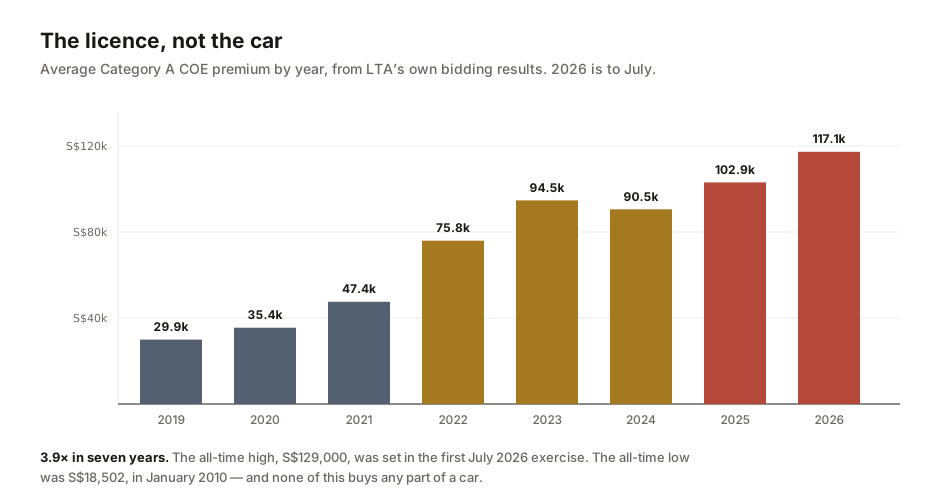
Averaged across each year's exercises, Category A has gone from S$29,906 in 2019 to S$117,094 so far in 2026. The all-time high, S$129,000, was set this month. The all-time low was S$18,502, in January 2010.
Two countries that tax completely different things
Most people know Singapore is "more expensive" and Malaysia is "cheaper". But the totals hide the shape of the costs, and that shape determines which car is the better buy.
Singapore taxes owning a car at all. The COE is the same whether you buy a small hatchback or a well-equipped saloon inside the same category. It is a quota system, so the price is set by how many other people want one this fortnight.
Malaysia taxes engine size, steeply. Road tax is flat up to 1600cc and then climbs on a per-cc scale that gets brutal at the top. Look at what that does to the comparison:
The gap collapses as engines grow. By three litres, Malaysia's steep scale brings its road tax almost level with Singapore's; the real punishment in Singapore is reserved for small cars.
There is one number in the Malaysian scale worth memorising if you are buying there. Road tax is RM90 flat at 1600cc, and at 1601cc it jumps to a RM200 base plus 40 sen for every cc above 1600. A single extra cubic centimetre more than doubles the bill, and it keeps climbing from there. That cliff is a large part of why so much of what sells in Malaysia is exactly 1.5 or 1.6 litres.
The February change that made Singapore cars quietly worse
Singapore's system gives you money back when you deregister: a COE rebate for the unused months, and a PARF rebate that returns part of the Additional Registration Fee you paid at the start. These rebates give a Singapore car a computable residual value, not just a guessed-at resale price.
In February 2026 the PARF half of that was cut roughly in half.
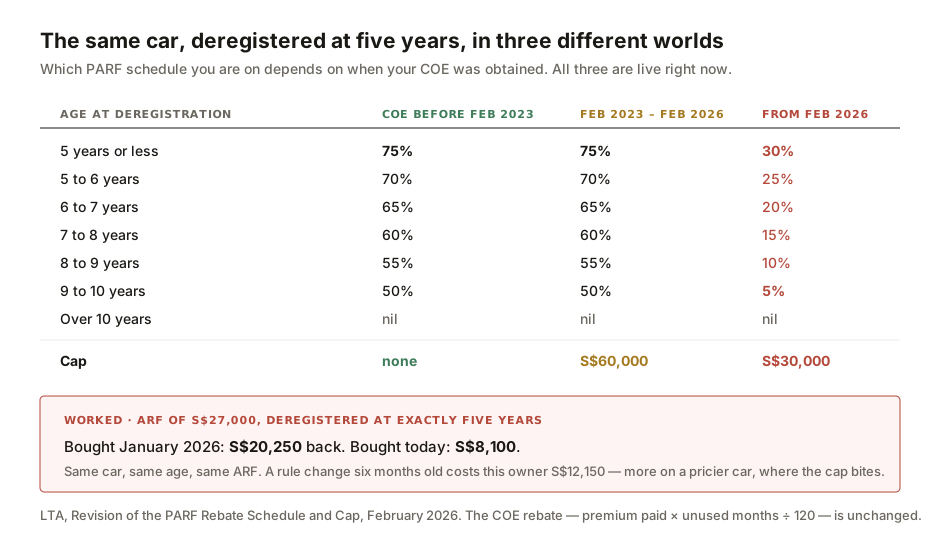
Take a mass-market car with an Open Market Value of S$25,000. The ARF on that is S$27,000 — the first S$20,000 of OMV at 100%, the next S$5,000 at 140%. Deregister at exactly five years:
- If you bought in January 2026, PARF returns 75% of ARF: S$20,250.
- If you buy today, PARF returns 30%: S$8,100.
The COE rebate is identical in both cases and unchanged by the reform. The difference is S$12,150 on the same car at the same age. On expensive cars the damage is worse: the rebate cap fell from S$60,000 to S$30,000, so any car with an ARF over S$100,000 loses another S$30,000 outright.
LTA's stated reason, in its own words, is that "EVs are less pollutive than conventional petrol cars. As EVs become more commonplace, the need to encourage early deregistration through the PARF rebate is reduced." It's a coherent policy, but it's also a large, retroactive-feeling change to the economics of a ten-year purchase. If you last bought a car before February, the numbers in your head are wrong.
Note what this does to the shape of Singapore depreciation. Don't model a Singapore car's value as a sagging curve. It is a ten-year asset with a computable floor, and at exactly 120 months both rebates go to zero together. Every generic car-depreciation model, including the one we shipped until this week, gets that wrong.
Malaysia now has two prices for the same petrol
Since 30 September 2025, RON95 has had a subsidised price for eligible Malaysians under BUDI95 and a floating unsubsidised one for everyone else. For the week of 30 July to 5 August 2026, in Peninsular Malaysia:
Fifteen thousand kilometres a year at 6.5 L/100km is 975 litres. That is RM 1,940 a year subsidised, RM 3,724 unsubsidised — a difference of nearly RM 1,800 for identical driving.
And the subsidised price is quota'd, reported at 300 litres a month with a cut to 200 under discussion. A Malaysian driver's fuel cost isn't a single price. It's a two-tiered rate with a monthly quota, so your final bill depends on your eligibility and your mileage.
We are not putting a figure on Singapore pump petrol. Listed prices for 95 differ sharply between sources on the same day, and Singapore retailers discount 20–24% through loyalty and credit-card combinations, so the listed price is not what anyone actually pays. A number here would look authoritative and be wrong.
How to work out your own figure
Our total cost of ownership calculator now computes road tax from the published scales. Pick a market and an engine size, and it adds the correct figure, in the right currency, to your running costs. Pair it with the car loan calculator if you are borrowing, since the calculator deliberately excludes financing interest, and the fuel economy calculator to turn your actual mileage into litres before you apply either of Malaysia's two prices.
For Singapore, one modelling note that matters more than any of them. Put the COE inside the purchase price, and the PARF plus COE rebate inside the resale value. The tool will then be doing arithmetic that matches the market. Be careful not to take a "resale value" from used-car ads. Those prices already include the remaining COE, so you would be counting it twice.
In Malaysia, watch the 1600cc line — one cc over doubles your road tax, and the scale keeps climbing. Check your BUDI95 eligibility and your monthly litres, because the difference between the two RON95 prices is nearly RM1,800 a year on ordinary mileage. In Singapore, find out which PARF schedule your car is on before you assume anything about what you will get back; if your COE dates from the second February 2026 bidding or later, halve whatever figure you had in your head. Model a Singapore car as a ten-year asset, not a depreciation curve. And compare the road tax before the engine: the two countries disagree so completely about what to tax that the sensible car in one is the expensive one in the other.
What this audit found in our own tools
This guide began, as they all do here, by reading the source of every tool it was going to link to — ten of them, in our auto category.
The arithmetic was fine. The loan amortisation, the affordability solve, the depreciation curve and the power conversions all check out, and unlike our payroll tools none of them shipped embedded rates that could go stale.
The problem was that none of them knew which country you were in. Searching all ten for "certificate of entitlement", "road tax", "open market value" and "additional registration fee" returned nothing. No COE. No ARF. No PARF. No road tax for either country. The two costs that dominate car ownership in this region were absent. Road tax, a figure both governments publish to the cent, was buried in a generic "Other (tax, parking…)" field where a reader would have to guess.
Both road tax scales are now in our shared calculation kernel with the authority cited on every line, along with the COE and PARF rebate formulas and all three PARF schedules, guarded by 25 automated checks. A proper COE calculator is a bigger build and is queued rather than half-done.
One more thing, because it is the kind of error this guide is about. The first version of the fix added the road tax straight into the total without touching the currency — so a ringgit figure was being summed into a US-dollar total. That wasn't a labelling slip; it was wrong arithmetic. The bug survived until someone checked the output instead of just the code. Choosing a market now pins the currency.
- All COE figures are computed from LTA's own bidding results dataset on data.gov.sg (dataset d_69b3380ad7e51aff3a7dcc84eba52b8a), downloaded 1 August 2026 — 1,960 rows covering January 2010 to July 2026. The July 2026 second-exercise premiums, the yearly averages and the all-time high and low were all aggregated from that file.
- The ARF bands, the Open Market Value definition, the road tax formula by engine capacity and the COE rebate formula are from LTA's published vehicle tax structure and PARF pages, read 1 August 2026. Singapore road tax figures include the 0.782 rebate factor in force.
- The revised PARF schedule, the reduction of the cap from S$60,000 to S$30,000, the effective date and the quoted rationale are from LTA's news release "Revision of Preferential Additional Registration Fee (PARF) Rebate Schedule and Cap", February 2026.
- Malaysian road tax is from JPJ's own "Garis Panduan Pengiraan Kadar Lesen Kenderaan Motor (LKM)" for Peninsular Malaysia, Sabah and Sarawak, as amended after Budget 2009, extracted from the PDF on jpj.gov.my on 1 August 2026. The figures used are for a privately owned saloon in Peninsular Malaysia; company-owned cars pay roughly double and East Malaysia runs its own lower scales.
- Malaysian fuel prices are the weekly retail prices for 30 July to 5 August 2026, Peninsular Malaysia, under the BUDI95 targeted subsidy in force since 30 September 2025. The Perodua Myvi 1.5 X price of RM50,900 on the road is the current listed variant price.
- Currency conversions use S$1 = RM3.1804, the European Central Bank reference rate for 31 July 2026. Rates move; the ringgit figures are illustrative of scale rather than quotes.
General information about how vehicle taxes and running costs are structured, not financial advice. Every figure carries the date it was read because these move constantly — COE premiums change fortnightly, Malaysian fuel prices weekly, and the PARF schedule changed six months ago. Verify anything that will decide a purchase against the authority's current published figures.

View author profile → · Editorial policy