Every Malaysian payslip carries three statutory deductions before income tax even enters the picture: EPF (the Employees Provident Fund, or KWSP — your retirement savings), SOCSO (the Social Security Organisation, PERKESO — injury and invalidity insurance) and EIS (the Employment Insurance System, or SIP — a small levy that funds unemployment benefits). The short answer for a typical local employee under 60: 11% of your wages goes to EPF, roughly 0.5% to SOCSO and 0.2% to EIS, with your employer paying more on top of your salary for all three.
A new, voluntary levy introduced in mid-2026 makes it worth re-checking these numbers rather than trusting an old payslip template. On 1 June 2026, PERKESO introduced a brand-new employee-borne levy — SKBBK, marketed as Skim LINDUNG 24 JAM — covering accidents outside working hours. It started at 0.75% of wages, deducted entirely from the employee. Then, by Cabinet decision effective 8 July 2026, it was made voluntary for local employees (still mandatory for foreign workers). If you don't want it, you must actively opt out between 13 July and 31 August 2026 via the Portal Lindung Faedah — do nothing and you're auto-enrolled permanently after 31 August, with no exit later. If you are reading this after that date, the window has closed: check your payslip for the SKBBK line rather than the opt-out portal. June 2026's deductions, made while the levy was still mandatory, are not refundable.
We will review how each deduction works before running a full worked example at RM4,250 a month.
EPF: the big one
EPF is by far the largest line on the deductions side. For most employees, the rates are set by the Third Schedule of the EPF Act 1991 — the current edition took effect 1 October 2025 (KWSP: EPF Act 1991 Third Schedule):
| Who | Employee | Employer |
|---|---|---|
| Under 60, wages RM5,000 and below | 11% | 13% |
| Under 60, wages above RM5,000 | 11% | 12% |
| Malaysian citizen, 60–75 | 0% | 4% |
| PR / pre-Aug-1998 foreign member, 60–75 | 5.5% | 6.5% (≤RM5,000) or 6% (>RM5,000) |
| Foreign worker (registered from 1 Aug 1998), all ages | 2% | 2% |
One common point of error involves EPF calculation: for wages up to RM20,000, employers cannot use an exact percentage. They must use the fixed ringgit amounts in the Third Schedule, which runs in RM20 wage bands up to RM5,000 and RM100 bands from there to RM20,000. Each band's amount is the rate applied to the band's upper limit, rounded up to the next ringgit — so the deduction is usually a few ringgit more than a straight 11% of your actual salary — a couple of ringgit in the RM20 bands below RM5,000, up to about RM11 in the RM100 bands above it (KWSP: Mandatory Contribution, Note 2). Only salaries above RM20,000 use exact percentages.
What counts as EPF wages? Salary, bonus, commission, allowances, incentives, arrears, and payment for unutilised annual or medical leave all attract EPF. What doesn't: overtime pay, service charge, gratuity, retirement and retrenchment benefits, and travel allowances (KWSP: payments liable and not liable). So a bonus month means a bigger EPF deduction; an overtime-heavy month does not. The Third Schedule even carries a specific bonus rule: if a bonus pushes a ≤RM5,000 earner's wages above RM5,000 for the month, the employer's rate stays at 13% — it doesn't drop to the 12% tier.
EPF also has no wage ceiling. Whether you earn RM3,000 or RM30,000, the full amount is contributable. This is unlike SOCSO and EIS, which are both capped at a maximum wage.
SOCSO: small amount, big coverage
SOCSO contributions buy two schemes for employees under 60 — the Employment Injury Scheme and the Invalidity Scheme, together called the First Category. The headline rates are roughly 1.75% employer and 0.5% employee, but like EPF, the actual figures come from a fixed schedule: the Act 4 contribution table has 65 wage bands with set ringgit amounts per band (PERKESO: Contributions).
The crucial number is the ceiling: contributions are calculated on wages up to RM6,000 a month, a ceiling raised from RM5,000 on 1 October 2024 and fully enforced since April 2025 (PERKESO: Rate of Contribution). Earn RM6,000 or RM60,000 — the SOCSO amount is the same.
From age 60, employees move to the Second Category: Employment Injury coverage only, paid entirely by the employer at 1.25%, with nothing deducted from the employee. New hires who first start contributing at 55 or older also fall into this category.
Here's what the First Category looks like at four sample wages, using the official Act 4 table (employee share shown is the mandatory Invalidity portion for a local employee who has not joined SKBBK):
| Monthly wage | Employer pays | Deducted from you |
|---|---|---|
| RM2,000 | RM34.15 | RM9.75 |
| RM3,500 | RM60.35 | RM17.25 |
| RM5,500 | RM95.35 | RM27.25 |
| RM7,000 (ceiling band) | RM104.15 | RM29.75 |
Note the definition of "wages" flips versus EPF: for SOCSO, overtime, commission and service charge all count as wages, but the annual bonus does not (PERKESO: wages definition).
EIS: the one everyone forgets
EIS is the smallest of the three deductions. It funds job-loss benefits and re-employment support under Act 800, at 0.2% from the employee and 0.2% from the employer — 0.4% total — for private-sector employees aged 18 to 60, subject to the same RM6,000 wage ceiling as SOCSO. It uses the same 65-band fixed-amount structure, not exact percentages.
| Monthly wage | Employer | Employee | Total |
|---|---|---|---|
| RM2,000 | RM3.90 | RM3.90 | RM7.80 |
| RM3,500 | RM6.90 | RM6.90 | RM13.80 |
| RM5,500 | RM10.90 | RM10.90 | RM21.80 |
| RM7,000 (ceiling band) | RM11.90 | RM11.90 | RM23.80 |
The maximum any employee can be deducted for EIS is RM11.90 a month. Small money — but it's the fund that pays out if you're retrenched.
Worked example: RM4,250 a month
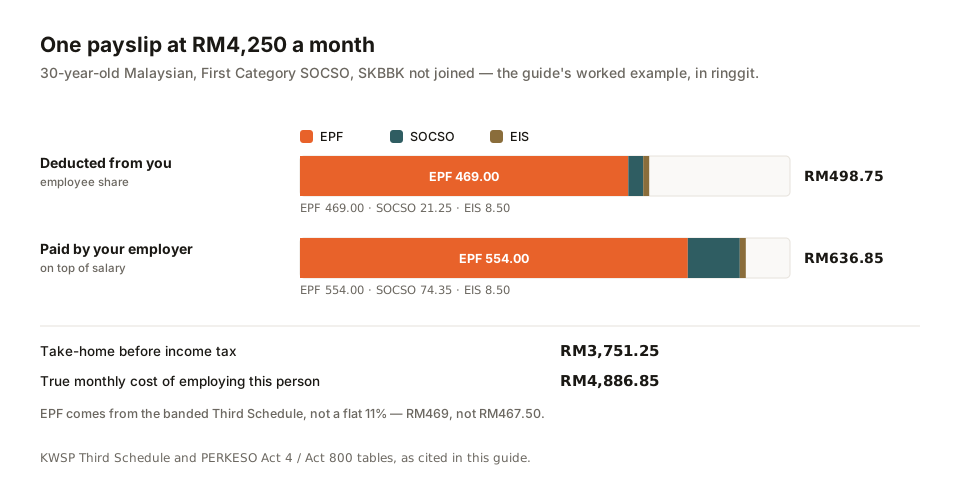
Take a 30-year-old Malaysian earning RM4,250 gross, no bonus or overtime this month, First Category SOCSO, SKBBK not joined.
Step 1 — EPF. RM4,250 falls in the Third Schedule band RM4,240.01–RM4,260.00. The schedule says: employee RM469, employer RM554. Notice the employee figure is not 11% × RM4,250 (which would be RM467.50) — it's 11% of the band's upper limit, RM4,260, rounded up to the next ringgit. The schedule figure is the legally correct one.
Step 2 — SOCSO. RM4,250 sits in Act 4 band 47 (above RM4,200, up to RM4,300): employer RM74.35, employee RM21.25.
Step 3 — EIS. Same band 47 in the Act 800 table: RM8.50 each from employer and employee.
| Item | Employee | Employer |
|---|---|---|
| EPF | RM469.00 | RM554.00 |
| SOCSO (First Category) | RM21.25 | RM74.35 |
| EIS | RM8.50 | RM8.50 |
| Total | RM498.75 | RM636.85 |
So the employee takes home RM3,751.25 before income tax, and the true cost of employing them is RM4,886.85 a month. If this employee joins SKBBK (or simply fails to opt out by 31 August 2026), a further RM31.85 employee-only deduction applies, cutting take-home to RM3,719.40 — the employer pays nothing extra.
Income tax is a separate calculation entirely — monthly tax is deducted as PCB/MTD, which you can estimate with our PCB calculator or read up on in our PCB guide.
Don't want to dig through 65-band PDFs yourself? Punch your salary into our free EPF, SOCSO & EIS Calculator and check your own payslip in 30 seconds — it uses the official SOCSO and EIS band tables. One honesty note: for EPF it estimates at the exact percentage rates, which can land a ringgit or two below the banded Third Schedule amounts your employer must legally use — the schedule rounds each band up, as explained above. The same applies to SKBBK, which the calculator now includes as an opt-in line: PERKESO has not published the Act A1788 band table, so we estimate at the flat 0.75% and you may see a few sen of difference against the RM31.85 figure above.
Five mistakes people make
1. "EPF is exactly 11% of my salary"
Not if you earn RM20,000 or less. KWSP prohibits exact-percentage calculation at that level; the fixed Third Schedule band amounts apply, computed on each band's upper limit and rounded up. At RM4,250, that's RM469, not RM467.50. Basis: KWSP mandatory contribution page, Note 2.
2. "Bonus and overtime are treated the same"
They're opposites across the two agencies. For EPF, bonus is liable but overtime is not. For SOCSO and EIS, overtime counts as wages but the annual bonus does not. A payroll system that gets one right and the other wrong will misstate both deductions. Basis: KWSP's liable-payments list versus PERKESO's wages definition.
3. "SOCSO and EIS still cap at RM4,000 or RM5,000"
Stale by nearly two years. The ceiling has been RM6,000 since 1 October 2024, pushing the maximum SOCSO employee share to RM29.75 and the maximum EIS share to RM11.90 each. Basis: PERKESO rate of contribution page.
4. "Employees over 60 still get deducted"
For Malaysian citizens aged 60 to 75, the EPF employee share drops to 0% (the employer pays 4%), SOCSO shifts to the employer-only Second Category at 1.25%, and EIS stops at 60. An over-60 local employee should see no statutory deduction from their own salary. Basis: KWSP rate table and PERKESO contributions page.
5. "My SOCSO deduction jumped in June 2026 — payroll made a mistake"
Almost certainly not a mistake. That was SKBBK/LINDUNG 24 JAM, the new 0.75% employee-borne levy that was mandatory for June 2026, then made voluntary for locals from 8 July 2026. June's deduction is not refundable. To avoid it going forward, opt out via Portal Lindung Faedah by 31 August 2026 — otherwise you're enrolled for good. Basis: PERKESO's official LINDUNG 24 JAM FAQ.
What changed recently
- 1 October 2024 — SOCSO and EIS wage ceiling raised from RM5,000 to RM6,000 (grace period to 31 March 2025).
- October 2025 salary — EPF became mandatory for foreign workers at 2% employee + 2% employer (Third Schedule Part F), replacing the old voluntary arrangement.
- 1 October 2025 — new Third Schedule edition took effect; citizen rates unchanged at 11% / 13% / 12%.
- 1 June 2026 — SKBBK / LINDUNG 24 JAM introduced under the Employees' Social Security (Amendment) Act 2026: employee-borne 0.75% (rising to 1.0%, then 1.25% in later phases), capped at the RM6,000 ceiling for a maximum RM44.65 a month.
- 8 July 2026 — Cabinet made SKBBK voluntary for local employees (still mandatory for foreign workers), with the opt-out window running 13 July to 31 August 2026. No action means permanent auto-enrolment.
The base SOCSO rates (1.75% / 0.5% / 1.25%) and the EIS 0.2% + 0.2% have not moved in 2025–2026 — only the ceiling and the new SKBBK levy changed.
What this guide doesn't cover
This guide covers the standard case: private-sector local employees under 60, First Category SOCSO. It doesn't go deep on foreign-worker payroll (EPF 2% + 2% is covered above, but SOCSO's foreign-worker rules and mandatory SKBBK deserve their own guide), voluntary EPF top-ups and self-contribution, pensionable public servants (who sit outside these schemes), or employer late-payment penalties beyond the basics — EPF is due by the 15th of the following month, with a minimum RM10 late charge.
This is general information, not financial advice. Rates and band figures were verified in July 2026 against official KWSP and PERKESO sources; schedules do change, so check the linked pages before making payroll decisions.

View author profile → · Editorial policy