
Open three different sleep-cycle calculators, type in the same 6:30 a.m. wake-up, and you will get three slightly different "perfect" bedtimes. Ours is one of them. That is not a bug. It is a clue that the arithmetic rests on a number the science does not actually hold still.
The whole idea rides on a single figure: the 90-minute sleep cycle. Round your night into neat 90-minute blocks, the story goes, and you will wake between cycles feeling refreshed instead of shattered. The rule is tidy, memorable, and repeated everywhere. But when you go back to the primary sources — the US National Institutes of Health, the American Academy of Sleep Medicine, the NHS — the fixed 90-minute cycle quietly falls apart.
This guide is the third in our formula-pedigree series, after the BMI, BMR and TDEE guide and the heart-rate zones guide. Same house rule: we tell you exactly where a popular formula comes from, where it is honest, and where it is a convenient average wearing the costume of a law. We also run a sleep calculator ourselves, so we hold our own tool to the same standard.
What a sleep cycle actually is
Sleep is not one flat state. Over a night you move through stages, grouped into non-REM (NREM) and REM sleep. The NIH's National Heart, Lung, and Blood Institute (NHLBI) describes the NREM stages in plain terms: stage 1 (N1) is "the transition between wakefulness and sleep"; by stage 2 (N2), "you are asleep"; and stage 3 (N3) is "deep sleep or slow-wave sleep," the stage you "usually spend more time in early in the night."
Then comes REM sleep, when, as NHLBI puts it, "your eyes twitch and your brain is active" and most dreaming happens. The National Institute of Neurological Disorders and Stroke (NINDS) describes the typical march through a cycle as N1 to N2 to N3, back to N2, then into REM — and notes the first REM period usually arrives "about 90 minutes after falling asleep," often lasting less than ten minutes early on, with later REM periods stretching longer.
The mix of sleep stages also changes as the night goes on. NHLBI: you get "more REM sleep later in the night." NINDS agrees — "as the night progresses the REM sleep stages become longer and NREM sleep stages become both shorter and lighter." Deep sleep loads the front of the night; REM loads the back. A single fixed block cannot represent a night that is deliberately lopsided.
The crux: NIH does not even agree with NIH
The core problem is that two institutes inside the same National Institutes of Health publish two different, non-overlapping ranges for a sleep cycle. Neither says 90 minutes exactly. They say ranges — and the ranges do not match.
| What they measure | NHLBI (NIH) | NINDS (NIH) |
|---|---|---|
| Length of one cycle | "The cycle starts over every 80 to 100 minutes" | Each cycle "lasting 90–110 minutes" |
| Cycles per night | "Usually there are four to six cycles per night" | 4 to 5 cycles on an average night |
| How the night shifts | More deep sleep (N3) early, more REM later | REM stages lengthen, NREM shortens and lightens as the night goes on |
Look at where 90 minutes actually sits: it is where the two ranges start to overlap. NHLBI's window runs 80–100; NINDS's runs 90–110. Ninety is a defensible middling value for a moving target — a plausible average, not a biological constant. And the count of cycles is soft too: four to six for one institute, four to five for the other.
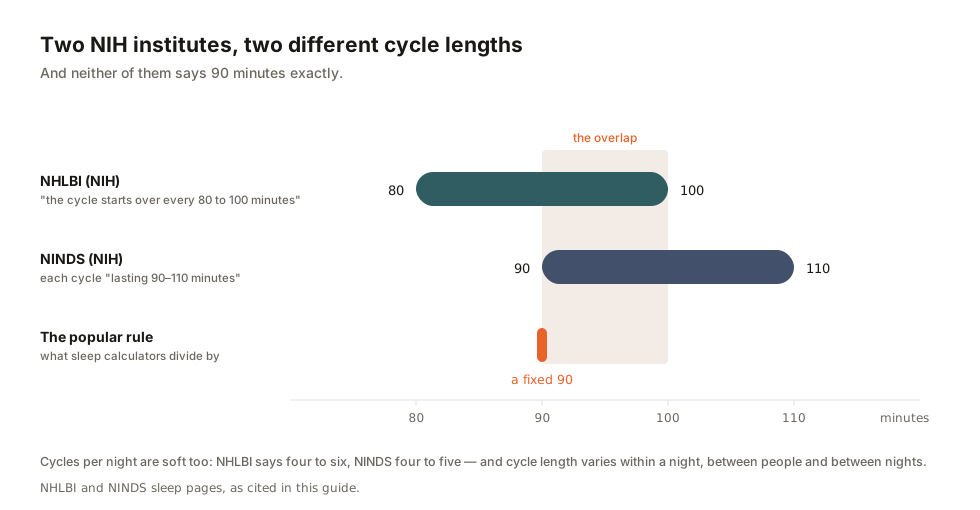
This matters because the popular 90-minute rule treats that one value as fixed and universal. The primary literature says the opposite in three directions at once: cycle length varies within a night, between people, and between nights. When two arms of the NIH cannot pin the number to better than a 30-minute spread, no consumer calculator can honestly claim to hit the gap between your cycles to the minute.
Where the 90-minute rule came from — and its real kernel
We went looking for the rule's birth certificate. We searched the AASM and its Sleep Education site, NHLBI, NINDS, the CDC and the NHS. None of them prescribe sleeping in 90-minute multiples, and none publish the "wake time minus 4.5, 6, or 7.5 hours" arithmetic that sleep calculators run. The rule is absent from every primary source. It is a consumer heuristic, built on a fixed average that those same sources explicitly describe as variable.
The rule is not worthless, though. It's built around a legitimate kernel: sleep inertia. A 2019 review in Nature and Science of Sleep defines it cleanly: "Sleep inertia, or the grogginess felt upon awakening, is associated with significant cognitive performance decrements that dissipate as time awake increases." In other words, being yanked awake at the wrong moment can leave you foggy for a while after you get up.
The rule's goal — don't get jolted out of your deepest sleep — points at something real. Its method is the weak link: fixed 90-minute math cannot track cycles that are, per the NIH, a moving range. The honest framing is that aiming to wake near the lighter end of a cycle is a sensible instinct; a clock-based multiple is just a rough guess at when that happens, not a measurement.
What actually matters: enough sleep, on a regular schedule
While cycle-timing is shaky ground, the science of sleep duration is not. The evidence here is strong and boringly consistent. The gold standard is the 2015 joint consensus of the American Academy of Sleep Medicine and the Sleep Research Society, published in the peer-reviewed journal SLEEP: "Adults should sleep 7 or more hours per night on a regular basis to promote optimal health." The same statement adds a caveat worth keeping: "Sleeping more than 9 hours per night on a regular basis may be appropriate for young adults, individuals recovering from sleep debt, and individuals with illnesses."
The CDC, drawing on that same consensus, states adults need "at least 7 hours" each day, teens 13–18 need "8 to 10 hours per 24 hours," and children 6–12 need "9 to 12 hours per 24 hours." The NHS puts the adult range at "7 to 9 hours." These are not in tension — they are the same evidence base described by different bodies.
The widely shared age-band table below comes from the National Sleep Foundation. We flag it deliberately: the NSF is an advocacy organisation, not a government or medical body, so its numbers are recommendations rather than clinical consensus. They are useful and broadly consistent with the CDC and NHS, but they carry a different weight than the AASM/SRS statement above.
| Age band | NSF recommended range |
|---|---|
| Newborns (0–3 mo) | 14–17 h |
| Infants (4–11 mo) | 12–15 h |
| Toddlers (1–2 y) | 11–14 h |
| Preschoolers (3–5 y) | 10–13 h |
| School-age (6–13 y) | 9–11 h |
| Teenagers (14–17 y) | 8–10 h |
| Young adults (18–25 y) | 7–9 h |
| Adults (26–64 y) | 7–9 h |
| Older adults (65+) | 7–8 h |
The second lever is regularity. That phrase in the AASM/SRS consensus—"on a regular basis"—is doing real work. A consistent wake time, seven days a week, does more for how you feel than shaving your bedtime to land on a 90-minute boundary. Hitting your total, on a steady schedule, beats optimising the fine structure of a single night.
The Singapore picture
The same evidence base surfaces close to home. Singapore's Health Promotion Board, through HealthHub, tells adults they need 7 to 9 hours of sleep daily — the identical range the NHS gives. And the HPB's national Sleep Challenge sets a 7-hour daily target, citing the US National Sleep Foundation's "at least 7 hours" advice directly. In other words, Singapore's public-health guidance is downstream of the same duration research, not a separate cycle-timing rule. There is no official "sleep in 90-minute multiples" message from HPB either — the target is hours, on a regular basis.
Sleep hygiene, per the primary sources
The habits that reliably help are unglamorous and well documented. From the NHS insomnia guidance:
- Keep a fixed schedule: "wake up and get out of bed at the same time every day."
- Cut screens before bed: "do not watch television or use devices, like smartphones, right before going to bed."
- Mind stimulants and alcohol: "do not smoke or drink alcohol, tea or coffee at least 6 hours before going to bed."
- Naps: for people with insomnia, the NHS advises "do not nap during the day."
The caffeine timing has a clean physiological basis. The FDA notes that after you consume caffeine, "it can take 4 to 6 hours for your body to metabolize half of what you consumed" — long enough that an afternoon coffee can still be working at bedtime. The FDA also puts the ceiling for healthy adults at 400 mg a day, roughly two to three 12-ounce cups of coffee. Because that clearance rate varies from person to person, our caffeine half-life calculator lets you set the half-life yourself and see how much of a given dose is still circulating at a chosen bedtime — an illustration of the decay curve, not a prediction about your own sleep.
When it stops being a hygiene problem
Some sleep trouble needs a clinician, not a calculator. The NHS says to see a GP if changing your sleep habits has not helped, if you have had trouble sleeping "for months," or if poor sleep is "affecting your daily life in a way that makes it hard for you to cope."
For obstructive sleep apnea, the AASM describes the warning pattern as loud, frequent snoring broken by silent pauses, then choking, snorting or gasping as the airway reopens. A bed partner's report of loud snoring or choking sounds is worth raising with a doctor, especially alongside daytime sleepiness. None of this is something to self-diagnose from an article — if these signs sound familiar, that is a conversation for a qualified clinician.
Two more caveats. Sleep advice for shift workers and during pregnancy differs from the standard adult picture, and infants and children need far more sleep on different patterns (see the age table above). The adult-oriented 90-minute heuristic is not the right frame for any of those groups.
Our own sleep calculator, honestly
We run a sleep calculator, so we hold it to the same standard. It uses a fixed 90-minute cycle and a 14-minute fall-asleep buffer, in three modes: "wake up at," "sleep at," and a "Wake Me Now" button that treats the current time as sleep onset. It offers four options — 6 cycles (9 hours), 5 (7.5 hours), 4 (6 hours) and 3 (4.5 hours) — with its own "Recommended," "Minimum" and "Not enough" labels.
Our calculator simplifies the underlying science in three places. First, it hardcodes 90 minutes where the NIH publishes 80–110 and says composition shifts within and across the night — one fixed number cannot capture that. Second, it applies the same 14-minute sleep-onset latency to everyone. Third, its quality labels are our own editorial framing; the cited evidence is simply "7 or more hours."
We also corrected the tool's label after reviewing it against this research. As of 21 July 2026 its formula source reads: "90-minute average sleep-cycle heuristic (NIH: real cycles run ~80–110 min and vary by person and night)." That is the accurate description: a useful heuristic timer, labelled as such. Treat its suggested bedtimes as starting points to experiment with, not as physiology measured on your own brain.
Frequently asked questions
Is the 90-minute sleep cycle real?
It’s a reasonable average, not a biological constant. The NHLBI puts a cycle at 80 to 100 minutes; NINDS puts it at 90 to 110. Ninety minutes is where those ranges start to overlap. Real cycles vary within a night, between people and between nights, so no clock-based multiple can reliably land you between them.
Should I set my alarm using 90-minute multiples?
You can try it as a rough guide, but do not treat it as precise. The instinct behind it — waking from lighter rather than deeper sleep feels better — has a real basis in sleep inertia. The method does not track your actual, variable cycles. A far more reliable move is a consistent wake time every day and enough total sleep.
How much sleep do I actually need?
For adults, the AASM and Sleep Research Society say 7 or more hours per night on a regular basis; the NHS gives 7 to 9 hours, and Singapore's HPB the same. Teens and children need more (see the age table). More than 9 hours can be appropriate when recovering from sleep debt or illness.
Does waking mid-cycle really make me groggy?
Grogginess on waking is a documented effect called sleep inertia. The popular "wake between cycles" advice is a rough workaround for it, but enough sleep on a steady schedule reduces the problem more dependably. Enough sleep and a steady schedule reduce the problem more dependably.
This guide is general information, not medical advice. It does not diagnose any condition. If you have persistent sleep difficulties, suspected insomnia or signs of a sleep disorder such as apnea, consult a qualified healthcare professional.
- Stages of Sleep — NHLBI (NIH) (accessed 21 Jul 2026)
- Brain Basics: Understanding Sleep — NINDS (NIH) (accessed 21 Jul 2026)
- Watson NF et al., AASM/SRS joint consensus, SLEEP 2015 (PMID 26039963) (accessed 21 Jul 2026)
- About Sleep — CDC (accessed 21 Jul 2026)
- Hirshkowitz M et al., NSF sleep duration recommendations, Sleep Health 2015 (PMID 29073412) (accessed 21 Jul 2026)
- Insomnia — NHS (accessed 21 Jul 2026)
- Spilling the Beans: How Much Caffeine is Too Much? — FDA (accessed 21 Jul 2026)
- Hilditch CJ & McHill AW, Sleep inertia: current insights, Nat Sci Sleep 2019 (PMID 31692489) (accessed 21 Jul 2026)
- Obstructive Sleep Apnea — AASM Sleep Education (accessed 21 Jul 2026)
- Sleeping Well (Adults) — HealthHub (SG HPB) (accessed 21 Jul 2026)
- Why Does the Sleep Challenge Aim for 7 Hours Daily? — HPB Help Centre (accessed 21 Jul 2026)

View author profile → · Editorial policy