An A1C result arrives as a single number with a per cent sign, and it gets read like an exam mark. It is not one. It is an estimate of your average blood glucose over roughly the previous three months, inferred from what has happened to your red blood cells — and that inference has conditions attached.
That means two things: the number can be converted into more useful units, and it can be misleading in common circumstances.
Read this part before the number
A1C works by measuring how much glucose has attached to haemoglobin. That only tracks your average glucose if your red cells are living a normal lifespan. When they are not, the result is not merely imprecise — it is systematically wrong, in a direction that depends on the cause.
The conditions that invalidate an A1C reading are not exotic:
- anaemia — iron-deficiency, haemolytic, or from blood loss
- haemoglobin variants such as HbS, HbC, HbE or thalassaemia
- pregnancy
- chronic kidney disease, especially on dialysis or erythropoietin
- a red-cell transfusion in the last three months
- recent significant blood loss, or any condition altering red-cell lifespan
For anyone in Southeast Asia, that second line is critical. HbE and the thalassaemias are common across the region; for a local clinician this is a routine consideration, not a rare-disease footnote. A person can carry a variant, feel entirely well, and have an A1C that misrepresents their glucose. This is why our A1C converter puts this list above the result rather than beneath it: an A1C that is simply wrong is more dangerous than no A1C, because it looks like data.
One result, four ways of writing it
The same measurement is reported differently depending on where you are and who ordered it, which makes comparing a result against a leaflet — or against last year's — unnecessarily hard.
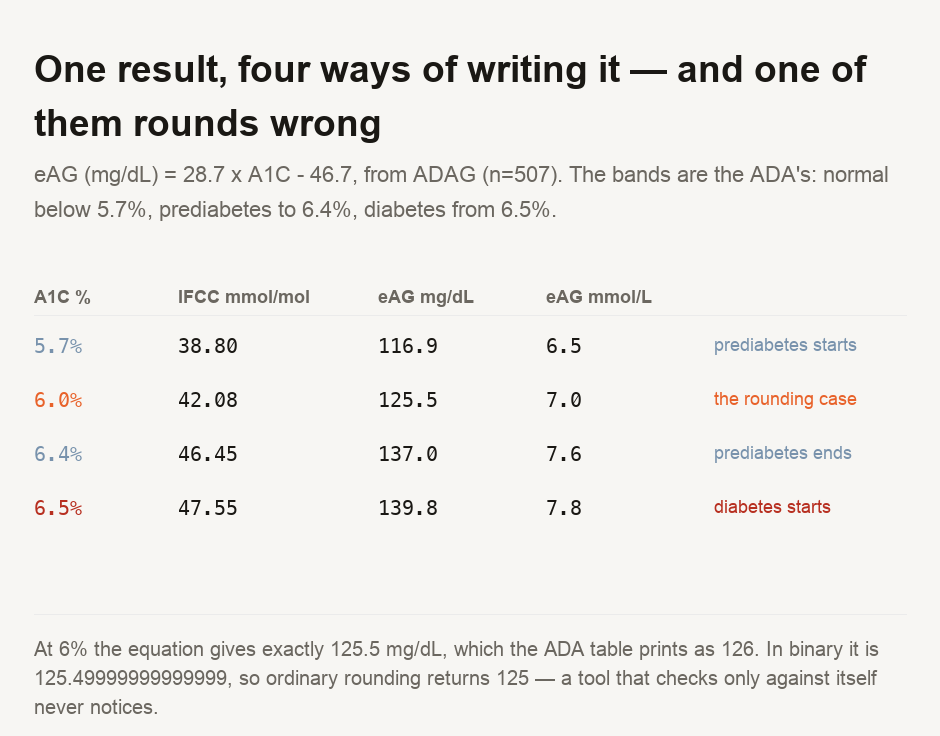
The glucose conversion comes from the ADAG study — 507 participants, published in Diabetes Care in 2008 — and is a straight line: estimated average glucose in mg/dL equals 28.7 × A1C − 46.7. Divide by 18.0182 for mmol/L.
The NGSP-to-IFCC conversion has a quirk. Both directions are published by the NGSP, and we use them verbatim: NGSP % = 0.09148 × IFCC + 2.152, and IFCC = 10.93 × NGSP − 23.50.
Those two are not exact inverses. The reciprocal of 0.09148 is 10.9314, not 10.93. Convert 6 per cent to IFCC and back and you land on 6.001478 rather than 6. The gap is far too small to matter clinically, and we keep it anyway, because the alternative is inventing a tidier equation than the standards body published and quietly attributing it to them.
The rounding case, and how we found it
At A1C 6 per cent, the ADAG equation gives exactly 125.5 mg/dL. The ADA's own published table prints 126.
In a computer that sum does not produce 125.5. It produces 125.49999999999999, because neither 28.7 nor 46.7 can be represented exactly in binary. Ordinary rounding therefore returns 125, and a converter would silently contradict the very table it cites — by one unit, on a round number, at a value people actually look up.
We found this by checking our output against the published table rather than against itself. A test that compared the tool to its own equation would have passed; the equation was never the problem. Our converter pre-rounds to twelve significant figures before rounding to the display precision, which erases the binary noise without touching any real precision.
We mention this small bug because it is the kind that survives review indefinitely: everything is internally consistent, and only an external authority disagrees.
What the bands mean, and what they do not
The ADA's thresholds are 5.7 per cent — below which is normal — 5.7 to 6.4 for prediabetes, and 6.5 and above for diabetes.
They are thresholds on a continuum, not a change of state. An A1C of 6.4 and one of 6.5 describe almost identical glucose — 137.0 against 139.8 mg/dL — and land in different named categories. A diagnosis normally requires a second confirmatory test on a separate day, precisely because one reading near a line is not a fact about a person.
The tool is for conversion, not diagnosis. It turns a number you already have into units you can compare.
A1C estimates your average glucose over about three months, and converts to eAG through a published straight line — 28.7 × A1C − 46.7 for mg/dL. The thresholds are 5.7 and 6.5 per cent, they are lines on a continuum rather than a change of state, and a diagnosis normally needs a second test on another day. Before any of that, check the list: anaemia, haemoglobin variants, pregnancy, kidney disease and a recent transfusion all break the relationship between A1C and glucose, and variants in particular are common across ASEAN. If any applies to you, the conversion is arithmetic performed on a number that does not mean what it says, and the person to raise it with is your clinician, not a calculator.
Converting your own result
Our A1C to average glucose converter handles all four units, and it puts the caveat list above the answer. For tracking a result over time, our percentage calculator avoids the percentage-point confusion this subject invites. The BMI calculator covers another measure often discussed alongside it, with the same warning that one number is not a diagnosis.
- The eAG equation is from Nathan DM et al., "Translating the A1C assay into estimated average glucose values", Diabetes Care 2008;31(8) — the ADAG study, 507 participants. The NGSP and IFCC conversions in both directions are taken verbatim from ngsp.org. Every constant is pinned in our clinical kernel and asserted by its test suite.
- The conversions were recomputed independently for this guide in exact decimal arithmetic, rather than read back from our own tool, because sourcing checks never catch arithmetic errors.
- ⚠️ That independent recomputation found a real error in our own source — not in the code or the tests, which were correct, but in two comments describing the binary value of the 6 per cent case. They stated 125.49999999999997; the actual value is 125.49999999999999. Corrected in the same change as this guide, and recorded here rather than fixed silently.
- ⚠️ The NGSP and IFCC equations are deliberately kept as published and are not exact inverses, so a round trip does not return precisely the value you started with. This is a property of the standards, not a defect in the tool.
- ⚠️ We are not the only A1C converter, and this page does not claim to be. The NGSP runs one, and several calculator sites carry one. What this offers is all four units in one place and the caveats treated as prominent rather than as fine print.
Educational information about a laboratory measurement and its units. It is not medical advice and not a diagnosis. Only a clinician can interpret an A1C in the context of your own health, and several common conditions make the result unreliable regardless of how it is converted.

View author profile → · Editorial policy