This is not contraception, and no calculator can identify a day free of risk. In the study these estimates come from, women who described their own cycles as regular still had a 1–6 per cent chance of being fertile on the day their next period was due. There is no day free of risk. If you are trying to avoid pregnancy, this arithmetic is not the tool for it.
Two pieces of advice about ovulation are repeated everywhere, usually in the same breath: that it happens on day 14, and that it happens 14 days before your next period. Both are offered as the same fact stated two ways.
They are not the same fact. On a 28-day cycle they are one day apart, and once you notice that, the rest of the subject opens up.
The off-by-one nobody mentions
Cycle day 1 is the first day of bleeding. So cycle day 14 is 13 days after your period started — not fourteen. Meanwhile the next period arrives 28 days after it. Subtract, and cycle day 14 sits 15 days before the next period.
So "ovulation is on day 14" and "ovulation is 14 days before your next period" cannot both be true. They describe days one apart. Most sources repeat both without noticing, which is a reasonable clue about how carefully either has been checked.
The one worth keeping is the second. Ovulation is anchored to the period that follows it, not the one before; the post-ovulation phase is the stable one.
What is actually stable, and what is not
The luteal phase — ovulation to the next period — is the steadier half. The follicular phase before it stretches and shrinks, which is why cycles differ in length at all.
Steadier is not fixed. A year-long study of healthy women measuring their own phases found the luteal phase varied by 4.0 days between women and 3.0 days within a single woman across her own cycles. And 55 per cent of those healthy women had at least one luteal phase shorter than 10 days.
That is the majority. A short luteal phase in one cycle is not a diagnosis and not a rarity; it is something more than half of healthy women recorded at least once in a year. A calculator that hard-codes 14 days is asserting something about you that the evidence does not support. Ours lets you set your own luteal length, and refuses to guess when the inputs are implausible.
The window is six days, and it closes on ovulation
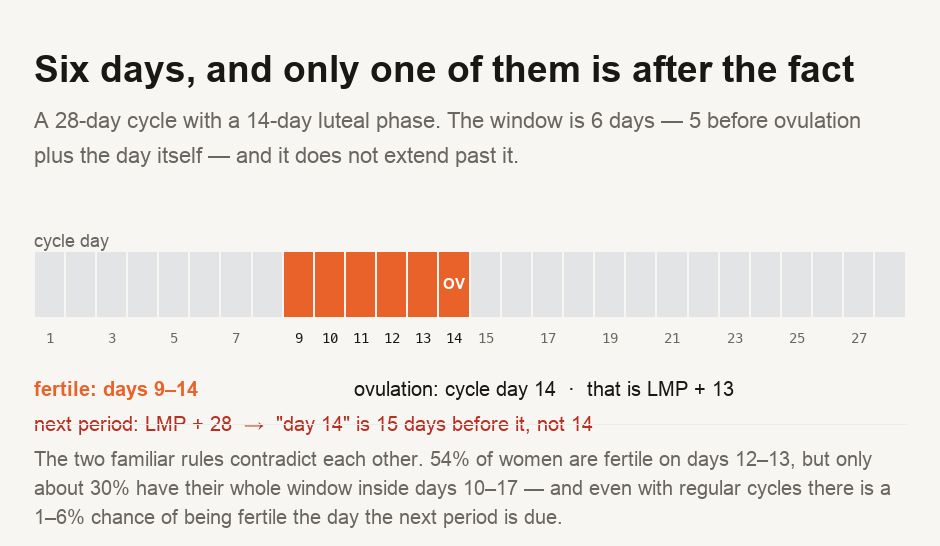
The fertile window is 6 days long: the 5 days before ovulation, plus the day of ovulation. It does not extend past it. Sperm can wait for the egg; the egg does not wait for sperm.
This is the part most cycle apps get subtly wrong by drawing a symmetrical band around a predicted date. The window is not symmetrical. Everything useful happens before.
Which days, for whom
54 per cent of women are fertile on cycle days 12–13. That is the single most likely pair, and it is where the day-14 folklore comes from.
But only about 30 per cent have their entire fertile window inside cycle days 10–17 — the range most advice treats as the answer. For roughly seven women in ten, some part of the window falls outside it.
Those two figures are not in tension. One describes the most common days; the other, how often those days are the whole story. Advice that quotes the first and omits the second is how a population average gets misread as a personal guarantee.
What our calculator does not do, said plainly
At the default 14-day luteal phase, our estimate of the ovulation date is arithmetically identical to the familiar "cycle length minus 14" rule. We checked it at cycle lengths of 22, 28, 34 and 40 days and it matches every time. We are not offering you a better central number, and any tool claiming to is worth a raised eyebrow.
The difference is in the details around that number. We give you a six-day window, not a single date. You can set your own luteal phase instead of inheriting a default. We check your numbers against the days 10–17 rule instead of assuming you fit it. And we refuse to answer when the inputs are implausible. A calculator that returns a confident date for a 90-day cycle is not being helpful.
Count backwards from your next period, not forwards from your last one. And remember that "day 14" and "14 days before" are a day apart, so they cannot both be right. The window is six days and ends at ovulation, so the days before are the ones that matter. Treat any single predicted date as the middle of a range rather than an appointment: the luteal phase moves by about 3 days within one woman's own cycles, and more than half of healthy women record a short one at least once a year. And none of this identifies a safe day, because there is not one.
Working it out for yourself
Our ovulation and fertile window calculator gives you the six-day window and shows how your own numbers fit the days 10–17 rule; it stores nothing and sends nothing anywhere. For the fiddly parts, the date add and subtract calculator handles month-end arithmetic without the off-by-one, and the date difference calculator confirms how long your own cycles actually ran. If the question has changed, the conception date estimator works backwards instead.
- Fertile window length, its position, the days 10–17 figure and the chance of being fertile on the expected period day: Wilcox AJ, Dunson D, Baird DD, "The timing of the 'fertile window' in the menstrual cycle: day specific estimates from a prospective study", BMJ 2000;321:1259-62. Every figure is pinned in our fertility kernel and asserted by its test suite, so this page and the calculator cannot drift apart.
- Luteal phase variability and the short-luteal figure: "Prospective 1-year assessment of within-woman variability of follicular and luteal phase lengths", Human Reproduction 2024;39(11):2565.
- The claim that our estimate matches "cycle length minus 14" at the default luteal phase was verified independently for this guide, at cycle lengths of 22, 28, 34 and 40 days, rather than asserted. It is recorded because a tool page should not imply an advantage it does not have.
- ⚠️ These are population statistics from studies of women tracking their own cycles. They describe how a group behaves and cannot tell you which group member you are. Nothing here is a substitute for a clinician, and a persistently short luteal phase, cycles outside 21–45 days, or a change in your own pattern are all reasons to ask one.
Educational information about menstrual cycle arithmetic. It is not medical advice, it is not a diagnosis, and it is not contraception — no calculation can identify a day on which pregnancy is impossible.

View author profile → · Editorial policy