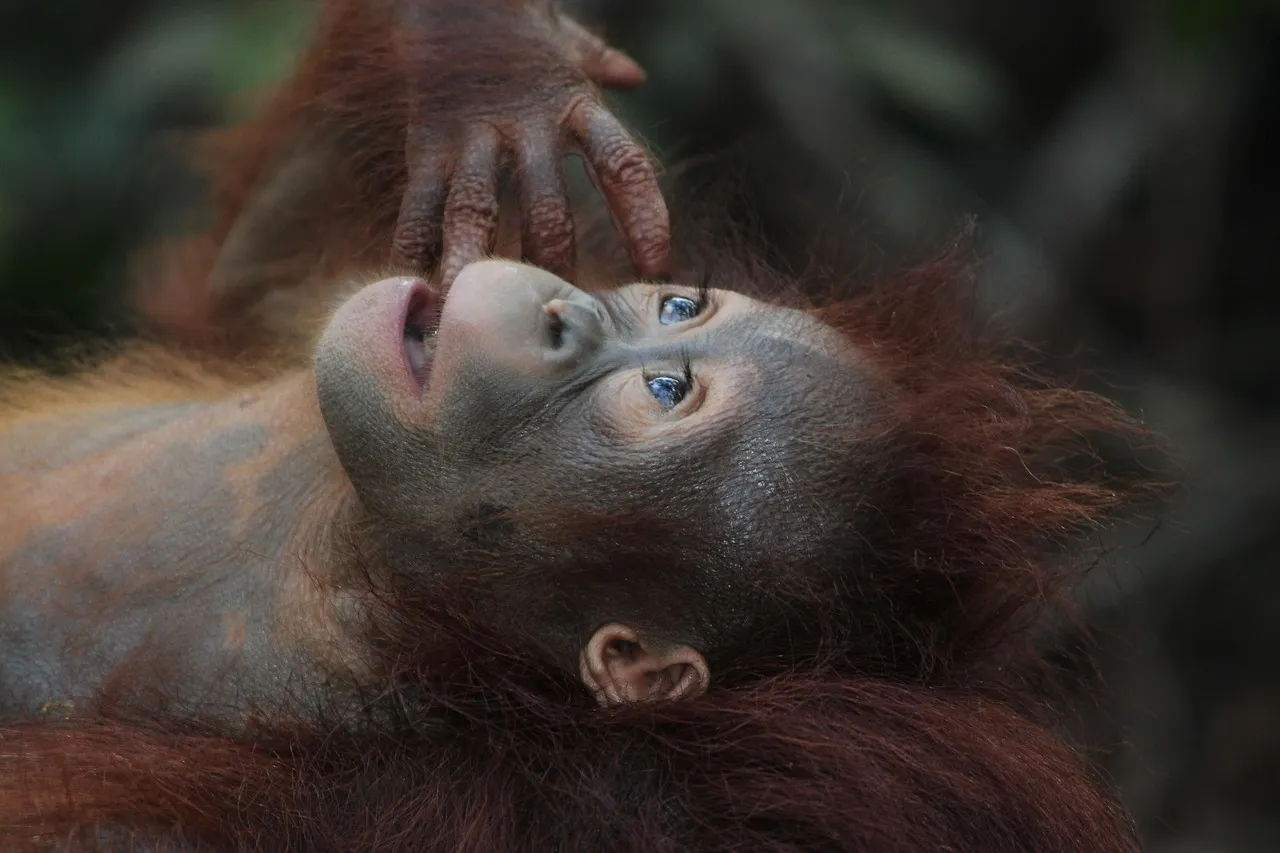
26 SEP 2026 — Twenty-one wild orangutans were followed from birth to independence at a research station in Sumatra. The long-term study found that the ones that spent most time watching others reached adulthood eating three times the range of foods.
The work took twelve years of field observation and 4,700 hours of watching to produce, and was published in Science on 24 September.
What the team measured
The study followed 21 immature Sumatran orangutans at the Suaq Balimbing research station in Gunung Leuser National Park, Indonesia, from birth to independence at around eight and a half years. It is run by the Max Planck Institute of Animal Behavior with Universitas Nasional in Jakarta.
From 4,700 hours of observation the team drew just under 7,000 records of learning, divided between what an infant worked out by trying something itself and what it took from watching another animal closely. Researchers call that watching peering.
The list is not short. An adult orangutan's diet runs to nearly 250 distinct food items, and an infant has to acquire that list before it stops travelling with its mother.
The threefold difference in diet
At independence the infants that had done the most social learning had roughly three times the diet breadth of those that had done the least.
That is a large gap for a single behavioural difference, and it is the study's central result. But it measures range, not outcome, so conclusions have to stay within that limit.
A ripple that lasts hours
Watching does not replace trying; it provokes it.
After a bout of attentive peering, an infant's own independent exploration stayed elevated for as long as two and a half hours. Revathe Thillaikumar, the first author and a Marie Sklodowska-Curie postdoctoral fellow at the institute, calls it a prolonged ripple effect on subsequent explorations.
Caroline Schuppli, the senior author and a group leader at the institute, gives the reason it matters: learning purely through individual exploration, she says, can be risky for a naive orangutan facing a diet that includes things it should not eat.
Two releases, two different claims
The two universities announcing the same paper describe its headline ratio as two different quantities, and a reader comparing them would not know which was meant.
The Max Planck release says the immatures engaged in social learning more frequently than individual learning, as much as five times more frequently on average. That is a count of how often each kind of learning happened.
The St Andrews release says the finding translates into youngsters acquiring five to six times more knowledge from their mother and others than from their own independent exploration. That is a claim about how much was learned, and it is derived from the two-and-a-half-hour effect rather than from counting events.
Both may be defensible readings of the same analysis. They are not the same statement, and we report the frequency figure because that is what the institute running the study published.
What the study does not show
It does not show that the better learners lived longer or bred more. Diet breadth is what was measured. The team says it now plans to look beyond it, to whether greater learning improves energy intake and ultimately whether that translates into survival and reproduction.
Twenty-one animals at one field site is a small sample in absolute terms, and large for a species that takes eight years to reach independence and has been followed here for twelve. The two kinds of learning are also not cleanly separable, since the study's own finding is that one triggers the other.
Andrew Whiten of the School of Psychology and Neuroscience at St Andrews, a co-author, reads the pattern as one humans share, with origins going back to a common ancestor millions of years ago. That is an interpretation offered by the researchers rather than something the eight years of observation establish on their own.

View author profile → · Editorial policy