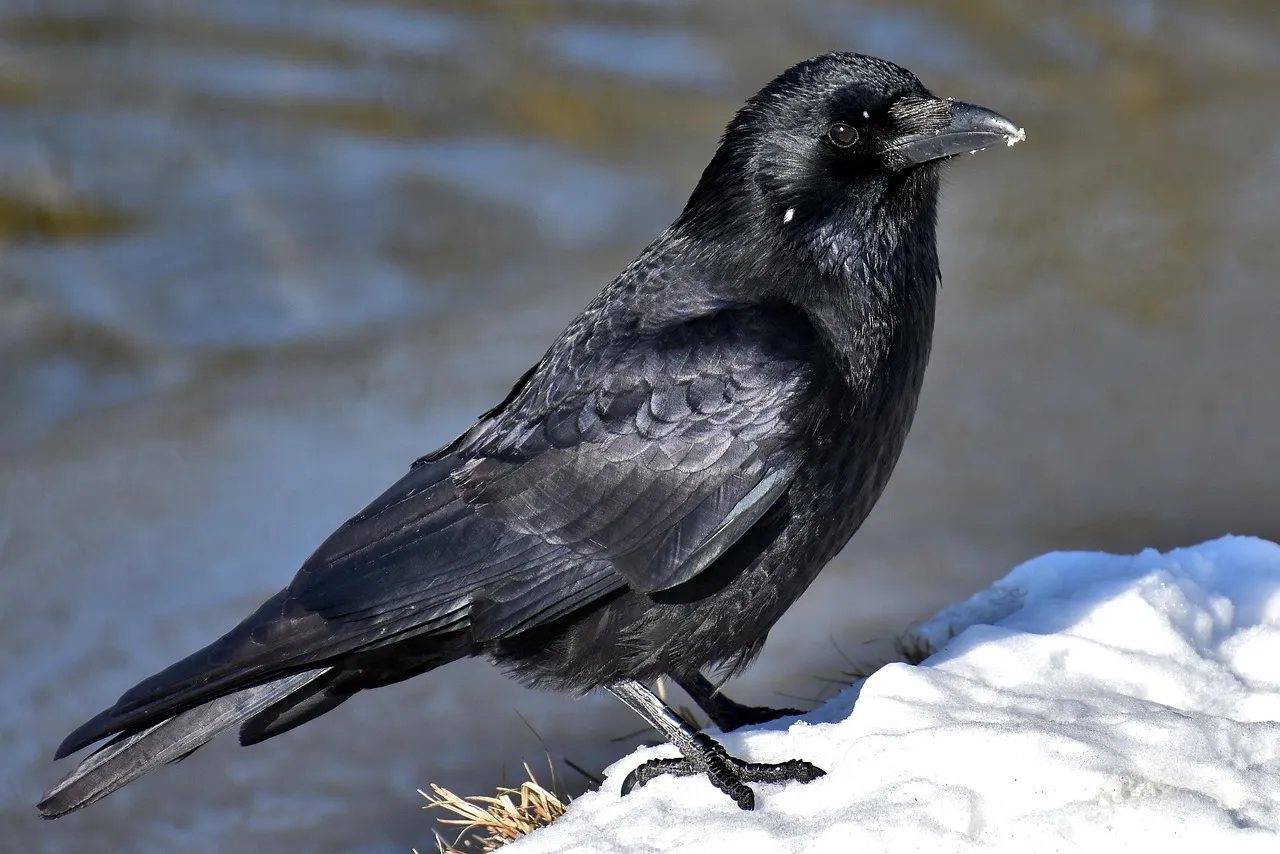
23 OCT 2026 — Two carrion crows took about 235 milliseconds on average to judge which way a cloud of dots was drifting and peck their answer, a two-person team from Germany's University of Tübingen reports in a study published in Science on 22 October 2026. Philipp Schmidbauer and Andreas Nieder of the university's Institute of Neurobiology say that is roughly double the speed observed in monkeys or humans.
The birds did not trade accuracy for that speed, the authors report. Recordings from their brains also showed the choice taking shape long before the beak moved.
What the crows were asked to do
The abstract calls it a classic visual motion discrimination task. Dots move across a touchscreen, and the animal has to say whether most of them are heading left or right. The crows answered by pecking a target circle on the matching side of the pattern to receive a reward, the university's press release explains.
Some patterns were hard to make out and others were clear, and the birds were tested across both.
On the hardest patterns the crows still did better than chance, Schmidbauer said in the release, "and with clear signals, they achieved an accuracy of nearly 100 percent."
Faster than the primate benchmark
The headline comparison comes from the paper's abstract, which says the choices arrived "roughly twice as fast as has been observed in monkeys or humans and without sacrificing accuracy". The wording matters. The comparison is with results reported in earlier work, and Live Science, in its report on the study, noted that the team did not test crows against humans and monkeys on the exact same task.
That caveat does not undo the result. It does mean the factor of two is a comparison across separate studies, and that the speed figure rests on two birds.
Watching the decision form
The second half of the work happens inside the head. The researchers recorded neurons in the nidopallium caudolaterale, an associative region of the bird brain that the release likens to the human prefrontal cortex.
Neurons tuned to a direction of motion began to encode the coming choice within about 70 milliseconds of the dots appearing, the abstract says, and about 170 milliseconds before the response. Their activity ramped up as the decision formed, scaled with the strength of the sensory evidence and converged when the bird responded.
The release describes activity rising until it reaches a decision threshold, at which point the crow indicates its choice, and says the neurons tracked both the strength of the visual information and the direction the bird picked.
A different brain, similar principles
Birds have no layered cerebral cortex, so the parallel is not anatomical. Nieder's argument is that the computation looks alike even though the tissue is organised differently.
"These findings show that neuronal dynamics in the avian brain are consistent with established models of decision-making in humans and non-human primates," he said in the release.
The abstract makes a similar point in drier language, describing the results as evidence of the efficiency of the decision circuitry in birds. It also opens by observing that mammals are where perceptual decision-making has mostly been studied, while its workings in other vertebrates remain unclear, which is the gap this paper sets out to fill.
Why speed might matter to birds
The authors suggest the speed may have been shaped by evolutionary pressure for rapid visual and motor control. They offer that as a possibility, and the release says more research is needed to find out exactly which mechanisms give birds the edge in time.
"Birds rely on their vision to carry out precise, rapid maneuvers during flight and to guide their beaks towards objects when foraging," Nieder said.
What the study does not show
The finding concerns one kind of judgement, a fast visual call about motion, made by two birds. It says nothing about crows reasoning faster than people in general, and neither the abstract nor the release claims that. Nor does it explain the speed. It shows where in the brain the decision appears and how early, which gives later studies a place to look.
The same pair presented preliminary work on these neurons as a poster at the FENS Forum in Barcelona in July.

View author profile → · Editorial policy