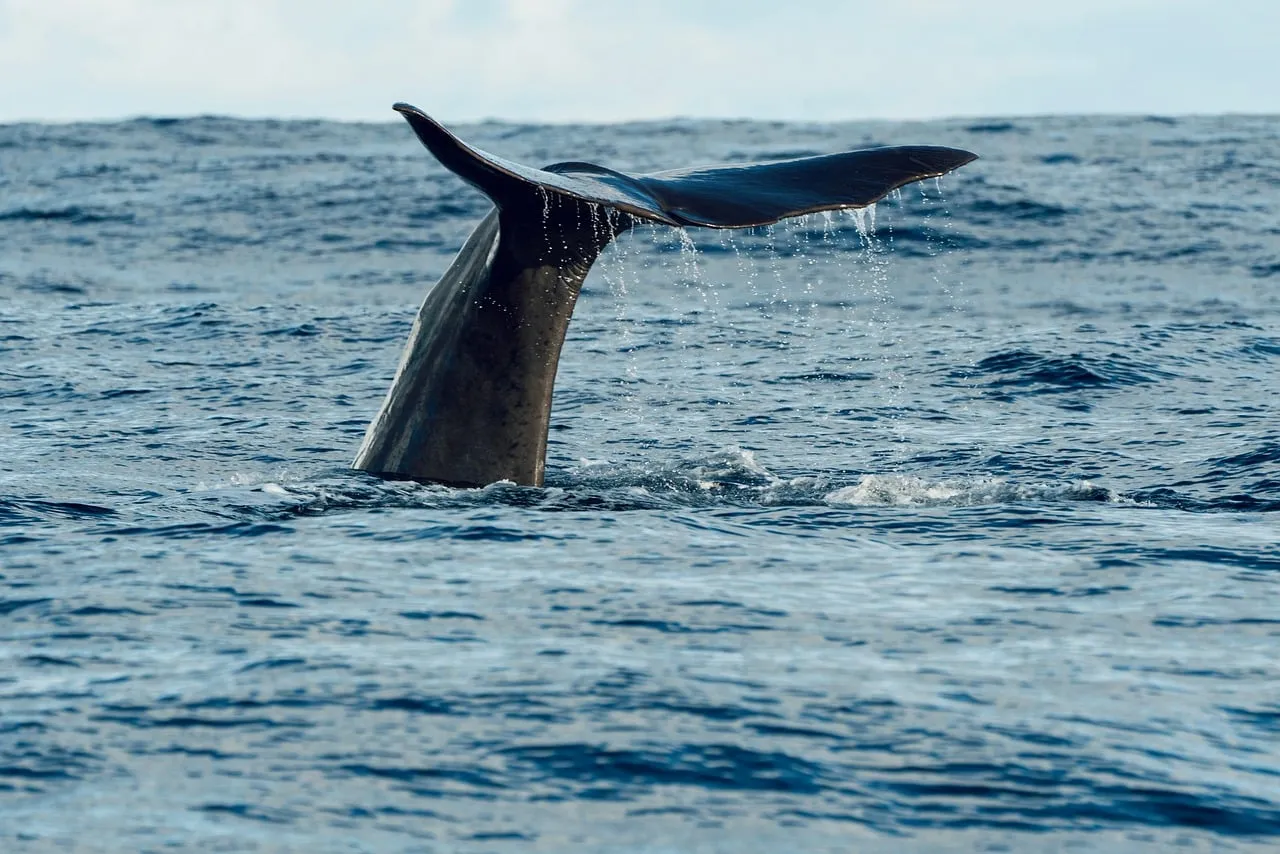
24 OCT 2026 — One of the least-known whales in the world turns out to have fairly predictable tastes. Researchers at Curtin University in Perth combed underwater recordings made off northwest Australia between 2005 and 2023 for the calls of the Omura's whale, and found the animals were most likely to be present where the water was warm and full of food. The study was published online in the journal Marine Mammal Science on 19 October, and the university announced it the next day.
The Omura's whale was recognised as a separate species only in 2003, and the IUCN Red List, kept by the International Union for Conservation of Nature, still rates it Data Deficient. That status means there is not enough information to say how close it is to extinction. Sightings are rare enough that the Curtin team chose to listen instead.
Eighteen years of recordings, revisited
The paper, led by Curtin PhD student Ciara Browne and four colleagues from the university's Centre for Marine Science and Technology, did not need a new survey. According to its abstract, the team reused archival recordings from 72 deployments across 35 sites. The university release puts the spread of those sites at about 1,800 kilometres of ocean.
Calls turned up in every season. Presence was not even across the year, though, and the whales were more likely to be heard from September to May, when the water was warmer.
"Omura's whales are notoriously difficult to study because visual sightings are rare, so listening for their calls provides an important way of understanding where they occur," Browne said in the release.
What the whales seem to follow
The researchers used statistical models to test which conditions lined up with the calls. Presence was linked to sea surface temperatures above 27.5°C, to stronger winds and to higher levels of chlorophyll-a, which the university treats as a sign of the microscopic life that ocean food webs are built on.
The lag stood out. Whale presence rose roughly a month after chlorophyll-a rose, which the authors read as the animals responding to the extra prey that follows a burst of productivity. The abstract also names closeness to continental shelf habitats shaped by wind-driven upwelling as a predictor.
There was a seasonal shift as well. In the austral winter, the abstract says, the whales' acoustic presence moved towards lower latitudes, closer to the equator.
A whale that may not need to migrate
The abstract sets the species against most baleen whales, which are capital breeders and travel between places where they feed and places where they breed. Omura's whales, by contrast, mostly stay in the tropics all year. The authors conclude that the whales off northwest Australia rely on prey that can be predicted throughout the year, and that they likely function as "income breeders" instead.
That conclusion rests on acoustic presence. Hearing a whale is not the same as counting it, and the team's own earlier paper on the species, published in Animals in October 2024, warned that a silent recorder does not prove the whales are absent, because animals can be present without calling. It also noted that scientists do not yet know whether only males make the calls.
Where the species has been found
That 2024 study gives the background. The species was first described from a stranded animal found in the Sea of Japan in 1998 and eight whaling specimens taken in the 1970s near the Solomon Islands and Cocos (Keeling) Islands. Before then, sightings and calls were put down to a small form of Bryde's whale.
The 2024 paper also records sightings of Omura's whales feeding off Indonesia, and the most northerly detection in its Australian dataset was in the Timor Sea. In the Joseph Bonaparte Gulf, also in the Timor Sea, calls were heard all year round. The new paper deals with Australian waters only and does not report on Indonesian or Timorese seas.
Why researchers want a baseline
Christine Erbe, a co-author who heads the Curtin centre, framed the work as a first step towards protection. "Our findings provide an important baseline for understanding how Omura's whales use Australian waters and how they may respond to environmental change," she said.
Erbe said the knowledge could inform marine planning and help assess noise from shipping and offshore industry. The team's 2024 paper had already pointed out that the species' known range off Australia overlaps heavily with offshore industry. Luke Twomey, chief executive of the Western Australian Marine Science Institution, said long-term datasets of this kind "help reveal patterns that would otherwise remain hidden".
The study's limits do not get much attention in the university release. The abstract describes the recordings as archival and used opportunistically, and the 2024 paper, built on similar archives, noted that data were incomplete at some sites. Nobody knows how many Omura's whales there are, and too little is known for the IUCN to judge the species' risk of extinction.
Discover Wildlife covered the study on 21 October with a clip of the whale's song. The Curtin centre keeps its own sound clip of the species, with a warning that some of the sounds are too low to hear unless sped up.

View author profile → · Editorial policy