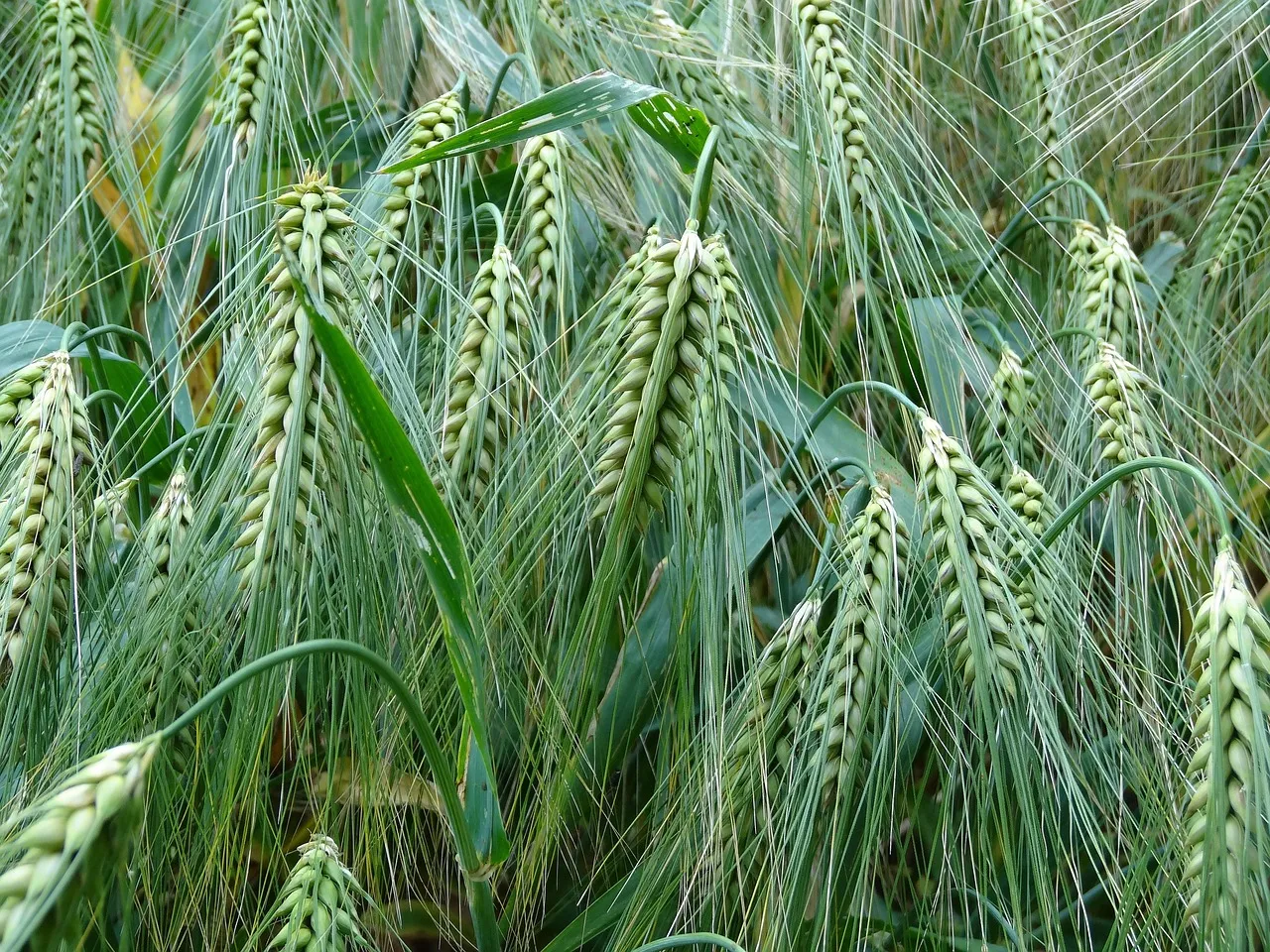
7 NOV 2026 — Across central and eastern China, farmers sow barley in autumn and need it out of the ground before the heat that comes ahead of summer, so that a summer crop can follow. A paper published in Nature on 4 November by 23 researchers from the Institute of Crop Sciences at the Chinese Academy of Agricultural Sciences, Germany's IPK Gatersleben and other institutes in China, Germany and Australia shows that eight decades of breeding met part of that deadline by spreading a single amino-acid change in a light-sensing protein.
The researchers sequenced 505 representative Chinese cultivars covering 80 years of modern breeding, plus 27 exotic lines. The early flowering traces to a PHYTOCHROME C (PhyC) variant carrying one amino acid swap, F380S, found alongside a winter-type version of VERNALIZATION 1. In the abstract's wording, the derived allele "accelerates heading and maturity, and its frequency has risen sharply in modern autumn-sown varieties."
We checked the rise against the cultivar list and genotype data published with the paper. In the autumn-sown south and centre of the country, the early PhyC allele was rare at first. Five of the 116 cultivars released in the 1940s and 1950s carried it, about 4%. By the 1990s to 2010s breeders had made it the majority type, in 63 of 93 cultivars (68%), after reaching 39 of 87 (45%) in the intervening decades. Spring-sown barley tells a different story. In the north only 4 of 42 recent cultivars carry it, and none of the 117 from the Qinghai-Tibet Plateau does. We averaged the heading values in the paper's Figure 3d. The 112 cultivars carrying the early pairing head at 145.2 days, against 156.9 days for 103 cultivars with the older PhyC on the same winter-type background, about 11.7 days sooner. At maturity the gap is 188.7 days against 193.2, roughly 4.6 days.
Edited plants and their limits
To test whether the change itself causes the earlier heading, the team used base editing to write the F380S change into barley and wheat. In their response to reviewers, published with the paper, the authors report that edited spring barley headed an average of 21.91 days earlier than unedited plants in the greenhouse. Outdoors the gain shrank to 9.35 days. Wheat behaved differently, with edited winter plants gaining slightly more in the field, 8.06 days, than under glass, where the figure was 6.69. Rice, a short-day plant, flowered later after the same edit, according to one reviewer's summary of the results.
Across two years at three locations, the PhyC/VRN1 region explained between 6.22% and 17.37% of the variation in heading date, depending on the environment. The authors call that "a major, but not exclusive, contributor to flowering time variation in Chinese barley." Field trials ran at four stations, Xinxiang, Yancheng, Kunming and Beijing, according to the supplementary information. The early allele also has a ceiling. When paired with a spring-type VRN1, a combination not found in natural barley, it flowered extremely early, cut biomass sharply and left grain yield "undetected".
The authors disclose a commercial interest. The competing-interests statement says the Institute of Crop Sciences has filed a Chinese patent application covering early-heading wheat and barley materials and the methods used to generate them, and that five of the authors are named inventors.

View author profile → · Editorial policy