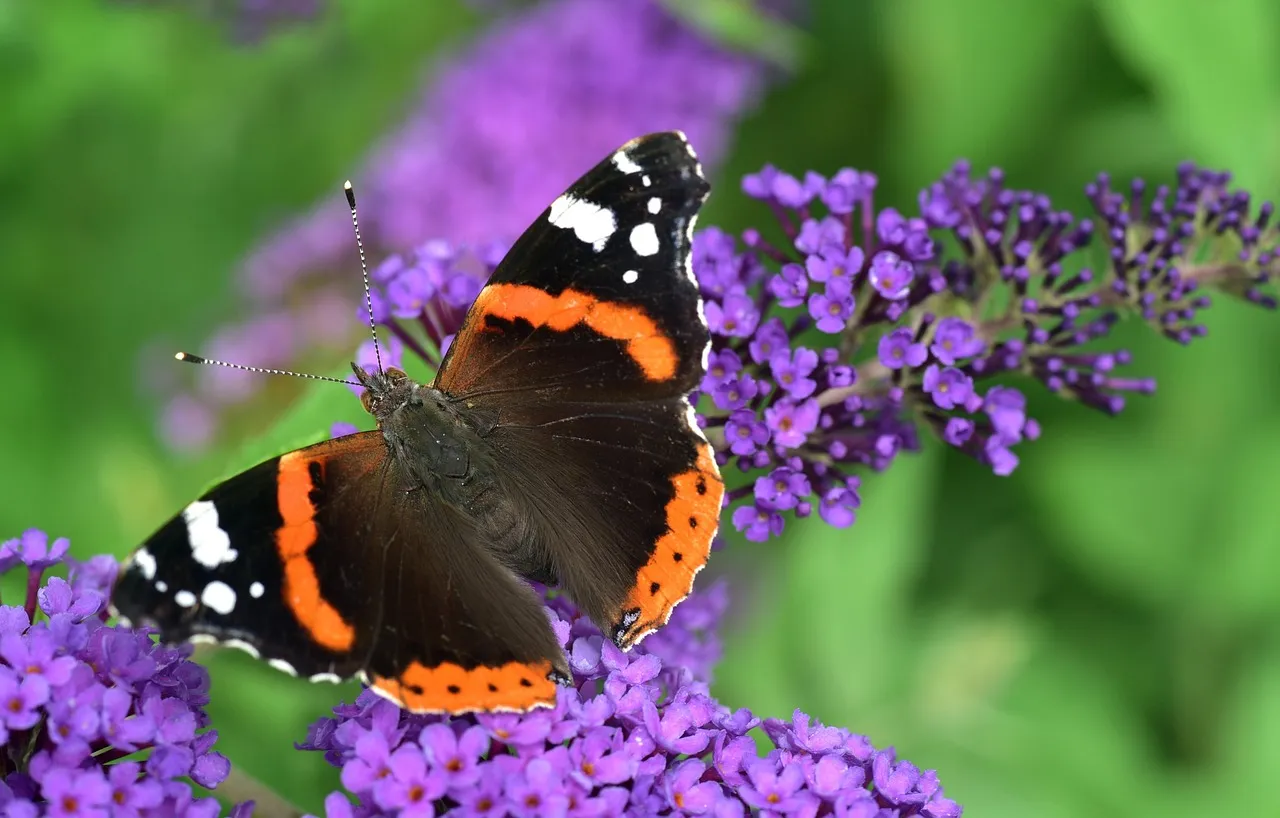
1 OCT 2026 — The bold stripes and spots on many butterflies' wings make them easy to see. According to a study published in Nature on 30 September, they also make them hard to catch: as the wings flap, the patterns create motion illusions that mislead a predator about where the butterfly is heading.
Researchers at the universities of Exeter and Essex say this answers an old puzzle. Butterflies are conspicuous, yet few predators specialise in catching them in flight.
A barber-pole trick
The mechanism resembles the barber-pole illusion, where stripes on a spinning pole seem to travel upwards. Butterfly wings bend as they flap, clapping together on the upstroke and peeling apart on the downstroke, so their stripes change angle and direction mid-beat.
"The first slow-motion video of a butterfly I put through our bird-vision computer model was glowing with downwards motion even though the butterfly was moving up," Jolyon Troscianko of Exeter said in the university's release. He first assumed it was a coding error.
Four lines of evidence
The team filmed real butterflies taking off at more than 1,000 frames a second and ran the footage through a model of motion vision. Natural wing patterns produced significantly more misleading motion than the same butterflies with the patterns digitally removed, the paper reports.
Simulated species and a catching game
Scaling up, the team simulated the flight of 757 wing forms from 397 European species, and motion-confusing patterns turned out to be common rather than a quirk of a few. To see whether the effect changed real behaviour, 100 volunteers played a touchscreen game, trying to catch virtual butterflies over 3,000 trials. Where they missed matched what the model predicted.
The last test approached the question from the other end. A genetic algorithm started from random patterns and kept whichever confused motion best. After 57,600 designs, its output looked strikingly like real butterfly wings.
The limits of the test
The test used people as the "predators", not birds. Birds see faster than humans, so the team slowed the virtual butterflies and kept the blur of faster flight. "Predation experiments with live birds and butterflies would have been ideal in many ways, but likely impossible and unethical in practice," Troscianko told Reuters.
The analysis covered European species only. The team chose Europe because it has no major mimicry rings and comparatively few of its butterflies are chemically defended. Tropical butterflies, including those of Southeast Asia, often rely on warning colours as well, and were not part of this analysis.
Beyond butterflies
Stripes on zebras and snakes have long been suspected of confusing predators, but there has been little firm evidence. Those tests used rigid prey, whereas a flapping wing moves partly against the direction of travel.
The least confusing butterflies tend to be brown or red, Troscianko told Reuters, suggesting those species rely more on camouflage or on warning colours. The team thinks motion confusion may be widespread, from flapping bird wings to flicking lizard tails.

View author profile → · Editorial policy