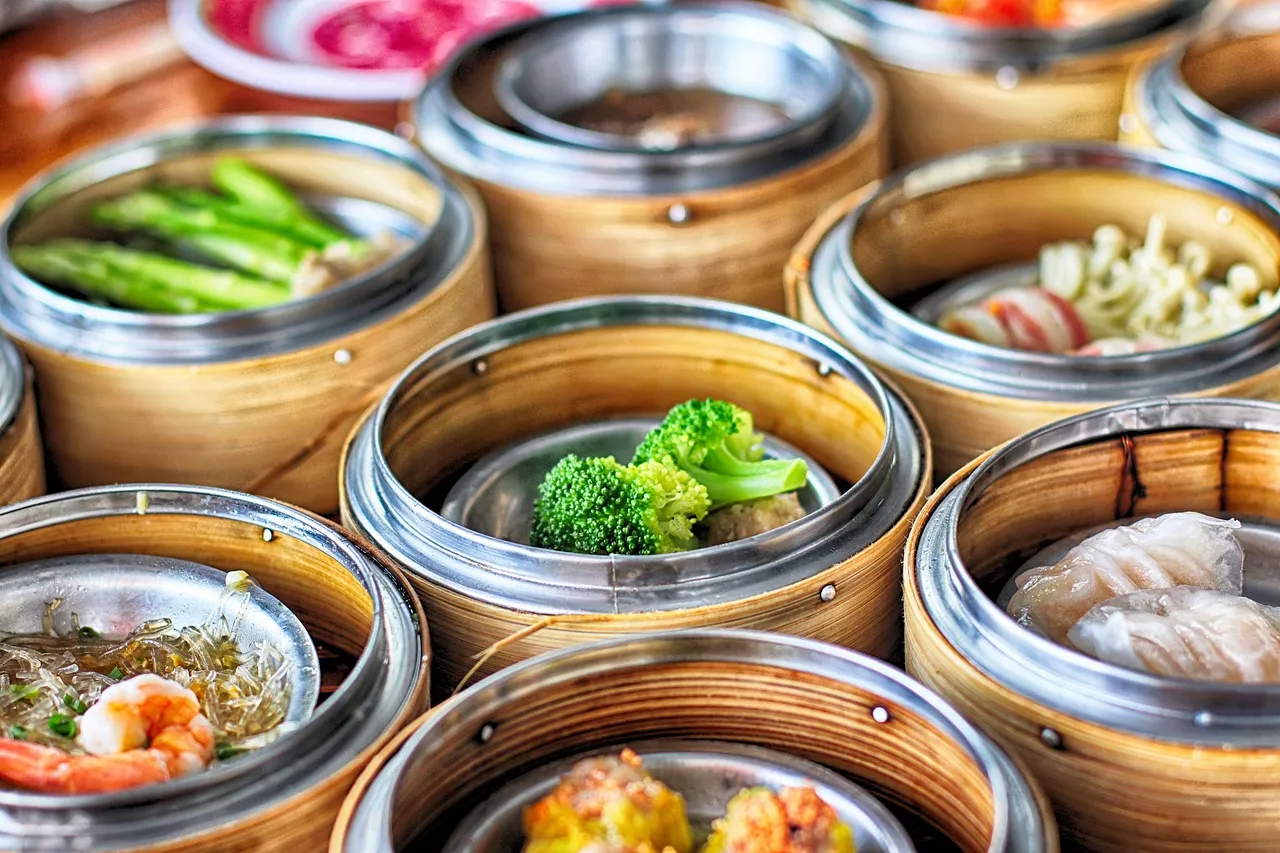
Most dim sum names simply describe the dish. 蝦餃 (har gow) is a shrimp dumpling, 燒賣 (siu mai) an open-topped pork and shrimp dumpling, 叉燒包 (char siu bao) a bun of barbecued pork, 腸粉 (cheung fun) a steamed rice-noodle roll, 鳳爪 ("phoenix claws") chicken feet, and 蘿蔔糕 a pan-fried cake of white radish, or daikon, that English menus call turnip cake, radish cake or, in Singapore, carrot cake. Only a few of these names reach English menus in Cantonese. The rest are translated, and every restaurant translates them its own way.
We copied the English names of 12 classic dishes from the published menus of 11 restaurants: two in Hong Kong, four in Singapore, two in Malaysia, and one each in London, New York and elsewhere in the United States. Between them they printed 102 labels, and 97 of those were different. Only 25 of the 102 used the Chinese name at all, and 19 of those were har gow and siu mai. Menus mostly translate dim sum rather than spell it. Our dim sum guide finds each dish under any of the spellings below, in either Chinese script or in Jyutping.
What each name says, and what the menus call it
| Dish | What the characters say | Labels on the 11 menus |
|---|---|---|
| 蝦餃 har gow | shrimp dumpling | 11 different labels on 11 menus; the Cantonese part spelled har gow, har gao, har gau, har kau, and once the Mandarin ha jiao |
| 燒賣 siu mai | literally "cook, sell"; where the name came from is unclear | siew mai on 5 menus, siu mai on 4, sui mai on 1 |
| 叉燒包 char siu bao | fork-roast pork bun | 9 of 10 simply say BBQ, barbecued or roast pork bun |
| 腸粉 cheung fun | "intestine noodle", for its rolled shape | cheung fun or cheong fun on 4 menus; rice roll or rice noodle roll on the rest |
| 鳳爪 | phoenix claws | chicken feet on 7; chicken claw on 2; phoenix claw on 2 |
| 蘿蔔糕 | radish cake | turnip cake on 5; carrot cake on 3; radish cake on 2 |
| 糯米雞 lo mai gai | glutinous-rice chicken | lotus-leaf, glutinous or sticky rice; lo mai gai on 1 menu |
| 流沙包 | "flowing sand" bun | salted egg, custard or lava bun, in every combination |
| 蛋撻 | egg tart (撻 borrows the English "tart") | egg tart on all 6 |
| 鹹水角 | "salt-water" horn-shaped dumpling | fried glutinous rice dumpling, in 5 wordings |
Even three branches of the same chain disagree. Tim Ho Wan's Hong Kong, Singapore and US menus print three different full labels for 蝦餃, and the Hong Kong one uses the Mandarin ha jiao where the other two say har gow.
Why the spellings wander
The Cantonese names that survive are spelled by ear, not by a consistent system. None of the menus we saw used Jyutping, the standard romanisation, which writes 蝦餃 as haa1 gaau2. The common "har" and "char siu" spellings, for instance, add an 'r' that isn't pronounced in Cantonese (the syllables are haa and caa in Jyutping). Our guide to why Hong Kong place names don't follow Jyutping finds the same loose habits on street signs, where one sound can be spelled several ways.
Regional habits account for some of the differences. Five of our six Singapore and Malaysian menus wrote siew mai, while both Hong Kong menus and Tim Ho Wan's US menu wrote siu mai. Mainland China is another story; a Beijing guide on English translation recommends Hanyu Pinyin for familiar foods, which turns 燒賣 into shaomai.
Carrot cake, turnip cake, radish cake
These are the same dish, and none of the three words is quite right. 蘿蔔 here is white radish, the long daikon, not a carrot and not a turnip. Hong Kong, London and the US menus we read called it turnip cake; all three "carrot cake" labels came from Singapore menus, and two restaurants, in Singapore and Malaysia, said radish cake. In Singapore, the English name "carrot cake" can also mean chai tow kway, a hawker favourite made by dicing and frying the same radish cake with egg. The context is key: on a dim sum menu it's the steamed or pan-fried slab, but at a hawker stall it's the fried dish.
Yum cha, and the two famous gestures
Going for dim sum is yum cha (飲茶), "drinking tea", and the old phrase 一盅兩件, "one cup, two pieces", describes the classic order: a lidded cup of tea and two dishes. The 盅 was a lidded cup rather than a teapot; most tea houses have since switched to pots. Many restaurants charge for tea by the head: Jin Xuan in Malaysia, for example, prints RM3 per person for most of its teas.
Two tea-related gestures have colourful origin stories, though they are best treated as legends. Tapping two fingers on the table to thank a tea-pourer is said to come from the Qianlong emperor travelling in disguise; his attendants tapped instead of kowtowing to avoid revealing his identity. The practice of leaving the teapot lid ajar to ask for hot water has two contradictory tales behind it, one involving an escaped bird and the other a scalded partridge. While the stories are apocryphal, the gestures are still used and understood.
The menus were read in September 2026, from each restaurant's own site where possible. Three of the 11 are Tim Ho Wan branches, the New York menu comes from an undated third-party listing, one Malaysian menu was read from its introductory page only, and we found no English menu published by a Guangzhou tea house, so treat the counts as a sample, not a census. The meaning of 一盅兩件 is from the Hong Kong culture site ThinkHK, and the list of classic dishes from the Hong Kong Tourism Board.