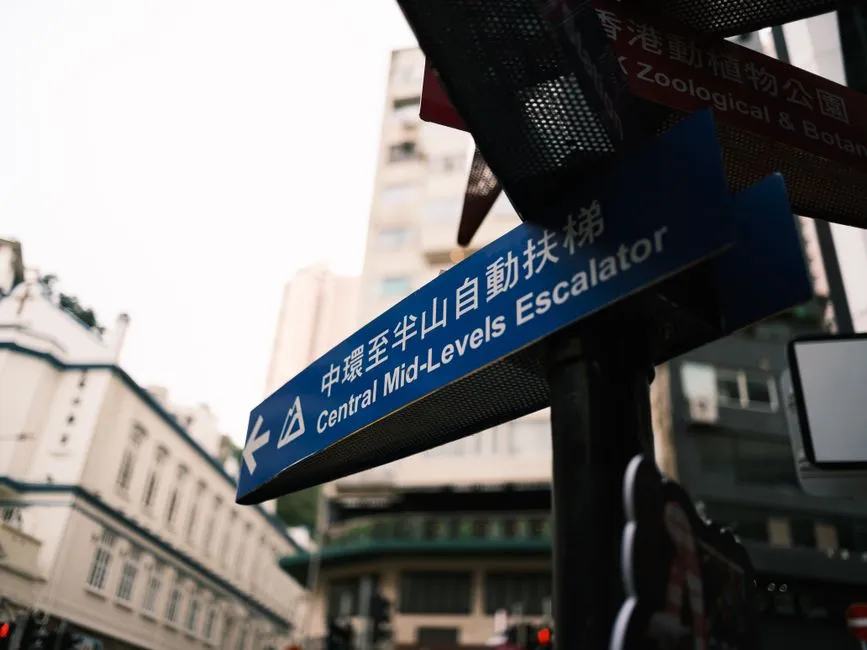
Hong Kong's official English place names are not written in Jyutping, the Cantonese romanisation taught to learners. They follow an older government spelling habit that marks no tones, has no published rulebook, and spells the same sound in different ways from one name to the next. 荃灣 is Tsuen Wan, but 杏花邨, a few stops away, is Heng Fa Chuen, although the two characters 荃 and 邨 have the same sound, cyun in Jyutping. So you cannot reliably get from a pronunciation to the name on the sign.
Our guide to how Macau spells names found that Hong Kong has no written rule at all, and the government's own answer to a 2019 Legislative Council question says new names normally follow "Cantonese Romanisation" without saying which one. So we measured how much of a rule is there anyway. We took 2,870 official names, every MTR station, every Light Rail stop and the Lands Department's gazetteer of place names, converted their Chinese characters to Jyutping and compared each syllable with its English spelling. Our Cantonese Jyutping converter gives the Jyutping for any name; the English on the sign is a separate matter.
One sound, two spellings
Most of the disagreement comes down to two choices: ch or ts, and sh or s.
- The Jyutping sound s is written sh 713 times and s 318 times. 山 saan is Shan in 222 names and San in 9.
- The unaspirated Jyutping z sound is written ch 286 times and ts 249 times. The aspirated c is written ts 406 times and ch 201 times. Whether a name uses ch or ts, then, tells you nothing about aspiration.
- The same character can go both ways. 村, "village", is Tsuen in 317 names and Chuen in 2; 仔 is Tsai 78 times and Chai 8.
Of the 366 different toneless syllables in the names, 92 are written in more than one way, and those 92 make up almost half of all the syllables we compared.
How much of a rule we could recover
We tried a single fixed rule, giving each Jyutping sound the first English spelling listed for it in the standard comparison table of Cantonese romanisations (so z and c both become ts, s stays s, aa becomes a, and so on). Many names are not spellings at all: Admiralty is 金鐘 and Aberdeen is 香港仔, and a few hundred more are wholly or partly translated. Those were set aside, and the rule was tried on the names written entirely as spellings.
| MTR stations | Light Rail stops | Gazetteer place names | |
|---|---|---|---|
| Names written wholly as spellings | 65 of 100 | 46 of 68 | 2,224 of 2,702 |
| Syllables spelled as the fixed rule predicts | 75% | 81% | 78% |
| Whole names the fixed rule gets exactly right | 32 (49%) | 29 (63%) | 1,069 (48%) |
| Whole names right if ch/ts, sh/s and similar variants are allowed | 57 (88%) | 44 (96%) | 1,975 (89%) |
A fixed rule gets about three syllables in four right, but only about half of the place names, because one wrong syllable spoils the name. Then we gave the rule every advantage: each sound was assigned whichever spelling the official names use most often, a rule fitted after seeing the answers. Across all 2,870 names it still matches only 96% of syllables. No rule based on pronunciation alone can do better.
Many sounds squeezed into one spelling
The spellings also throw information away. In the names we compared, 596 different Jyutping syllables with their tones are written with just 322 spellings. Po stands for the syllables of 埔, 普 and 蒲 alike; Tai for 大 daai, 太 taai and others. None of the six tones appears in any name.
Apply the same fixed rule to every syllable in the dictionary and the squeeze is worse: 2,504 toned syllables fold into 437 spellings, about six sounds per spelling. The single spelling "tsam" covers 21 different syllables. The spellings lose tones, consonant aspiration, and vowel length.
The names no rule explains
About one syllable in twenty fits no rule at all, and these are often the most famous names.
- Hong Kong itself: 香港 is hoeng1 gong2, and "Hong" matches no spelling rule.
- Mong Kok, 旺角 wong6 gok3, keeps an older name for the area.
- Kowloon, Fanling and Whampoa are old spellings written as one word; the rule would give Kau Lung, Fan Leng and Wong Po.
- Keng for 徑 in 24 names such as Chek Keng, and Peng for 坪 in Peng Chau: these spell the everyday spoken readings rather than the dictionary readings ging3 and ping4.
- Some names run the other way, with Chinese characters chosen to approximate an English name, as in 佐敦 for Jordan, 柯士甸 for Austin, and 堅尼地城 for Kennedy Town.
Jyutping, Yale and the sign
Jyutping was finalised by the Linguistic Society of Hong Kong at the end of 1993. It spells each sound one way and writes the tone as a plain digit from 1 to 6 after the syllable (香港 hoeng1 gong2), which makes it easy to type. Yale, older and common in textbooks, marks tones differently; our guide to the h in Cantonese Yale compares the two. Neither is what the government uses on signs. For learning to pronounce Cantonese, pick Jyutping or Yale; for finding a place, use the name on the sign, because no system will reliably produce it.
The station lists are the MTR Corporation's open data, and the gazetteer is the Lands Department's Geographic Name dataset; all three were downloaded on 22 September 2026. The Jyutping readings came from an automatic converter, so a rare character in a village name may occasionally have been given the wrong reading, and some village names may be Hakka rather than Cantonese in origin. The Jyutping scheme itself is published by the Linguistic Society of Hong Kong.

View author profile → · Editorial policy