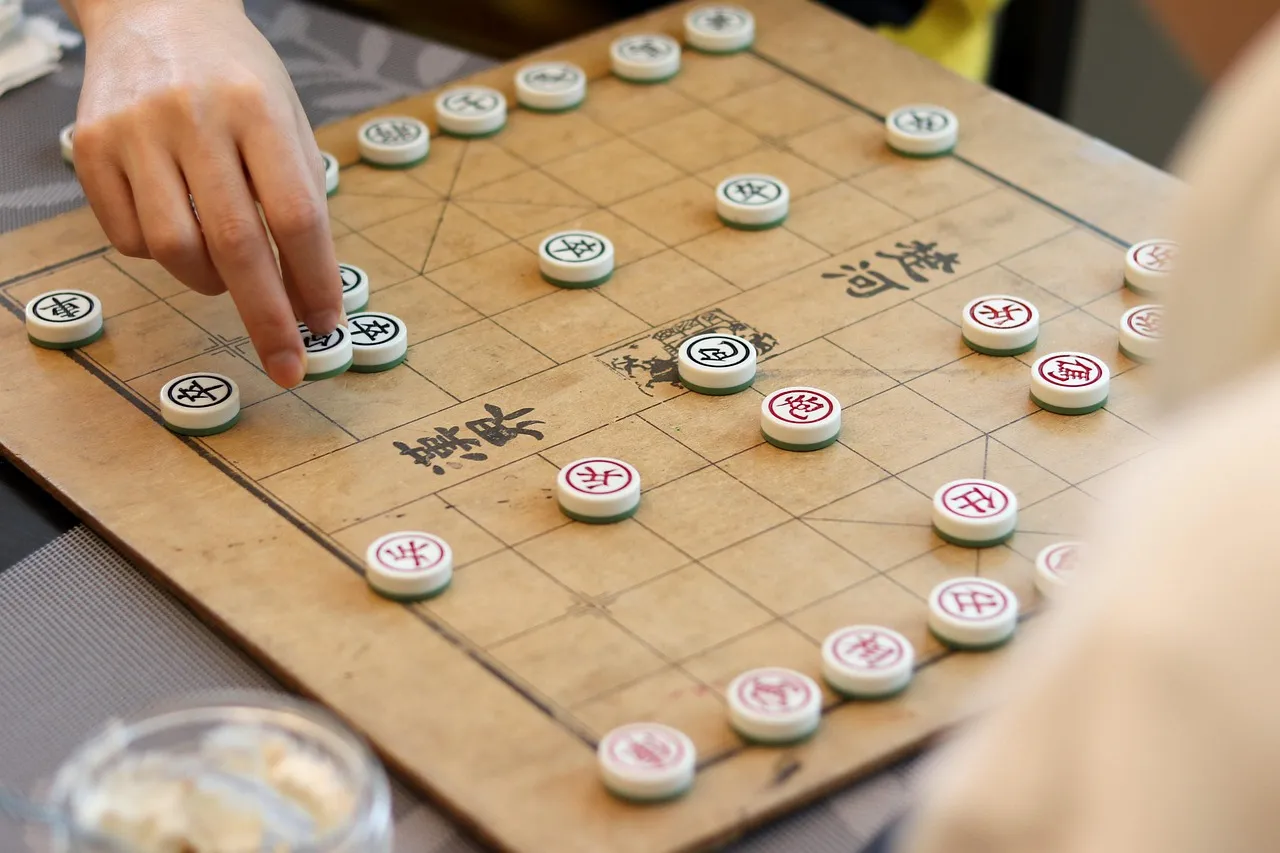
In 152 of the 300 games of the 2000 Chinese national individual championship that we replayed move by move, at least one Chinese chess (xiangqi, 象棋) move could not be written the ordinary way, because two identical pieces stood on the same file. Across all 24,756 moves that happened 393 times, and each time the record (象棋记谱) swaps the file number for 前, front, or 后, rear.
A standard move is four characters, like 炮二平五. These specify the piece, its starting file, the direction of movement, and a final number. The direction is 进, advance, 退, retreat, or 平, move sideways. Red counts the nine files 一 to 九 from its own right and Black 1 to 9 from its own right, so both sides write their moves from where they sit.
Counting steps is only for pieces that move in straight lines
What the last number means depends on the piece. After 平 it is always the file the piece moves to. After 进 or 退, the chariot (车), cannon (炮), pawn (兵) and general (帅) count steps along their file, so 车二进六 is the chariot on file 二 moving six points forward. The horse (马), elephant (相) and advisor (仕) move diagonally and cannot count steps along a file, so for them the number is the file they land on: 马二进三 is the horse on file 二 moving forward to file 三. Forward always means towards the opponent, so Black's 进 moves down the board as Red sees it.
Numbering the files starts from each side's own right
The Chinese Xiangqi Association's competition rules (《象棋竞赛规则》, 2020 edition, in a copy hosted by a third party) put it in one sentence: 「红棋方面从右到左用中文数字一至九来标识,黑棋方面从右到左用阿拉伯数字 1 至 9 来标识」. So Red's 炮二平五 and Black's 炮8平5 are the same move for each side: in the opening position both cannons stand on the same column of the board, and each goes to the centre file. The numerals usually tell you whose move it is, though the rules' own recording example writes Black's full moves in Chinese numerals as well, and screens often show Black's digits full-width, as 8.
The pieces' characters differ by side in most sets. The World Xiangqi Federation's introduction gives Red 帥, 仕, 相, 炮 and 兵 against Black's 將, 士, 象, 砲 and 卒, with 車 and 馬 on both sides. The Chinese association's rules are looser: they print 士 for both sides, and 炮 for both with 砲 only as an alternative for Black.
Stacking two identical pieces on a file brings in 前 and 后
When two chariots, cannons, horses or pawns of one side share a file, the file number no longer says which one moved, so it is replaced: 前炮退二 is the front cannon retreating two. We took the first 300 games in the xqbase game database, all from that November 2000 championship, and replayed each move with a writer built from the association's rules and xqbase's notation specification. It reproduced all 24,756 published moves exactly. The 393 that needed 前 or 后 were 162 cannon moves, 109 chariot, 87 horse and 35 pawn, 1.6% of the moves in one tournament, and the first came at a median of the 42nd ply in the games that had one.
Advisors and elephants are exempt. As xqbase puts it, two advisors or two elephants on one file need no 前 or 后, because 「能退的一定在前,能进的一定在后」: only the front one can retreat and only the rear one can advance. In Traditional script the rear piece is 後, as in 後車平六. Until 1 October 2026, our xiangqi notation reference wrote all 393 of those moves without 前 or 后, and 187 of the strings it produced also described a different legal move. It now matches the record on every one.
Lining up three pawns on a file is where the conventions part
Pawns are the only pieces a side can have three or more of on one file, and the written conventions disagree about them. xqbase uses 前, 中 and 后 for three pawns and 一 to 五 from the front for more than three. For pawns spread over two files it numbers them right to left and then front to back, although the parenthesis that follows its own rule says to start from the left; its worked example follows the right-to-left wording, writing 一兵平五 for the pawn it numbers first. The Chinese Wikipedia article on 象棋 gives 前、二、三、四 or 前、二、三、后 for four, and for two files a five-character form such as 前兵九平八. A file-format draft hosted by the World Xiangqi Federation labels pawns A to D from Red's right for both colours. None of these cases occurred in our 24,756 moves, so they are described here from the documents, not from play.
Switching to ICCS turns files into squares
ICCS, from the Internet Chinese Chess Server, writes each move as its start and end squares: files a to i from left to right as Red sees the board, and ranks 0 to 9 counted up from Red's back rank. Red's 炮二平五 becomes H2-E2, and engines using the UCCI protocol shorten that to h2e2. Because it names squares, ICCS never needs 前 or 后. These are the first moves of xqbase's own ICCS example, with our rendering in the WXF letter style beside them, Black in lower case as the Asian Xiangqi Federation's booklet writes it.
| Move | Chinese | ICCS | WXF style (ours) |
|---|---|---|---|
| 1. Red | 炮二平五 | H2-E2 | C2=5 |
| 1. Black | 炮8平5 | H7-E7 | c8=5 |
| 2. Red | 炮五进四 | E2-E6 | C5+4 |
| 2. Black | 士4进5 | D9-E8 | a4+5 |
| 3. Red | 马二进三 | H0-G2 | H2+3 |
| 3. Black | 马8进7 | H9-G7 | h8+7 |
| 4. Red | 炮八平五 | B2-E2 | C8=5 |
| 4. Black | 马2进3 | B9-C7 | h2+3 |
| 5. Red | 前炮退二 | E6-E4 | C+-2 |
| 5. Black | 车9平8 | I9-H9 | r9=8 |
Shortening a move to letters and symbols has no single standard
The various letter-based systems disagree on three points. For the pieces, the federation's FEN document uses K, A, E, R, C, H and P; its file-format draft uses G for guard and M for minister; and xqbase and many sites use B and N. For a sideways move, the file-format draft and the Asian Xiangqi Federation's English rules use =, while xqbase uses a full stop. And for front and rear, xqbase and the federation-hosted draft use different symbols for the middle and rear piece. The Asian federation's booklet also writes Red in capitals and Black in lower case, as in C4+1 and r2-3. None of these is named as the single standard in the documents we read.
The World Xiangqi Federation was founded in Beijing in 1993. The Singapore Xiangqi General Association (新加坡象棋总会), which the federation credits with hosting the first world championship in 1990, is scheduled to co-host the federation's 2026 tournament series in Singapore from 10 to 15 November.
The Chinese association's rulebook has a shorter form of its own that drops 进, 退 and 平 altogether. A line under the last digit means forward, a line over it means back, and a blank means sideways, so 炮二平五 becomes 炮2 5.