DISC is not really used as four scores. It is used as a label. Someone says "I'm a high D" in a workshop, a team map goes up on the wall, and everyone is a letter for the rest of the afternoon.
So the question worth asking of a DISC result is not whether the four numbers are right. It is whether there is a shape underneath them at all — and how much of the label survives one person answering one question differently on a different day.
We publish a DISC test, which means we can check rather than speculate. It asks 16 questions, four for each of dominance, influence, steadiness and conscientiousness, on a five-point scale. Every trait lands between 4 and 20, so the whole space of possible results is 83,521 score sheets. Small enough to examine every one.
The label is one point deep, a third of the time
The headline letter is whichever trait scored highest. That is a clean rule while one trait is clearly ahead, and a fragile one when two are close.
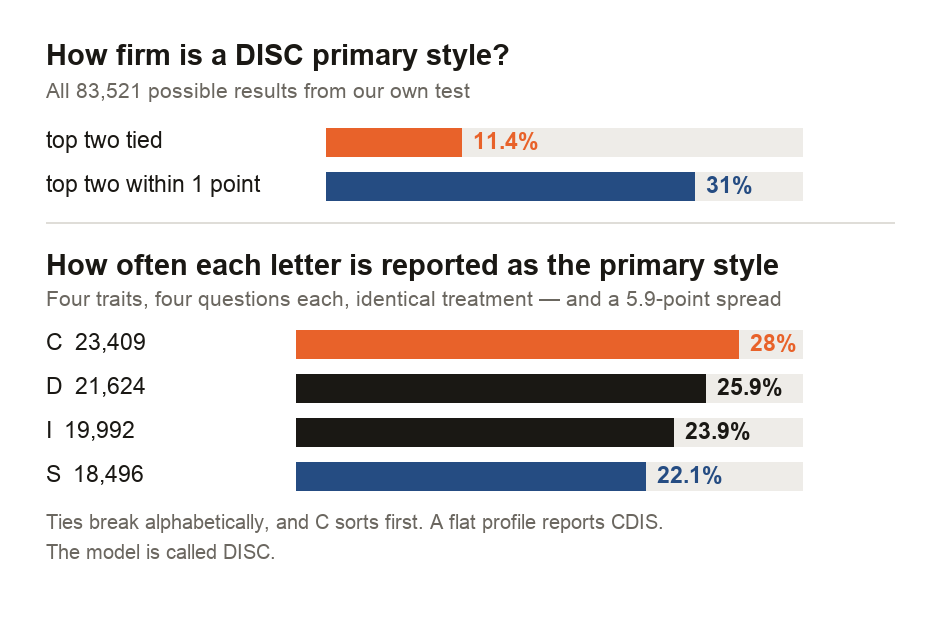
Across the space, the top two traits are exactly level in 9,537 score sheets — 11.4%. In those cases, the letter you are given does not reflect a top score — because there is not one. It is just whichever of the tied traits comes first in the alphabet.
Widen it by a single point and the picture changes considerably: in 25,921 score sheets — 31% — the top two traits are within one point of each other. Answer one question one notch differently and the label on the wall changes.
C wins more often than S, and the questions have nothing to do with it
The four traits are treated identically by the instrument: four questions each, same scale, same scoring. Over a space that is symmetric by construction, each should take the primary label a quarter of the time.
They do not.
| Primary style | Score sheets | Share |
|---|---|---|
| C — conscientiousness | 23,409 | 28.0% |
| D — dominance | 21,624 | 25.9% |
| I — influence | 19,992 | 23.9% |
| S — steadiness | 18,496 | 22.1% |
C is reported as the headline style 5.9 percentage points more often than S. Nothing in the questions favours it. The order is alphabetical: conscientiousness, dominance, influence, steadiness — and every tie in the space goes to whichever of the tied traits comes first in that list. Ties are common enough that the effect shows up in the totals.
The flat profile is called C
The clearest example is a score sheet with no preference at all. Answer all 16 questions identically — every "agree", or every "neither agree nor disagree" — and all four traits land on the same score. There are 17 ways to do that, and every one produces the same reading: the traits come back in the order C, D, I, S, and the headline style is C.
The model is called DISC. A profile with no information in it reports CDIS, because that is the alphabet.
Whether there is a shape at all
The label is only half of what DISC is used for. The other half is the shape — high on this, low on that — which is what the team map on the wall is drawing.
A shape needs spread. Across the space, all four traits sit within two points of each other in 991 score sheets and within three points in 2,531. As a share of the whole space those are small — 1.2% and 3% — and that is the honest good news in this piece: most score sheets in the space do have a spread wide enough to draw.
The catch is that our walk of the mathematical space is not a survey of real respondents. A uniform walk counts "all 4s" and "20, 4, 4, 4" as equally likely, and real respondents cluster towards the middle of scales, where spreads are narrower and ties are commoner. So 1.2% is a floor on how often the shape is flat, not an estimate of it. The real figure among actual respondents is higher, and this measurement cannot tell you by how much.
The letters are not stored anywhere
One thing we found while measuring, which is a fault in our own work rather than in DISC. The test's question bank publishes no letter mapping at all. The D, I, S and C come from the kernel taking the first character of each trait's internal name — dominance, influence, steadiness, conscientiousness.
It produces the right letters today, entirely because those internal names happen to be the English words the model is named for. Rename one of them for any ordinary engineering reason and the letters on the page would change with nothing failing anywhere. The kernel's own comment warns about this fallback in as many words. We have left it as it is and written it down here rather than quietly patching it, because a latent fault that is documented is worth more than one that is fixed and forgotten.
Reading a DISC result honestly
Look at the gap between the top two scores before you accept the letter. One point of daylight is not a personality trait; it is the resolution limit of a 16-question instrument. If the top two are level or nearly level, the honest reading is that you are somewhere between two styles, which is more useful than either label on its own.
And if the four scores are bunched, the instrument has not found a shape. That is a real result. It is just not one that fits on a name badge.
Our companion piece on the Holland Code asks the same instrument family a different question — not whether the headline is firm, but how much of a three-letter code is decided by the alphabet after the first letter is settled. The broader case — that every scored questionnaire with a threshold behaves this way — is made in why your personality result changes when you retake it, and our Big Five explainer covers the model that reports dimensions rather than a label, which sidesteps the problem entirely.
Before you accept a letter, look at the distance between your top two scores. Across all 83,521 possible results the top two are exactly level in 11.4% and within a single point in 31%, which means a third of the space would be relabelled by one answer on a different day. The tie-break does the rest: C is reported as the primary style 28% of the time against S's 22.1%, on four traits the questions treat identically. A profile with nothing in it comes back as CDIS.
- Produced by
measure-disc.cjs, committed with this guide. It enumerates all 174 = 83,521 score vectors and ranks each withrankedOrderandtopCodeloaded from the shipped personality kernel — the code the live test runs, not a copy of it. - The instrument's shape (4 traits, 4 items each, a 1–5 scale) is read from the test's own question bank, so the measurement follows the test.
- ⚠️ Counts SCORE SHEETS, each once, which treats every combination as equally likely. Real respondents are not uniform and cluster mid-scale, where ties are commoner. Every figure here is a property of the space, and the flat-profile shares in particular are floors rather than estimates. None of it may be read as a frequency among people.
- A control is asserted before counting: the alphabetically-first trait must take more primaries than an even quarter share, or the run stops rather than describe a tie-break that is not behaving as this guide says it does.
RECATOOLS publishes the DISC test examined here. This guide reports properties of our own instrument, including an unfixed weakness in how its letters are derived. The scoring arithmetic is correct.

View author profile → · Editorial policy