
"What's your attachment style?" has quietly become a second-date question, usually with anxious and avoidant already tossed around as shorthand for a partner who clings or a partner who bolts. Underneath the pop-psychology gloss is a deep research literature that the Enneagram and Myers-Briggs cannot claim, starting with lab observations of toddlers and growing into one of the most-studied ideas in relationship science.
This guide walks through where the idea came from, what the four styles actually describe, and what the research does and does not let you say about them. We host the interactive test, but the point here is the map, not the quiz.
Start here. Attachment styles describe tendencies and patterns, not a diagnosis, a disorder, or a fixed identity. The research treats attachment as something that varies in degree — how much anxiety, how much avoidance — rather than a box you get permanently sorted into, and it shows those patterns can shift over a life. Nothing here is a clinical assessment or a substitute for professional support. This guide is not a substitute for professional support. If relationship patterns are causing you distress, a licensed therapist or counsellor is the proper resource, not an online quiz. Read any result, ours included, as a prompt for reflection rather than a verdict on you.
Where the idea started: babies, not daters
Attachment theory did not begin with romance. It began with the British psychiatrist John Bowlby, who argued in Attachment and Loss (Vol. 1, 1969) that the bond between an infant and a caregiver is an evolved behavioural system rather than a byproduct of feeding. Infants who kept a responsive caregiver nearby were, over evolutionary time, more likely to survive; the caregiver becomes what Bowlby called a "secure base" from which the child ventures out to explore and returns for comfort. That two-way rhythm — go out, come back, go out again — is the seed of everything that followed.
Bowlby's collaborator Mary Ainsworth turned the theory into something you could measure. Her Strange Situation, developed in the 1970s and written up in full in 1978, is a standardised lab procedure that watches infants of roughly nine to eighteen months through a scripted sequence of mild stress: a caregiver leaves, a stranger appears, the caregiver returns. What the child does at reunion turned out to be the tell. Ainsworth sorted the babies into three patterns. Secure infants explore happily with the caregiver present, may be upset at separation, and are readily settled at reunion before going back to play. Avoidant infants show little distress and pointedly ignore the caregiver when she returns. Resistant, or ambivalent, infants are wary throughout, very distressed at separation, and then torn at reunion — reaching for contact while squirming away from it.
A fourth category came later. Working with cases that fit none of Ainsworth's three cleanly, Mary Main and Judith Solomon described disorganized attachment in the 1980s — infants whose behaviour lacked a coherent strategy, sometimes freezing or approaching the caregiver with apprehension. Keep that word parked, because it trips people up once they jump to adults. Disorganized is an infant category, measured in the Strange Situation. It is not the same thing as the adult "fearful-avoidant" style you'll meet below, even though the two share a lineage.
The jump to adults, and the two dimensions underneath
The move from nursery to bedroom happened in 1987, when Cindy Hazan and Phillip Shaver asked whether adult romantic love runs on the same machinery as infant attachment. Their answer, in the paper that launched the whole adult-attachment field, described romantic love as "a biosocial process by which affectional bonds are formed between adult lovers, just as … between infants and their parents." They wrote three short self-descriptions matching Ainsworth's three infant patterns and asked adults to pick the one that fit. In their original sample, roughly 60 percent called themselves secure, about 20 percent avoidant, and about 20 percent anxious — figures worth reading as one study's numbers, not a law of nature, since distributions move around by sample and setting.
The three-way scheme had a blind spot, though. It lumped together two very different kinds of avoidance: people who keep their distance because they prefer independence, and people who want closeness but are frightened of it. In 1991 Kim Bartholomew and Leonard Horowitz split them apart with a cleaner structure. Instead of three types, they proposed four, defined by the intersection of two underlying dimensions: how positive your working model of yourself is, and how positive your model of others is. Cross those two axes and you get four cells rather than a line.
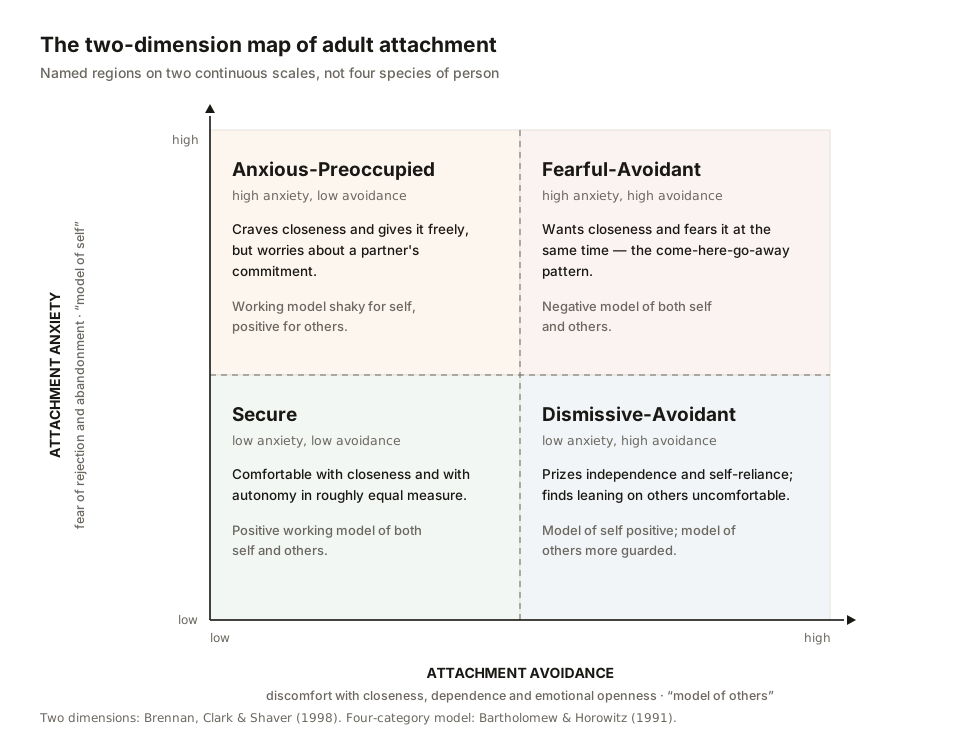
That two-dimensional insight is the load-bearing part of the modern theory and the basis for our test's scores. A few years later Kelly Brennan, Catherine Clark and Phillip Shaver (1998) factor-analysed nearly every English-language attachment questionnaire in existence and found they collapsed onto two roughly independent dimensions: attachment anxiety (fear of rejection and abandonment, a shaky sense of your own worth in relationships) and attachment avoidance (discomfort with closeness, dependence and emotional openness). Their instrument, the 36-item Experiences in Close Relationships scale, or ECR, became the field's workhorse, later refined into the ECR-R. Bartholomew's "model of self" maps onto anxiety and "model of others" onto avoidance — so the four-category picture and the two-dimension picture are the same map drawn two ways.
The four styles, in plain terms
The honest way to hold these labels is as named regions on two continuous scales, not as four species of person. Most people are a blend, sitting somewhere on each dial rather than parked in a corner. With that hedge firmly in place, the four regions the research describes look like this.
- Secure (low anxiety, low avoidance). Comfortable with closeness and with autonomy in roughly equal measure. Tends to trust partners, handle conflict without spiralling into catastrophe, and recover from separation without much fuss. A positive working model of both self and others.
- Anxious-Preoccupied (high anxiety, low avoidance). This style craves closeness and gives it freely, but worries about a partner's commitment and reads ambiguity as a warning sign. Any hint of rejection lands hard. The working model is shaky for self, positive for others.
- Dismissive-Avoidant (low anxiety, high avoidance). Someone with this style prizes independence and self-reliance, tends to downplay the importance of close relationships, and finds leaning on others uncomfortable. Their model of self is positive; their model of others, more guarded.
- Fearful-Avoidant (high anxiety, high avoidance). Wants closeness and fears it at the same time — the come-here-go-away pattern, drawn to connection but braced for it to hurt. A negative model of both self and others. This is the style Hazan and Shaver's three-way scheme couldn't separate out from ordinary avoidance.
Our attachment style test is built on exactly this structure. It is a 16-item original RECATOOLS question set — eight items each for anxiety and avoidance — that scores where you fall on the two dimensions and reports the resulting quadrant as one of these four styles. It runs entirely in your browser, free and without a sign-up. Two caveats: this is our own reflection tool, not the clinical ECR-R, and like any self-report it is a snapshot of how you answered today, not a fixed reading of who you are.
Why "styles" is shorthand, not a set of boxes
This argument will be familiar to anyone who has read our guide on the Big Five, where the same question comes up. Personality research favours the continuous Big Five over the discrete sixteen types of Myers-Briggs, for the simple reason that people do not actually cluster into neat categories — they spread out along scales. Adult attachment ran into the identical question, and the data gave the identical answer.
When Fraley and Waller (1998) applied taxometric methods — statistical tests for whether a trait comes in genuine categories or continuous grades — romantic attachment failed the test for categories and fit a dimensional model instead. As Fraley's University of Illinois overview puts it, most researchers now conceptualise attachment "dimensionally rather than categorically," assuming the patterns "vary in degree rather than kind." The four style names stay useful — "anxious-preoccupied" is easier to say than "high on anxiety, low on avoidance" — but they are labels for corners of a two-dimensional space, not four natural kinds. Someone can sit near the middle, or just over a line, and a quiz that hands back a single word quietly rounds all of that off.
The parts most explainers skip
Attachment writing online tends to stop at the four styles, as if naming yours were the end of the story. The research is more interesting, and more forgiving, than that.
It is moderately stable, not fixed. Fraley's 2002 meta-analysis found attachment security is fairly consistent from infancy into early adulthood — real stability, but not a locked setting. The best models describe an early "prototype" that persists in the background yet gets revised by later experience. In Fraley's own framing, a person's attachment pattern can change when their relational experiences run contrary to what they expected.
"Earned security" is real, and easy to oversell. Some adults who describe difficult early relationships still reason about them coherently and function securely—a pattern researchers call earned security. Handle it carefully, though: Roisman and colleagues (2002) found that adults who looked "earned-secure" in retrospect were not necessarily insecure as infants when you check the actual early records. The phenomenon is real; the tidy insecure-child-becomes-secure-adult arc is messier than the internet version.
Self-report has limits. Questionnaires like the ECR — and any online quiz, ours included — rely on how well you can see and describe yourself, and interview-based or behavioural measures don't always agree with them. Treat a quiz result as a mirror held at one angle, not a scan.
It is somewhat relationship-specific. Attachment is not one global setting stamped across your whole life. How securely you relate to a parent and to a romantic partner correlate only modestly, and people can be more secure in one relationship than in another. A single label for "your" attachment flattens that.
What the research actually predicts
This is where it is easiest to overclaim, so read the verbs carefully. Attachment security is associated with — not "causes," not "guarantees" — better relationship satisfaction, more constructive handling of conflict, and a stronger sense of connectedness. The large-scale evidence comes from Li and Chan's 2012 meta-analysis of 73 studies and 21,602 people. It found both anxiety and avoidance related to lower romantic relationship quality, but in different flavours — avoidance was tied more strongly to lower satisfaction, anxiety more to conflict. A later meta-analysis (Candel and Turliuc, 2019) found the links hold at the partner level too — your attachment tends to predict a little of your partner's satisfaction, not only your own.
The crucial caveat is the size of these effects. They are modest, the data are correlational, and the outcomes are probabilistic, measured across populations. Nobody is doomed by a style, and nobody is guaranteed a happy relationship by one. To poke at the relational side from other angles, our love compatibility calculator and emotional intelligence test are lighter companion tools — reflection prompts in the same spirit, not measurements of fate.
Does attachment look the same across cultures?
Broadly yes, with honest asterisks. The classic evidence is van IJzendoorn and Kroonenberg's 1988 meta-analysis of 32 Strange-Situation samples across eight countries, which found the same secure-majority shape recurring rather than a purely Western artefact, with a global average around two-thirds secure. But distributions shift by culture — one North German sample leaned more avoidant, a Japanese sample more resistant — and, tellingly, the variation within cultures was larger than the variation between them, by roughly half again. Culture nudges the mix; individual differences still dominate. The authors also flagged that non-Western regions were under-represented, and that remains true: East and Southeast Asian samples are comparatively thin, and there's an active debate about whether Strange-Situation coding travels perfectly to cultures that prize emotional restraint or interdependence, where behaviour scored as "avoidant" may mean something different. Worth knowing, not worth over-reading.
Which of our tools to try
All of these run free, need no account, and score in your browser. Pick by the question you're actually asking.
- To place yourself on the two dimensions, the attachment style test is the main event — 16 items scoring anxiety and avoidance into one of the four styles.
- To think about how you like to give and receive care, our appreciation styles test works a related, friendlier angle.
- To reflect on a specific pairing, the love compatibility calculator is a conversation starter, not a prophecy.
- To look at how you notice and manage emotion, the emotional intelligence test covers adjacent ground.
As we said at the start, none of these tools is a diagnosis, and none is therapy. None of these is a diagnosis, and none is therapy. A style is a description of tendencies that can and do change, not a label stamped on your file or a forecast of how your relationships will go. If attachment patterns are genuinely hurting your relationships, that is exactly the situation a licensed therapist or counsellor is trained for — and it is the one thing a quiz can never do for you.
FAQ
Is my attachment style fixed for life?
No. The research treats attachment as moderately stable rather than permanent. Early patterns tend to persist as a kind of default, but they can be revised by relationships that don't match your expectations, and "earned security" — moving toward secure functioning after a rocky start — is a documented pattern. A result is a snapshot, not a life sentence.
What are the four attachment styles?
Secure (comfortable with both closeness and independence), anxious-preoccupied (craves closeness, worries about rejection), dismissive-avoidant (values independence, keeps distance), and fearful-avoidant (wants closeness but fears it). They sit at the corners of two continuous dimensions — attachment anxiety and attachment avoidance — so most people are a blend rather than a pure type.
Is the attachment style test the same as the clinical ECR-R?
No. Our attachment style test is an original 16-item RECATOOLS question set that scores the same two dimensions the academic model uses — anxiety and avoidance — and reports one of the four styles. It is a reflection tool, not the clinical Experiences in Close Relationships scale, and not a diagnostic instrument.
Does knowing my style tell me if my relationship will last?
No. Attachment security is associated with better relationship satisfaction and conflict handling in large studies, but the effects are modest, correlational, and measured across populations. It describes tendencies, not outcomes for any individual couple. No style dooms a relationship and none guarantees one.
Which of your tools should I try first?
Start with the attachment style test to place yourself on the two dimensions. From there, the appreciation styles test and emotional intelligence test explore related ground, and the love compatibility calculator is a light way to reflect on a specific pairing. All are free and scored in your browser.
- Bowlby, J. (1969). Attachment and Loss, Vol. 1: Attachment. London: Hogarth Press (accessed 25 Jul 2026)
- Ainsworth, M. D. S., Blehar, M., Waters, E., & Wall, S. (1978). Patterns of Attachment. Hillsdale, NJ: Erlbaum (accessed 25 Jul 2026)
- Main, M., & Solomon, J. (1990). "Procedures for identifying infants as disorganized/disoriented during the Ainsworth Strange Situation." In Attachment in the Preschool Years. University of Chicago Press (accessed 25 Jul 2026)
- Hazan, C., & Shaver, P. (1987). "Romantic love conceptualized as an attachment process." Journal of Personality and Social Psychology, 52(3), 511–524 (accessed 25 Jul 2026)
- Bartholomew, K., & Horowitz, L. M. (1991). "Attachment styles among young adults: A test of a four-category model." Journal of Personality and Social Psychology, 61(2), 226–244 (accessed 25 Jul 2026)
- Brennan, K. A., Clark, C. L., & Shaver, P. R. (1998). "Self-report measurement of adult romantic attachment." In Attachment Theory and Close Relationships. Guilford (accessed 25 Jul 2026)
- Fraley, R. C., Waller, N. G., & Brennan, K. A. (2000). "An item-response theory analysis of self-report measures of adult attachment." Journal of Personality and Social Psychology, 78(2), 350–365 (accessed 25 Jul 2026)
- Fraley, R. C., & Waller, N. G. (1998). "Adult attachment patterns: A test of the typological model." In Attachment Theory and Close Relationships. Guilford (accessed 25 Jul 2026)
- Fraley, R. C. (2002). "Attachment stability from infancy to adulthood: Meta-analysis and dynamic modeling." Personality and Social Psychology Review, 6(2), 123–151 (accessed 25 Jul 2026)
- Roisman, G. I., Padrón, E., Sroufe, L. A., & Egeland, B. (2002). "Earned-secure attachment status in retrospect and prospect." Child Development, 73(4), 1204–1219 (accessed 25 Jul 2026)
- Li, T., & Chan, D. K.-S. (2012). "How anxious and avoidant attachment affect romantic relationship quality differently: A meta-analytic review." European Journal of Social Psychology, 42(4), 406–419 (accessed 25 Jul 2026)
- Candel, O.-S., & Turliuc, M. N. (2019). "Insecure attachment and relationship satisfaction: A meta-analysis of actor and partner associations." Personality and Individual Differences, 147, 190–199 (accessed 25 Jul 2026)
- van IJzendoorn, M. H., & Kroonenberg, P. M. (1988). "Cross-cultural patterns of attachment: A meta-analysis of the Strange Situation." Child Development, 59(1), 147–156 (accessed 25 Jul 2026)
- Fraley, R. C. "A Brief Overview of Adult Attachment Theory and Research." University of Illinois (accessed 25 Jul 2026)

View author profile → · Editorial policy