
You finish a career-interest test and it hands you three letters. ACE, say. The page tells you what they mean, and the letters feel like a finding the answers revealed about you. The first letter often is. The third, frequently, is the alphabet.
We publish one of these tests, so we could take the question apart properly rather than argue about it. Our Holland Code career test asks 24 questions, four for each of the six RIASEC interests, on a five-point scale. That gives every interest a score between 4 and 20, and the code is the top three in order. The whole space of possible score sheets is 24,137,569 combinations, and it is small enough to walk end to end.
So we walked it.
Where the third letter comes from
Ranking six numbers is only unambiguous while they differ. When two are equal, something has to break the tie, and the code that ships breaks it alphabetically — conventional before enterprising, artistic before investigative. The kernel that does the ranking says so in its own comments, and calls a six-way tie "a disclosed consequence and not a meaningful result".
That is honest, and it is buried in source code where no reader will ever meet it. On the page you get three letters and an explanation of what they say about you.
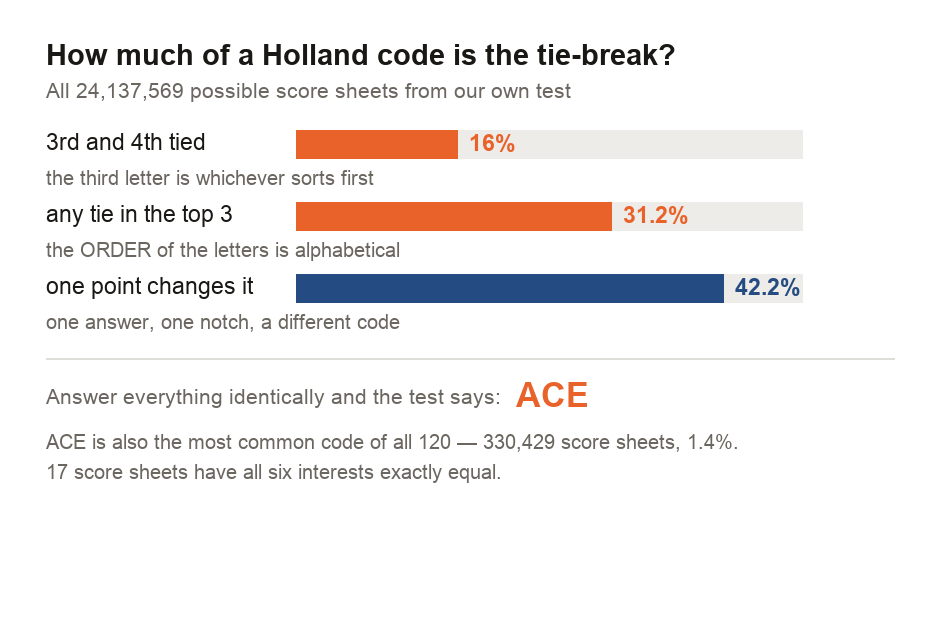
Across the whole space, the third and fourth interests are exactly level in 3,865,409 of the 24,137,569 score sheets — 16%. In every one of those, the third letter of the code is the one that sorts first, and the interest it beat is sitting on precisely the same score.
The order is softer than the letters
A Holland code is read as a ranking. First letter dominant, second supporting, third present. That reading assumes the three scores are clearly ordered, but often they are not. Somewhere inside the top three, two interests tie in 7,523,809 score sheets, or 31.2% of the space. Nearly a third of the time, at least one adjacent pair in your code could be swapped without contradicting a single answer you gave.
The letters are still yours. Their sequence, in those cases, is the sorting rule's.
One answer, one point
A more practical measure is how little it takes to change the result. If the gap between your third and fourth interests is a single point, then one question answered "would enjoy" instead of "neutral" moves a different letter into your code.
That describes 10,197,889 score sheets — 42.2% of the space. This is not a tie or an error. It is a result that a normal amount of day-to-day variation would flip. Anyone who has taken a questionnaire twice in different moods knows the size of that variation.
ACE, and why it is the most common code
Answer all 24 questions identically — every one "neutral", or every one "would strongly enjoy" — and all six interests land on the same score. There are 17 ways to do that, one for each point on the scale from 4 to 20, and every one of them produces the same code: ACE.
Artistic, Conventional, Enterprising. The first three interests alphabetically, from a score sheet that expressed no preference whatsoever. It reads like a result. It is a sorting rule with nothing to sort.
That is not a rounding curiosity. ACE is the single most common code in the whole space — 330,429 score sheets, 1.4% of all of them, ahead of every other combination. All 120 possible codes do occur, so the test is not collapsing; it is that ties pile up on the alphabetically early letters, and A, C and E are as early as it gets.
What the numbers do not say
Every score sheet above is counted once. That treats "all sixes" as exactly as likely as any realistic pattern of interests, which it is not — real people answer in shapes, not uniformly at random. So none of these percentages is a claim about how often this happens to people. They describe the instrument's space, which is a different thing and the only thing a walk of the space can honestly measure.
Nor is any of it a fault in the test. RIASEC is a sound framework, the arithmetic is right, and a tie has to be broken somehow — alphabetically is as defensible as any rule and more defensible than most. The problem is the presentation: three letters, delivered with the same confidence whether they were won by four points or by the letter C sorting before D.
Reading your own code
The useful move is to ignore the letters for a moment and look at the six scores underneath them, which our test shows you.
If your top three sit clearly above the other three, the code is doing real work and the order means what it appears to mean. If the third and fourth are within a point or two of each other, treat the third letter as a coin landing rather than a finding — and look at the interest that just missed, because on your answers it is as strong. If all six are bunched, the honest reading is that this instrument did not find a preference, which is itself worth knowing and is not what a three-letter code communicates.
The same caution applies to any ranked profile, including the four-letter kind. Our companion piece on DISC takes the same instrument apart from the other end, asking not about the last letter but about whether the profile has a shape at all. And if you have ever taken one of these twice and got a different answer, why your personality result changes when you retake it makes the general version of the argument: every threshold in every scored questionnaire does this.
A Holland code presents three letters as a firm ranking. Our own test's numbers show how soft that ranking can be: the third and fourth interests tie in 16% of score sheets, some pair inside the top three ties in 31.2%, and 42.2% would report a different code if one answer moved a single point. Answer everything identically and you are told you are an ACE, which is the alphabet rather than a result. Read the six scores instead, and treat the gap between third and fourth as the measure of how much the last letter is worth.
- Every figure is produced by
measure-holland.cjs, committed with this guide. It enumerates all 176 = 24,137,569 score vectors and ranks each one usingrankedOrderandtopCodeloaded from the shipped personality kernel — the same code the live test runs, not a reimplementation of it. - The instrument's shape (6 interests, 4 items each, a 1–5 scale) is read from the test's own question bank rather than typed in, so the measurement follows the test if the test changes.
- ⚠️ Counts SCORE SHEETS, each once. That treats every combination as equally likely, which real respondents are not. These are properties of the space and must not be read as frequencies among people.
- The tie-break rule is asserted before anything is counted: a six-way tie must produce the first three interests alphabetically, or the measurement stops rather than describing a test that no longer works the way it is described here.
RECATOOLS publishes the career-interest test examined here. This guide reports a property of our own instrument; nothing in it says the test is wrong, and the arithmetic it performs is correct.

View author profile → · Editorial policy