
Spend any time in coaching, small-group ministry, or the corner of social media where people trade four-digit self-descriptions, and you will meet the Enneagram. Someone will tell you they are a Type 2, or an Eight with a Nine wing, and mean something specific by it. The system sorts people into nine personality types drawn on a nine-pointed figure, and over the last few decades it has spread through workplaces, churches, and therapy-adjacent coaching faster than almost any other typology.
It also arrives wrapped in mysticism—talk of ancient Sufi masters, sacred geometry, and hidden lineages stretching to Pythagoras. This guide sets that aside. It explains the nine types and the machinery around them plainly, tells the real and fairly recent story of where the model came from, and then does the harder thing and looks honestly at what the research actually shows. The Enneagram is a rich mirror for self-reflection and a weak scientific instrument.
One caveat before the types. Reading a type description that fits you is a strange feeling, and it is easy to mistake that click of recognition for proof. A type is a lens, not a diagnosis or a cage. Plenty of people never settle firmly on one number, most of us show shades of several, and none of this is a substitute for professional support if you need it. Treat any result, ours included, as a starting point for thinking rather than a verdict about who you are.
The nine types, plainly
Each type is built around a core motivation, usually framed as a driving fear and a matching desire, rather than a surface behaviour. That motivational focus is part of what people find compelling about it, since two people can act the same way for very different reasons. The names below follow the Riso-Hudson convention used by the Enneagram Institute, the most widely adopted labelling; the narrative tradition of Palmer and Daniels attaches slightly different names, which is why most types carry two.
- Type 1, the Reformer or Perfectionist. Principled and self-disciplined, wants to be good and get things right, and carries an inner critic that rarely goes quiet.
- Type 2, the Helper or Giver. Warm and attentive, a Two wants to be loved and needed, and can lose track of their own needs in the process.
- Type 3, the Achiever or Performer. Driven and image-aware, wants to be valued and successful, and measures itself against goals and how it is seen.
- Type 4, the Individualist or Romantic. Sensitive and introspective, wants to be authentic and distinct, and is drawn to what feels missing.
- Type 5, the Investigator or Observer. Private and analytical, wants to understand and feel competent, and guards its energy and attention closely.
- Type 6, the Loyalist or Loyal Skeptic. Committed and vigilant, wants security and support, and scans for what could go wrong.
- Type 7, the Enthusiast or Epicure. A Seven is upbeat and exploratory, wants freedom and fresh experience, and stays ahead of pain by keeping options open.
- Type 8, the Challenger or Protector. Assertive and direct, wants control over its own life, and dislikes being vulnerable or controlled by others.
- Type 9, the Peacemaker or Mediator. Easygoing and accommodating, wants inner and outer harmony, and can go along to avoid conflict.
Read those as tendencies, not compartments. The tradition itself says everyone has some access to all nine; the claim is only that one motivation tends to dominate.
How the model fits together
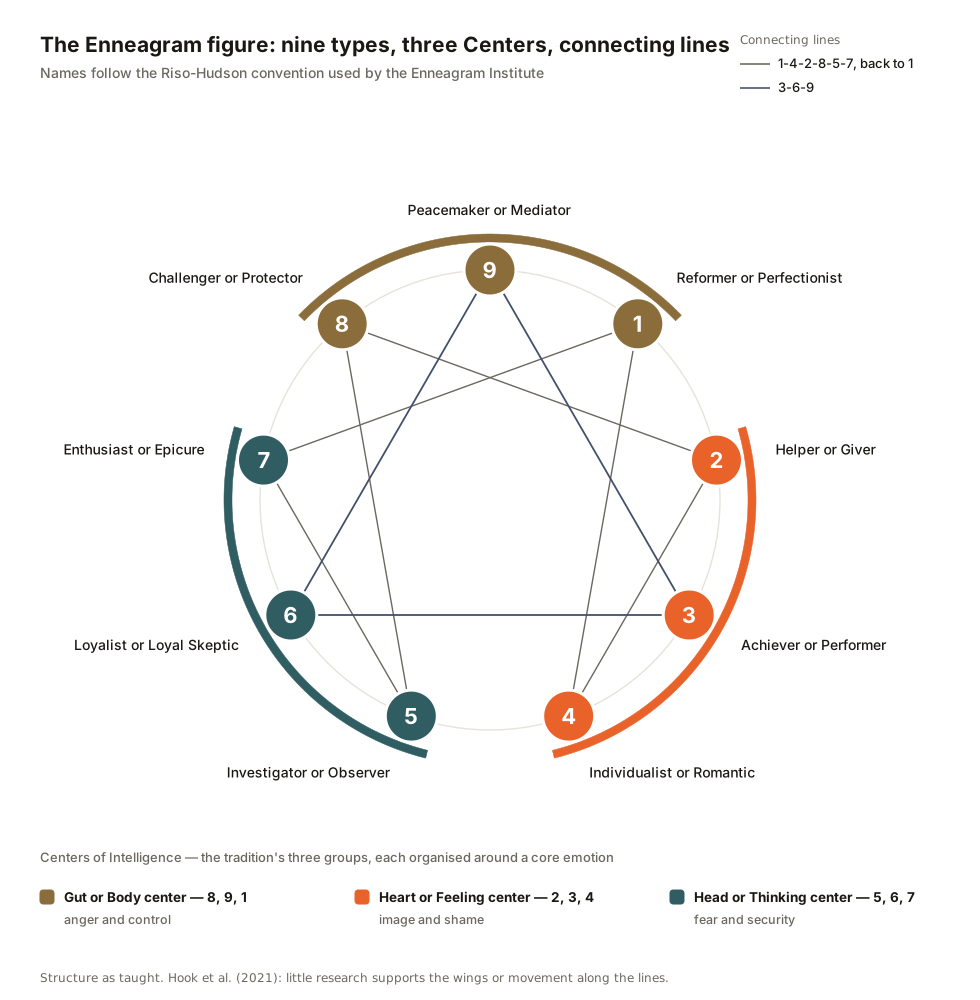
The figure is meant to be more than nine boxes on a wheel, which is why enthusiasts talk in fractions and arrows. Three extra pieces of structure sit on top, and it helps to know them even if you never adopt them.
Wings. Your type is said to be coloured by one of its two neighbours on the circle. A Nine leaning toward One (written 9w1) reads as more orderly and principled; a Nine leaning toward Eight (9w8) reads as more forceful. The wing is meant to explain why two people of the same type can feel quite different.
The connecting lines. Inner lines link each type to two others, and the model reads them as directions of movement. One direction points toward integration or growth, the other toward disintegration or stress. The model claims that in health or under pressure, you take on qualities of the type at the other end of your line. The sequences are fixed: 1-4-2-8-5-7 loops back to 1, and 3-6-9 loops among themselves. Whether people actually move along those paths is, as we will see, the least tested part of the whole system.
The three Centers. The nine types cluster into three groups the tradition calls Centers of Intelligence, each organised around a core emotion. The Gut or Body center (types 8, 9 and 1) is framed around anger and control; the Heart or Feeling center (2, 3 and 4) around image and shame; the Head or Thinking center (5, 6 and 7) around fear and security. This triad is the piece with the clearest inheritance from George Gurdjieff, who taught that people run on three centers of intelligence long before anyone attached nine personality types to the figure.
Where it actually came from
The origin story you will hear at a workshop tends to reach back centuries, to Sufi brotherhoods, the Desert Fathers, or Pythagorean number mysticism. Treat those as contested claims rather than history. Even Integrative9, a major Enneagram training body, concedes there is a gap of nearly six hundred years with no documented use of the symbol in its modern form, and notes that Sufi roots are not common to all Sufi traditions. The honest timeline is much shorter and much better attested.
The nine-pointed symbol itself reached the modern West through George Gurdjieff, the Armenian-Greek teacher who introduced it to his study circles in Moscow and St. Petersburg around 1914 to 1917. He presented it as a universal process diagram and taught it through movement and sacred dance. He did not teach a system of nine personality types; that mapping came later and from someone else.
That someone was Oscar Ichazo, who founded the Arica School in Chile in 1968 and was the first to lay a psychology of ego-fixations, passions and virtues over the figure. His student Claudio Naranjo, a Chilean-born psychiatrist, took the framework to California in the early 1970s and fleshed out the detailed type descriptions most people would recognise today, blending Ichazo's scheme with Gestalt therapy and psychoanalysis. From Naranjo's groups the system spread into Jesuit and other Christian circles, and it was formally codified at the first International Enneagram Conference at Stanford in 1994, which led to the International Enneagram Association. So the model people call ancient is, in its psychological form, younger than the ballpoint pen.
What the evidence says
Now for the evidence. The best single source is Hook and colleagues (2021), a systematic review in the Journal of Clinical Psychology that pulled together 104 independent samples. Their overall conclusion was that the Enneagram literature shows "mixed evidence of reliability and validity". "Mixed evidence" is neither a takedown nor an endorsement.
Start with what does not hold up. When researchers factor-analyse Enneagram questionnaires, looking for how many distinct dimensions the answers really contain, they typically find fewer than nine. No study has used clustering methods to derive the nine types as natural groupings in the data. The secondary machinery fares worst of all: the review found little research supporting the wings and the intertype movement along the lines, the very features that make the diagram feel like a working system. Different questionnaires also disagree with each other about who you are. In one comparison the RHETI and the WEPSS, two of the better-known instruments, agreed on a person's type only about 42 percent of the time. Underneath all this sits a structural problem: to test a questionnaire, you need an agreed-on way to determine a person's "true" type, and the Enneagram has none.
Now the fairer half. The same review found that Enneagram subscales relate to established measures, including the Big Five traits, in ways that match what the theory would predict. Some instruments show reasonable test-retest reliability. Anna Sutton's 2012 review in The Enneagram Journal, written by an advocate surveying the field's own output, is candid that while several Enneagram questionnaires reach reasonable reliability, demonstrating validity is the harder task, and that the pool of rigorous studies is relatively small. When even a sympathetic reviewer says that, it is a fair assessment. The Enneagram is not debunked. It is under-tested, and the parts that have been tested come back mixed.
The contrast that makes this concrete is the Big Five, or five-factor model, which is the framework mainstream personality research actually runs on. The Big Five was built from the ground up out of statistical analysis of how people describe one another, it measures continuous traits rather than sorting people into boxes, and its structure has been reproduced across dozens of languages and cultures. If you want the personality model with the strong scientific pedigree, that is the one, and we cover it in a companion guide: the Big Five, explained. The table below lays the two side by side without stacking the deck.
| Enneagram | Big Five (Five-Factor Model) | |
|---|---|---|
| What it reports | One of nine motivation-based types | Five continuous trait scales |
| Where it comes from | Ichazo (1968) and Naranjo (1970s), on a symbol from Gurdjieff | Lexical studies and factor analysis of trait words |
| Statistical structure | Studies typically find fewer than nine factors | Five factors recovered repeatedly across cultures |
| Used in peer-reviewed personality research | Rarely, and mostly at the margins | The standard model |
Why it stays popular anyway
A model can be a poor measuring instrument but a useful tool for thought, and the Enneagram's staying power comes from that second job. Its descriptions are about motivation, so they name why you do things rather than just cataloguing what you do, and that reads as insight in a way a trait score rarely does. The nine stories are vivid, a little flattering, and easy to see yourself and other people inside. They give couples, teams and small groups a shared vocabulary for talking about friction—valuable, even if the underlying categories aren't scientifically established.
That usefulness travels. The Enneagram rides the same coaching and church networks that carry other self-development frameworks, which is part of why it took off in evangelical communities and in parts of the Asia-Pacific, with a visibly active certification market in South Korea and across the region. That spread is a fact about culture, not a fact about validity, and the two should not be confused. A framework can be useful for reflection without being a validated psychometric test.
Which of our tools to try
All of these run free in your browser, with no sign-up, and none of them is a clinical or diagnostic instrument. Pick by the question you are actually asking.
- Our Enneagram type finder is the natural companion to this guide. It is an original RECATOOLS set of 36 questions, not the trademarked RHETI or any clinical test, and instead of stamping you with a single number it shows your full ranked profile across all nine types, so you can see how strongly each one fits. Read it as a reflection aid, not a validated measurement.
- If you want the type-based format most people know, the 16-type personality test uses the familiar four-letter MBTI-style layout. Like the Enneagram it is a popular typology rather than a research instrument, and the same retest-instability criticisms that dog MBTI apply to it.
- For the scientifically grounded read, take the Big Five personality test. It scores five continuous traits using a validated public-domain item set, and it is the one on this list that matches the model psychologists actually use.
- To look at something narrower and behavioural, our conflict style test maps how you tend to handle disagreement, which is often more useful in the moment than a whole-person label.
FAQ
Is the Enneagram scientifically proven?
No, and it is not fair to call it debunked either. The largest systematic review, Hook et al. (2021), found the evidence for its reliability and validity was mixed across 104 samples. Statistical studies usually turn up fewer than nine factors, no study derives the nine types by clustering, and the wings and arrows are barely tested. Its subscales do correlate with the well-validated Big Five in expected ways, so there is a signal there, just not enough to treat the nine types as an established measurement.
Is the Enneagram actually ancient?
The symbol is old-ish and the personality system is not. The nine-pointed figure reached the modern West through George Gurdjieff around 1914 to 1917, but he taught it as a process diagram, not a set of personality types. Oscar Ichazo first mapped psychology onto it in 1968, and Claudio Naranjo developed the detailed type descriptions in the early 1970s. Claims of Sufi, Desert Father or Pythagorean origins are popular but contested, with no continuous documented lineage.
What are wings and lines?
They are the extra structure the model layers on the nine types. A wing is the influence of one of your two neighbouring types, so a Nine might be a 9w1 or a 9w8. The lines connect each type to two others and are read as directions of growth and stress. Both are central to how the system is taught and are also the parts with the least research support.
Enneagram or Big Five, which should I take?
For a scientifically grounded read, the Big Five personality test is the one, since it uses continuous, validated trait scales that mainstream research relies on. For a motivation-focused prompt to reflect on, the Enneagram type finder is engaging and often insightful, as long as you treat the result as a mirror rather than a measurement. Many people find it worthwhile to try both.
- Hook, J. N., Hall, T. W., Davis, D. E., Van Tongeren, D. R., & Conner, M. (2021). "The Enneagram: A systematic review of the literature and directions for future research." Journal of Clinical Psychology, 77(4), 865–883. DOI 10.1002/jclp.23097 (accessed 25 Jul 2026)
- Sutton, A. (2012). "But Is It Real? A Review of Research on the Enneagram." The Enneagram Journal (International Enneagram Association) — advocate review reporting Dameyer (2001) and Newgent et al. (2004) (accessed 25 Jul 2026)
- Integrative9 — "A Short and Comprehensive History of the Enneagram's Origins," integrative9.com/enneagram/history (accessed 25 Jul 2026)
- The Enneagram Institute — "The Traditional Enneagram," enneagraminstitute.com — Riso-Hudson type names and structure (accessed 25 Jul 2026)

View author profile → · Editorial policy