Almost every business article about 孫子兵法 quotes the same sentence, and quotes it wrong. The line is 知彼知己,百戰不殆 — know the other and know yourself, and in a hundred engagements you will not be endangered. It is routinely rendered as "a hundred battles, a hundred victories," which is a different phrase, 百戰百勝. That phrase does appear in the same chapter, two lines earlier, where Sun Tzu uses it as the example of what good generalship is not: 百戰百勝,非善之善者也.
The book's most-quoted sentence, then, is habitually fused with the very idea it was written to reject. This small error points to the whole problem. A text that everyone cites but nobody reads becomes a mirror, reflecting whatever ideas the reader brings to it.
This piece tries the opposite. It works from the Chinese, sets traditional and simplified side by side, and tests the text against something specific — the capital war among AI labs as it stands in July 2026. Not because ancient wisdom is eternal, but because one chapter of 孫子兵法 turns out to be about exactly the thing that is happening, and it is the chapter that business writing never quotes.
It is an argument, not a reference. If you want the text itself — the thirteen chapters and the thirty-six stratagems, each with the Chinese, the pinyin and its origin — that is being built out separately at our Art of War hub, and it is the better place to start if you have not read the work.
A document with an excavation date
First, let’s be clear about the document itself. 孫子兵法 is not timeless wisdom; it’s a physical text with a manuscript history and a specific excavation date.
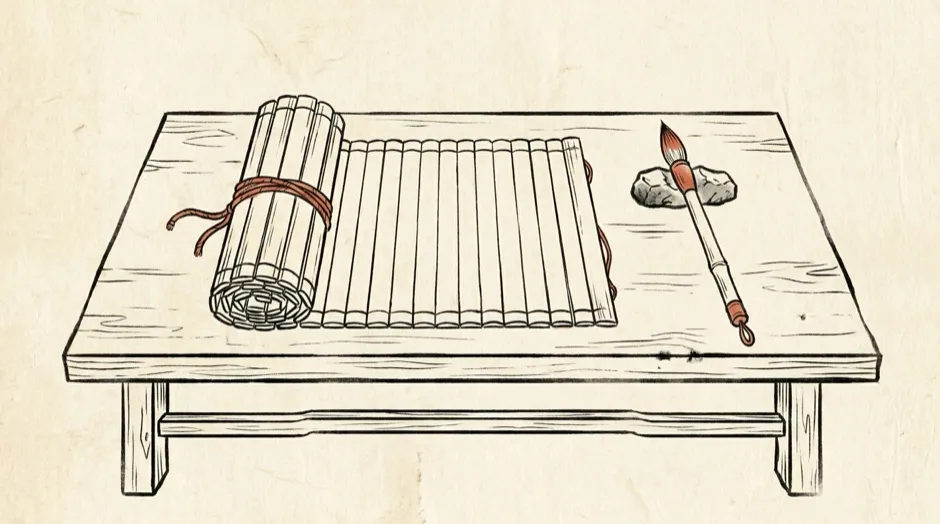
In April 1972, at Yinqueshan (銀雀山) in Linyi, Shandong, an early Western Han tomb yielded 4,942 whole and fragmentary bamboo slips, written between roughly 140 and 118 BCE. Among them were 《孫子兵法》十三篇 and 《孫臏兵法》十六篇 — recovered as two separate texts. Transcriptions were published in 1975 and reorganised in 1985.
That is a fact about physical objects in a tomb, and it does more work than any aphorism. It means the thirteen-chapter text has a datable transmission, that scholars argue about its readings, and that the received version we quote is one witness among several rather than a voice from the ether.
The separateness matters more than it sounds. Sun Bin's own treatise was lost for over a thousand years, and its disappearance is what allowed a long-running argument that Sun Wu and Sun Bin were one man under two names — that the thirteen chapters and their supposed author had been assembled from a single tradition. Finding both texts in one tomb ended it: two works, two authors. Sun Bin was also a working strategist. His manoeuvre at Guiling in 353 BCE, relieving the siege of Handan by attacking Wei's lightly held capital instead of marching to the defence, survives as the stratagem 围魏救赵 — and its principle is worth carrying into everything below: you do not reinforce the place where the pressure is being applied.

One consequence matters for what follows. Where the witnesses disagree, this guide shows both readings rather than choosing silently. There is one place where that disagreement sits directly under the argument, and it is flagged where it arises.
作戰篇: the chapter nobody quotes
Chapter 2 is called 作戰, and business writing skips it, because it is about logistics and money. It opens by counting the cost of putting an army in the field — chariots, armour, provisions, glue and lacquer for repairs, a thousand pieces of gold a day — and then makes an argument that has nothing to do with tactics.
| 繁體 | 简体 |
|---|---|
| 故兵聞拙速,未睹巧之久也;夫兵久而國利者,未之有也。 | 故兵闻拙速,未睹巧之久也;夫兵久而国利者,未之有也。 |
In war one hears of clumsy speed; one has never seen skilful delay. There has never been a case of a prolonged war benefiting the state.
The claim is economic, not tactical. Sun Tzu is not saying long wars are hard to win. He is saying that the state financing a long war loses whether or not it wins, because the treasury is consumed by the campaign rather than by the outcome. The chapter spends its length on this: 國之貧於師者遠輸 — what impoverishes a state is hauling supplies a long way; 力屈財殫 — strength exhausted, wealth spent. The general who understands war, the chapter concludes, holds the fate of the people and decides whether the state is secure.
Now the 2026 numbers.
And then the assessment that matters most, because it does not come from a market commentator. The Bank for International Settlements — the central banks' central bank — named an AI capital-expenditure bust and a circular-financing collapse among the top three threats to global financial stability in its 2026 Annual Report, alongside sovereign debt fragility.
夫兵久而國利者,未之有也 is a sentence from a bamboo-slip military manual. "Inference revenue cannot grow fast enough at falling prices to service the debt and depreciation on this infrastructure" is the BIS's concern in 2026. They are the same argument. One of them is roughly 2,400 years older.
This mapping is strong, not merely suggestive, because Chapter 2 is not a metaphor about competition. It is a chapter about the arithmetic of sustained expenditure, applied to an activity where the expenditure is the strategy.
因糧於敵, and its exact inverse
The same chapter gives the remedy, and it is not thrift.
| 繁體 | 简体 |
|---|---|
| 善用兵者,役不再籍,糧不三載,取用於國,因糧於敵,故軍食可足也。 | 善用兵者,役不再籍,粮不三载,取用于国,因粮于敌,故军食可足也。 |
| 故智將務食於敵,食敵一鍾,當吾二十鍾。 | 故智将务食于敌,食敌一钟,当吾二十钟。 |
One who is skilled in the use of arms does not conscript twice or haul provisions three times. He takes equipment from home and forages from the enemy, so the army's food is sufficient. … The wise general makes a point of feeding off the enemy: one 鍾 taken from the enemy is worth twenty of one's own.
Twenty to one is a claim about the capital efficiency of appropriation. You do not save by spending less; you save by making someone else's expenditure serve your campaign. That is the open-weight argument stated in the second century BCE, and it is being executed at scale right now.
The later stratagem tradition sharpened this into 借刀杀人 — kill with a borrowed knife. Its point is not treachery but arrangement: some ends are better reached through another party's hand, because it spares your own strength and turns their motives into your instrument. A firm serving customers on weights it did not pay to train is holding a borrowed knife. The stratagem is worth reading precisely because it does not pretend the arrangement is costless — the knife belongs to someone, and they had reasons for lending it.
As of the first half of 2026, four of the five leading open-weight model families come from Chinese labs — DeepSeek, Alibaba's Qwen, Moonshot and Zhipu. DeepSeek V4, released 24 April 2026, anchors the price floor. Qwen ships its most permissive tiers under Apache 2.0. Meanwhile Meta launched a closed frontier line under Meta Superintelligence Labs in April 2026, and its open Llama roadmap is now opaque from outside the company.
Note what that does. The ground on which everyone forages is now largely Chinese-published. A company in Johor or Jakarta building on open weights is, in Sun Tzu's terms, feeding its army from a granary it does not own and cannot audit — which is a real strategic advantage and a real dependency at the same time. The chapter recommends the move without pretending it is free.
There is a sharper reading available, and it cuts the other way. 役不再籍,糧不三載 — do not conscript twice, do not haul provisions three times — is a prohibition on moving the same resources repeatedly and counting the effort each time. Circular financing, where an investment returns to the investor as revenue for the investor's own product, is precisely that: the same capital completing laps, booked once per lap. Sun Tzu's logistics chapter contains a rule against the structure the BIS is worried about.
上兵伐謀,其次伐交
I had assumed, before working through the text, that Sun Tzu treats alliances thinly and that the AI war's partnership layer would fall outside his frame. That was wrong, and the correction is more interesting than the assumption.
| 繁體 | 简体 |
|---|---|
| 故上兵伐謀,其次伐交,其次伐兵,其下攻城。 | 故上兵伐谋,其次伐交,其次伐兵,其下攻城。 |
The highest form of warfare attacks the enemy's plans; next, his alliances; next, his army; the lowest attacks walled cities.
伐交 — attacking alliances — is ranked second of four, above engaging the enemy's forces and far above assaulting fortifications. Sun Tzu does not neglect the diplomatic layer; he ranks it near the top and then declines to elaborate. The fair criticism is that 伐交 is underdeveloped relative to its own ranking, not that it is absent.
And it is the layer the AI war is actually fought on. Microsoft's US$250bn Azure commitment to OpenAI through 2030; Anthropic's US$200bn, five-year, five-gigawatt Google Cloud arrangement; Stargate as a joint venture between OpenAI, SoftBank and Oracle. These are not product decisions. They are the 交 — the alliance structure — and they determine outcomes more directly than any benchmark result.
Sun Tzu ranks 伐交 near the top and then declines to develop it; the tradition developed it elsewhere. The canonical formulation is a stratagem rather than a chapter — 远交近攻, Fan Sui's counsel to King Zhaoxiang of Qin in the third century BCE: stop spending on distant campaigns that win territory you cannot hold, keep the far states friendly, and absorb the near ones methodically. It became the backbone of Qin's unification. As a description of how compute commitments and equity positions are actually being arranged, it is closer to the mark than anything in the thirteen chapters.
Which suggests the benchmark cycle is doing something else. 兵者,詭道也 — war is the way of deception — and 能而示之不能, when able, appear unable. Leaderboards are the visible form: legible, comparable, endlessly reported. Contracts are not. It is worth asking whether an industry that publishes its benchmark scores weekly and its distribution agreements never is telling you where it thinks the contest is.
求之於勢 against 用間: a contradiction worth keeping
Two chapters give contradictory advice about people, and it’s best to leave them in tension.
| 繁體 | 简体 |
|---|---|
| 故善戰者,求之於勢,不責於人,故能擇人而任勢。 | 故善战者,求之于势,不责于人,故能择人而任势。 |
| 相守數年,以爭一日之勝,而愛爵祿百金,不知敵之情者,不仁之至也。 | 相守数年,以争一日之胜,而爱爵禄百金,不知敌之情者,不仁之至也。 |
The skilled seek victory from momentum and do not demand it of individuals, so they can choose the right people and let momentum carry them.
To hold out for years, contending for victory on a single day, and then to grudge rank, rewards and a hundred pieces of gold — remaining ignorant of the enemy's condition — is the height of inhumanity.
Chapter 5 says do not demand victory from individuals; position and momentum decide. Chapter 13 says that after years of campaigning, begrudging the price of knowing your opponent is the worst failure a commander can commit. Both are in the book, and the AI talent market has been arguing about which applies since 2025.
The reported figures need care, because they are themselves a form of display. Sam Altman said publicly that Meta offered OpenAI staff signing bonuses as high as US$100m; Meta's CTO responded that the figure applied to a few very senior people and was structured as stock vesting over years, and one named recipient called the framing inaccurate. The Wall Street Journal reported a package around US$1.5bn over six years for one hire, which Meta called "inaccurate and ridiculous" while not disputing the hire itself. What is well-evidenced is narrower: nine-figure multi-year packages exist for a very small number of researchers, and standard senior compensation at frontier labs runs past US$1m a year.
My reading is that the packages are rational not for the output they buy, but for the knowledge they deny to a competitor. That is closer to 反間 — turning or removing the other side's sources — than to recruitment. It also means Chapter 5 and Chapter 13 are not really in conflict. 不責於人 says individuals will not win it for you; 用間 says knowing your opponent is worth almost any price. Paying enormously for someone who will not personally decide the outcome, in order that they cannot inform the other side, satisfies both.
避實而擊虛: what DeepSeek actually did
| 繁體 | 简体 |
|---|---|
| 夫兵形象水,水之形,避高而趨下;兵之形,避實而擊虛。 | 夫兵形象水,水之形,避高而趋下;兵之形,避实而击虚。 |
Military form is like water: water avoids the heights and runs to the low ground; forces avoid what is solid and strike what is empty.
The consensus reading of the cheap-model shock was that efficient training undermines the capital-expenditure thesis. I think that misses the move. Open-weight families now sit at roughly US$0.20–3.00 per million tokens, commonly five to ten times below frontier proprietary pricing, having largely closed the practical coding and reasoning gap.
The vulnerability that attacks is not capability. It is that an incumbent with an enterprise sales motion cannot match a near-zero price without destroying its own pricing power. That is 虛 in the precise sense: not where the enemy is weak, but where the enemy cannot defend without injuring himself. Efficiency was the weapon; the pricing asymmetry was the wound.
The stratagem for this is 釜底抽薪 — take the firewood from under the pot. Meeting a boiling opponent head-on spends your strength against theirs; remove the fuel and the boiling stops by itself. Frontier pricing was the fuel under the whole apparatus, since it is what services the debt and the depreciation described earlier. You do not have to beat a model to damage the business that ships it.
Where the frame breaks
The frame is only useful if you also test where it breaks. Four points of failure in applying 孫子兵法 to this war are instructive.
There is no victory condition. Sun Tzu assumes bounded conflict — a campaign, a settlement, terms. This has no surrender and no treaty, which means 兵貴勝,不貴久 offers a diagnosis with no available cure. You cannot end a war quickly when there is no mechanism for it to end.
知彼 may be unavailable in principle. The entire framework rests on the knowability of the opponent. Frontier capability is opaque even internally; nobody knows what the next training run produces until it produces it. A doctrine built on reconnaissance struggles where the relevant fact does not yet exist.
No discontinuity. 能因敵變化而取勝者,謂之神 — winning by changing with the enemy — handles gradual adaptation well. It does not contemplate an opponent's capability moving by a step change rather than a gradient.
The terrain legislates back. 地 in Sun Tzu is passive: high ground, marsh, narrow pass. Jurisdiction is ground that writes its own rules. Vietnam enacted the region's first stand-alone AI law, in force March 2026. Malaysia mandates local storage for financial and telecommunications data and has built ILMU with training data resident on domestic sovereign infrastructure. Seven of ten ASEAN member states have enacted or are finalising personal data protection laws — and there is still no ASEAN-wide definition of what data sovereignty means in practice. Ground with a legislature is outside his model entirely.
不可勝在己: the part that concerns you
Most readers of this are not combatants in the capital war. They are terrain it is being fought across. That changes which passage matters.
| 繁體 | 简体 |
|---|---|
| 昔之善戰者,先為不可勝,以待敵之可勝。不可勝在己,可勝在敵。 | 昔之善战者,先为不可胜,以待敌之可胜。不可胜在己,可胜在敌。 |
| 故善戰者之勝也,無智名,無勇功。 | 故善战者之胜也,无智名,无勇功。 |
The skilled warriors of old first made themselves unbeatable, then waited for the enemy to become beatable. Being unbeatable rests with you; being beatable rests with the enemy. … The victories of the skilled bring no reputation for wisdom and no credit for courage.
This is a clean statement of a control boundary, and it sorts the question of what to focus on. Which lab wins is 在敵 — not yours to determine, and not worth planning around. Your own defensibility is 在己, and it is entirely within reach.
There is a stratagem that states the position almost exactly: 以逸待劳 — wait at your ease for the exhausted enemy. Force has a cost that mounts with distance and time; the party that must march spends itself on the march, and the party that chooses the ground spends nothing. Read next to Chapter 2, it is the same argument twice. The labs are marching. You are not required to march with them, and the discipline is to spend the interval making yourself hard to dislodge rather than trying to keep pace with people burning a hundred billion a year to do it.
Three moves follow, and they are deliberately unglamorous:
以迂為直 — take the indirect route. 軍爭之難者,以迂為直 — the difficulty of manoeuvre is making the roundabout way the direct one. Do not build AI capability. Build the data and process discipline that makes any model useful, because that survives every model generation while a fine-tune does not. The company that spent last year cleaning its data schema is better positioned than the one that shipped a chatbot, and it has nothing to show for it. 無智名,無勇功.
因糧於敵 — forage, do not farm. Let the capital war pay for your capability. Open weights at a fraction of frontier pricing, already at practical parity for most commercial work, are provisions someone else hauled. Per-million-token prices only become a budget once you know how many tokens your actual documents contain, which is an arithmetic problem rather than a strategic one — our tokens, words and characters converter will turn a representative sample into a number you can multiply.
兵貴勝,不貴久 — do not enter a long war you have no treasury for. This applies to lock-in as much as to building. A dependency you cannot exit within a budget cycle is a prolonged campaign, and the chapter is unambiguous about how those end for the party financing them. The stratagem literature is blunter still: 上屋抽梯, lure them onto the roof and take away the ladder. Its second sense is the one to watch — people blunder when an easy-looking advance quietly closes behind them. Generous credits, free tiers and migration assistance are the ladder, and nobody announces the moment it is withdrawn. Given that the open-weight ground is largely published from one jurisdiction and your regulator may be writing rules about exactly that, portability is not hygiene. It is 形 — the disposition you adopt before you need it.
A note on method, including where I was wrong
Two witnesses were used for every passage: the 十一家注孫子 text as carried by the Chinese Text Project, and Chinese Wikisource. They disagree in two places that matter.
The first is under the spine of this argument. Chapter 2's opening clause is attested as 其用戰也,貴勝,久則鈍兵挫銳 — in using war, prize victory; prolong it and the troops are blunted — and also as 其用戰也,勝久則鈍兵挫銳, which forces a strained sense of seeking victory through prolongation. This guide follows 貴勝, because it agrees with the chapter's own conclusion at 兵貴勝,不貴久 and with 拙速. Readers should know the choice was made.
The second concerns 于 and 於. The Chinese Text Project's text reads 取用于國,因糧于敵 while giving 務食於敵 in the next sentence; Wikisource reads 於 throughout. My first explanation was that the inconsistency proved a round trip through simplified characters, since simplification merges 於 into 于. I tested it, and it is wrong: converting Wikisource's 於 to simplified and back returns 於 intact, and converting the simplified form to traditional produces 於. A round trip would have manufactured the opposite of what is there. 于 is the older preposition, standard in pre-Qin texts, and its appearance is plausibly genuine rather than corrupt.
The test did show something narrower and more useful. Of sixteen known simplification merges run through traditional → simplified → traditional, fifteen survive perfectly — 皇后 and 之後, 乾坤 and 幹部, 麵條 and 面孔, 鍾情 and 時鐘, 歷史 and 曆法 all return correct. Exactly one fails, and it is 于: a genuine classical 于 comes back silently rewritten as 於.
You can reproduce that in about a minute. Our Chinese converter runs the same OpenCC library used for the test above and highlights every character that changed, so paste 取用於國,因糧於敵 in, convert to simplified, then convert the result back and watch which characters survive the round trip and which quietly do not. So the working rule for a text like this is not the vague warning that conversion loses information. It is specific: never put the traditional column through a converter at all, because the one character it will quietly normalise is the exact character the witnesses disagree about. Derive the simplified column, in that direction, once.
Finally, a limit. The Yinqueshan slips are cited here only for what they establish — the excavation, the dating, and the recovery of 孫子兵法 and 孫臏兵法 as separate texts. No passage-level bamboo-slip variant is claimed anywhere in this guide, because establishing one properly requires a critical edition rather than the freely available transcriptions, and an authoritative-sounding invention would undo the point of the exercise.
Chapter 2 of 孫子兵法 is an argument about the economics of sustained expenditure, and it says that a prolonged campaign impoverishes the party financing it regardless of who wins. In 2026 the BIS reached the same conclusion about AI capital expenditure by a different route. The genuinely useful passages for anyone who is not a frontier lab are 不可勝在己 — your defensibility is yours to determine, the outcome of their war is not — and 以迂為直, which argues for the boring work that survives every model generation. The famous line about knowing your enemy is less useful than either, and is usually misquoted anyway.
- 《孫子兵法·作戰篇》, Chinese Text Project — 十一家注孫子 / 四部叢刊初編本 孫子集注 (accessed 26 Jul 2026)
- 《孫子兵法·謀攻篇》, Chinese Text Project (accessed 26 Jul 2026)
- 《孫子兵法》, 維基文庫 (Chinese Wikisource) — second textual witness (accessed 26 Jul 2026)
- 銀雀山漢簡 — excavation April 1972, tomb 1, 《孫子兵法》十三篇 and 《孫臏兵法》十六篇 recovered as separate texts (accessed 26 Jul 2026)
- Sun Bin's Art of War — the work's loss for over a millennium, the resulting dispute over whether Sun Wu and Sun Bin were one person, and its resolution by the Yinqueshan find (accessed 26 Jul 2026)
- Reporting on the Bank for International Settlements 2026 Annual Report — AI capex bust and circular financing named among top systemic risks (accessed 26 Jul 2026)
- Fortune, "Big Tech's $700 billion AI spending spree has no clear end in sight" (30 April 2026) (accessed 26 Jul 2026)
- Hyperscaler AI capex, depreciation schedules and the projected debt issuance (accessed 26 Jul 2026)
- Open-weight model landscape, H1 2026 — DeepSeek V4 (24 April 2026), Qwen licensing, Meta's closed frontier line (accessed 26 Jul 2026)
- CNBC — Altman on reported US$100m signing bonuses (accessed 26 Jul 2026)
- EY Singapore — sovereign AI in Southeast Asia (accessed 26 Jul 2026)
- ASEAN AI sovereignty — Vietnam's stand-alone AI law (in force March 2026), Malaysia's ILMU and local storage mandates (accessed 26 Jul 2026)