

This is the third piece I have written about Forward Deployed Engineers, and it is the one I was most reluctant to start. The two before it had arguments. This one is the explainer — what the job is, why the demand arrived so suddenly — and there are already a dozen of those, most written by firms that sell forward deployed engineering.
So I have written it differently. Everything below the definition is an audit. I took the numbers this subject repeats most and tried to trace each one back to a primary source. Two hold up completely. One is arithmetically correct and misread almost everywhere it appears. Two have no traceable origin at all. And the statistic doing the most work, the one that explains why every enterprise suddenly wants one of these people, is the flimsiest of the lot.
What the job is
A Forward Deployed Engineer is embedded inside a customer's organisation, decides which problem is worth solving, builds the production system that solves it, and remains accountable for it afterwards.
The best short definition comes from OpenAI's own May announcement rather than from a recruiter or an explainer. Here is how it described what it was buying:
"embed engineers specialized in frontier AI deployment, known as Forward Deployed Engineers, or FDEs, into organizations working on complex problems in demanding environments. These FDEs will work closely with business leaders, operators, and frontline teams to identify where AI can make the biggest impact, redesign organizational infrastructure and critical workflows around it, and turn those gains into durable systems."
The same document lays out the engagement shape: a diagnostic to locate value, a shortlist of priority workflows picked with the customer's leadership, then engineers inside the organisation designing, building, testing and deploying production systems tied to that customer's own data, tools and controls.
Notice what is missing. There is no handover.
Why it is not the four things people keep calling it
Since the title became fashionable, a great many existing jobs have been relabelled with it. The distinction is sharper than the discourse suggests, and it comes down to a single question.
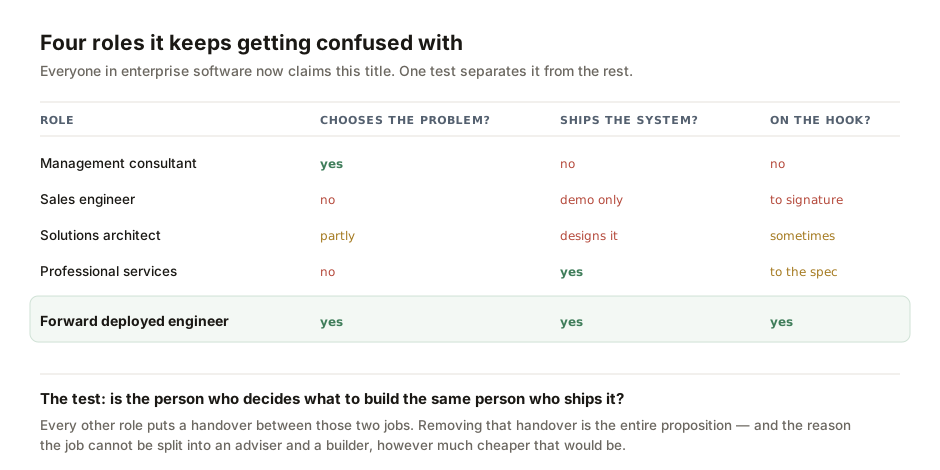
Management consultants diagnose, then leave. Sales engineers demonstrate and hand over at signature. Solutions architects design systems for other people to build. Professional services implements a specification that someone else wrote. All four roles are perfectly respectable — and all four insert a handover between deciding what to build and building it.
Removing that handover is the point. It is also why the job cannot be split into a cheaper adviser plus a cheaper builder, which is the first thing every organisation tries.
What actually happened this year
The verifiable part of the story is dramatic on its own — it doesn't need the contested statistics.
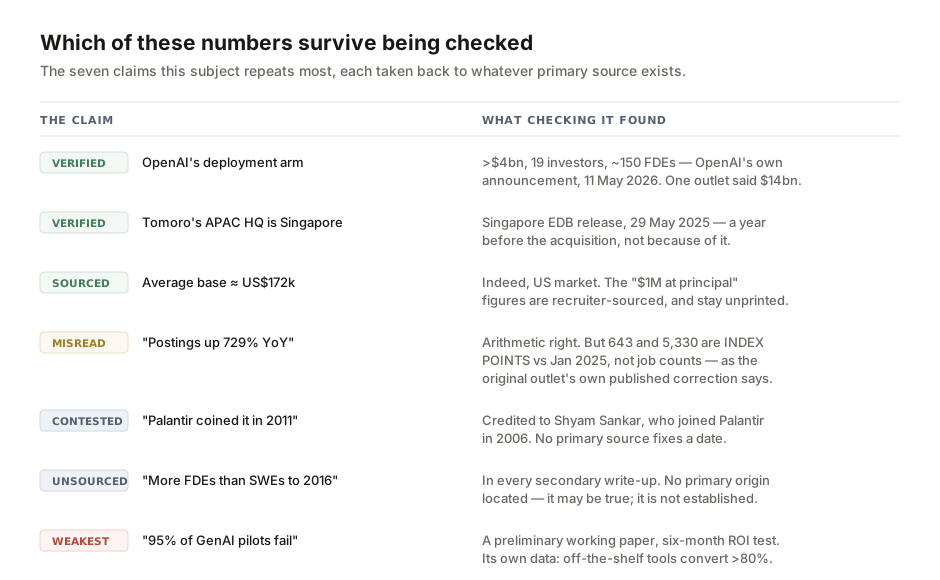
On 11 May 2026, OpenAI announced the OpenAI Deployment Company. Its own announcement says it launches with more than US$4 billion of initial investment, as a partnership between OpenAI and 19 investment firms, consultancies and system integrators — led by TPG, with Advent, Bain Capital and Brookfield as co-lead founding partners, and Bain & Company, Capgemini and McKinsey among the investors. It is majority-owned and controlled by OpenAI. In the same announcement it agreed to acquire Tomoro, an applied AI consultancy, bringing approximately 150 Forward Deployed Engineers and Deployment Specialists from day one.
Read that as a sentence about strategy rather than a press release. The company with the best models in the world spent four billion dollars on the proposition that the models are not the bottleneck. Deployment is.
One correction to my own earlier writing, since it matters for anyone in this region. In the first piece I said Tomoro's APAC headquarters in Singapore meant OpenAI's deployment arm was being built partly out of Southeast Asia. The Singapore facts are right and better documented than I had them — Singapore's Economic Development Board announced the APAC headquarters on 29 May 2025, describing it as Tomoro's "regional command centre", with a plan to recruit 30 or more AI engineers, solution designers and researchers in Singapore within twelve months, and co-founder Albert Phelps relocating from the UK to lead it. But that was a year before the acquisition. OpenAI's deployment arm did not build a Singapore foothold; it inherited one that already existed. Same destination for the reader, arrived at honestly.
Now the numbers
Here is every widely-repeated claim about this job that I could find, and what happened when I went looking for its source. The entry bars behind these figures are also wired into our FDE Readiness Checker, which tells you which of them you clear.
"Job postings are up 729% year on year"
This is the number that launched a thousand LinkedIn posts, and the arithmetic behind it is fine. It comes from Indeed data shared with Business Insider in May.
What the reporting actually says is that in April 2025, postings stood 543% above January 2025 levels, and by April 2026 they stood 5,230% above those same January 2025 levels — which works out at roughly 729% year on year. That calculation checks out: 643 to 5,330 is a factor of 8.3.
But 643 and 5,330 are not job postings. They are index points against a January 2025 baseline. The article carries a published correction at its foot saying exactly that. Secondary write-ups that render this as "postings grew from 643 to 5,330" have converted an index into a headcount, and at least one added a wrong base year on the way through.
The choice of baseline month is also revealing. January 2025 sits immediately before the surge. Anchor an index just before a boom and you will get an enormous percentage, honestly and automatically.
None of which means the growth is fake. It means the growth is an index, and nobody knows from this figure how many forward deployed engineers are actually being hired. For contrast, the same reporting cites AlphaSense finding mentions of "FDE" inside company documents up 17% over six months. That is what an ordinary strong trend looks like standing next to a 729% index move.
Three other growth figures are also in circulation for the same role in the same period: up 1,165% this year, demand up tenfold in eighteen months, and demand quadrupled. They cannot all be true, and none of them traces to a dataset anyone can open.
The salaries
One figure here is properly sourced and one is not. Indeed reports an average base salary of about US$171,911, with a range of roughly US$170,000 to over US$200,000. That is a real number from a real dataset, for the US market.
The exciting figures — total compensation of $385,000 at mid-level rising past a million at principal — come from recruiters and search firms rather than from any filing. I've declined to print them in all three pieces, and I'm naming the omission rather than keeping quiet about it, because an unsourced number that flatters the reader is the one most likely to get repeated.
Where it is checkable, the primary evidence is narrower: Palantir's own posting lists US$135,000–200,000 base, and Anthropic's US$200,000–300,000. Both were read in full for the earlier piece in this series.
The origin story
Almost everything written about this role opens by saying Palantir coined the term around 2011. I cannot substantiate the date. The term and the practice are credited to Shyam Sankar, now Palantir's chief technology officer, who joined the company in 2006 and is described as its first forward deployed engineer. 2011 may be when the title started circulating publicly. It is not, on anything I could find, when the practice began.
The companion claim — that until 2016 Palantir employed more forward deployed engineers than software engineers — appears in essentially every article on the subject, occasionally with the hedge "reportedly". I could not find its origin: no filing, no company statement, no executive interview that I could open. It may well be true. It is not established, and it is quoted as though it were.
And the number holding the whole thing up
Every argument for hiring these people eventually rests on the same statistic: that 95% of enterprise generative AI pilots fail. If that figure were solid, the case for a person who carries a project from diagnosis to production would be overwhelming. So it gets the hardest look of anything here — and it holds up worst.
It comes from a paper by MIT Media Lab's Project NANDA, The State of AI in Business 2025. Four things about the number are rarely mentioned:
- It is a preliminary working paper. Self-described as such. It is not a peer-reviewed study, and it was never presented as one by its authors — only by the people quoting it.
- "Failure" has a narrow definition. Deployment beyond pilot with measurable KPIs and return on investment demonstrated within six months. Efficiency gains, cost reduction, churn and pipeline effects fall outside that test entirely.
- Its own data contradicts the headline. The same report found general-purpose tools — ChatGPT, Copilot and the like — converting from pilot to implementation at above 80%. The finding is that bespoke six-month-ROI builds struggle while off-the-shelf adoption succeeds. That is a very different claim. (Added 31 July 2026, after reading the full PDF: the report is equally clear that those tools "primarily enhance individual productivity, not P&L performance", so adoption succeeding is not the same as value landing. The buyer's piece works through what the paper actually says.)
- The evidence base is modest. Over 300 publicly disclosed initiatives reviewed, 52 organisational interviews, 153 executive surveys gathered at four industry conferences. Reasonable for a working paper. Thin for a number cited as settled fact.
Enterprise AI deployment is hard, and the role is necessary. The job postings are real, the four billion dollars is real, and the problem is real. But the single number used to prove it does not mean what it is used to mean. A field this full of money should be able to make its case without it.
What holds up: the deployment-arm terms from OpenAI's announcement; Singapore's role, a year earlier than implied, from an EDB release; a US salary average from Indeed. What doesn't: the origin date, the Palantir headcount comparison, the compensation bands, and the failure rate that justifies the whole boom. The job-posting growth is real, but it is an index and not a headcount.
The role and the demand are real. The arithmetic around them is a game of telephone, and knowing which parts are load-bearing matters more than any single number.
If you are in ASEAN and wondering whether this matters to you
The regional facts are among the better-documented in this piece, which is unusual. Singapore's EDB put its name to a media release about an AI deployment consultancy choosing Singapore as its regional command centre and committing to thirty-plus specialist hires. That firm is now part of OpenAI's deployment arm. Whatever happens to the growth statistics, that is a concrete regional foothold with a government agency's name attached to it.
What the role demands of you is covered properly in the two companion pieces rather than repeated here: what the job ads actually screen for, which is not what most people assume, and why no course in this region will get you there. If you are weighing the move, read those two. This piece just exists to make sure the numbers underneath them are honest.
Two small pieces of practical advice, since compensation is what most readers came for. The US bands do not transfer to Singapore or Malaysia; run the actual figure through our Singapore take-home salary calculator before you rearrange anything. And if the vocabulary in the job postings is unfamiliar — retrieval, agents, evaluation, context — our AI and LLM glossary defines it in plain English, which is a shorter afternoon than any of the courses charging for the same material.
- OpenAI — OpenAI launches the OpenAI Deployment Company, 11 May 2026, read in full from OpenAI's own site on 31 July 2026. The capital figure, the count of 19 partners, the named lead and co-lead investors, the majority-ownership statement, the ~150 engineer figure and the quoted description of the role are taken from that page. Note that at least one outlet reported the capitalisation as US$14 billion; OpenAI's own page says more than US$4 billion.
- Singapore Economic Development Board — media release on Tomoro AI's APAC headquarters, 29 May 2025. The "regional command centre" wording, the 30+ hiring plan over twelve months and the leadership detail are quoted from it.
- Job-posting growth and salary figures originate with Indeed data shared with Business Insider (Cadie Thompson and Lakshmi Varanasi), reported mid-May 2026 and widely syndicated. The indexed-values clarification is from the published correction carried at the foot of that reporting. The AlphaSense figure on document mentions and the US$171,911 average are as reported by LeadDev and Indeed respectively. Accessed 31 July 2026.
- MIT Media Lab, Project NANDA — The State of AI in Business 2025. The working-paper status, the six-month ROI definition of success, the evidence base of 300+ initiatives, 52 interviews and 153 surveys, and the above-80% conversion rate for general-purpose tools are as reported in coverage and analysis of the paper, accessed 31 July 2026.
- Palantir origin: attribution of the term and the practice to Shyam Sankar, and his 2006 start date, come from biographical and industry accounts. No primary Palantir document fixing either the 2011 date or the claim that FDEs outnumbered software engineers until 2016 could be located, and both are reported here as unverified rather than as fact.
- Salary bands quoted from the Palantir and Anthropic postings were read in full on 31 July 2026 and are cited in the first piece in this series. Disclosure: this guide was drafted with a model made by Anthropic, one of the employers whose posting the series analyses.
Figures are as published on 31 July 2026. Compensation is US-based and does not transfer directly to ASEAN markets. Where a claim could not be traced to a primary source it is labelled as such above rather than omitted, so that readers can weigh it themselves.