

Every pitch you will hear for embedded AI engineering rests on one statistic. Ninety-five per cent of enterprise AI pilots fail. It appears in vendor decks, recruiter posts, conference keynotes and most of the articles written about this job, including two of mine.
So I downloaded the paper and read all twenty-six pages of it.
It is a better document than its reputation suggests, and it contains a complete buyer's playbook that almost nobody quotes. Several of its findings argue against hiring anyone to embed in your company — at least not yet, and not before you have done three cheaper things first. The report says more than its headline lets on.
First, what the 95% is actually about
The paper is MIT NANDA's The GenAI Divide: State of AI in Business 2025. Its front matter describes it as "Preliminary Findings" from a research period of January to June 2025, based on a review of over 300 publicly disclosed AI initiatives, structured interviews with 52 organisations, and 153 senior-leader survey responses gathered at four conferences. Modest, and honest about being modest.
The headline sentence reads: "Despite $30–40 billion in enterprise investment into GenAI, this report uncovers a surprising result in that 95% of organizations are getting zero return."
The surrounding sentences, however, narrow the claim enormously:
"Tools like ChatGPT and Copilot are widely adopted... Meanwhile, enterprise-grade systems, custom or vendor-sold, are being quietly rejected. Sixty percent of organizations evaluated such tools, but only 20 percent reached pilot stage and just 5 percent reached production."
The 95% is about custom and vendor-sold enterprise systems. It is not a statement about artificial intelligence in general, which is very nearly always how it gets used.
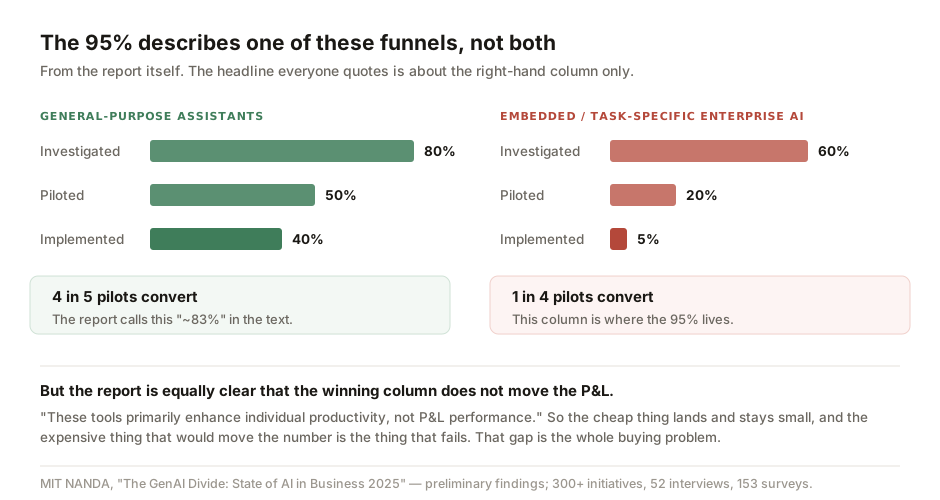
The report's own exhibit puts general-purpose assistants at 80% investigated, 50% piloted and 40% successfully implemented — four pilots in five converting, which the text calls "~83%". The embedded and task-specific column runs 60%, 20%, 5%. One pilot in four.
Now the part that stops this being a straightforward argument for buying the cheap thing, and the qualifier I should have carried in an earlier piece: "But these tools primarily enhance individual productivity, not P&L performance."
So the cheap option lands reliably but stays small, while the expensive one that could move a number is the one that fails. This is the buyer's problem, and no amount of enthusiasm closes the gap.
Buy beats build, two to one — with a caveat the report prints and nobody repeats
One finding belongs in front of any executive weighing an AI budget:
"In our sample, external partnerships with learning-capable, customized tools reached deployment ~67% of the time, compared to ~33% for internally built tools."
The accompanying exhibit gives strategic partnerships 66% of deployments against internal development's 33%, with the hybrid build-buy model marked "Insufficient data to quantify". Elsewhere the paper lists as one of five myths: "The best enterprises are building their own tools → Internal builds fail twice as often." Employee usage rates, it adds, were nearly double for externally built tools.
Directly underneath that exhibit, the authors print this:
Important Limitation: "These success rate differences may reflect organizational capabilities rather than implementation approach alone. Organizations choosing external partnerships may have different risk tolerance, procurement sophistication, or internal technical capacity than those building internally. The correlation between external partnerships and success does not necessarily prove causation."
I have not seen that paragraph reproduced anywhere it is quoted. A piece whose entire argument is "read past the headline" does not then get to hide its own source's caveats, so there it is. In a sample of 52 organisations, buying looks better than building — though some of that advantage probably belongs to the kind of company that chooses to buy.
If you are not an enterprise, you are in the better position
This is the finding most useful to readers in this region, and I have never seen it quoted once.
"Enterprises, defined here as firms with over $100 million in annual revenue, lead in pilot count and allocate more staff to AI-related initiatives. Yet this intensity has not translated into success. These organizations report the lowest rates of pilot-to-scale conversion."
"By contrast, mid-market companies moved faster and more decisively. Top performers reported average timelines of 90 days from pilot to full implementation. Enterprises, by comparison, took nine months or longer."
Ninety days against nine months. The firms with the most money, the most staff and the most pilots convert worst.
If you run a mid-sized manufacturer in Johor or a logistics business in Singapore and you have been reading enterprise AI coverage with a slight sense of being outgunned, the paper's own data says the opposite. Shorter approval chains, fewer systems to integrate with, and the person who understands the workflow sitting two desks from the person who signs the invoice — these are the advantages that cut nine months down to ninety days.
The cheapest demand research you will ever run is already happening
The most practical finding in the report has nothing to do with vendors.
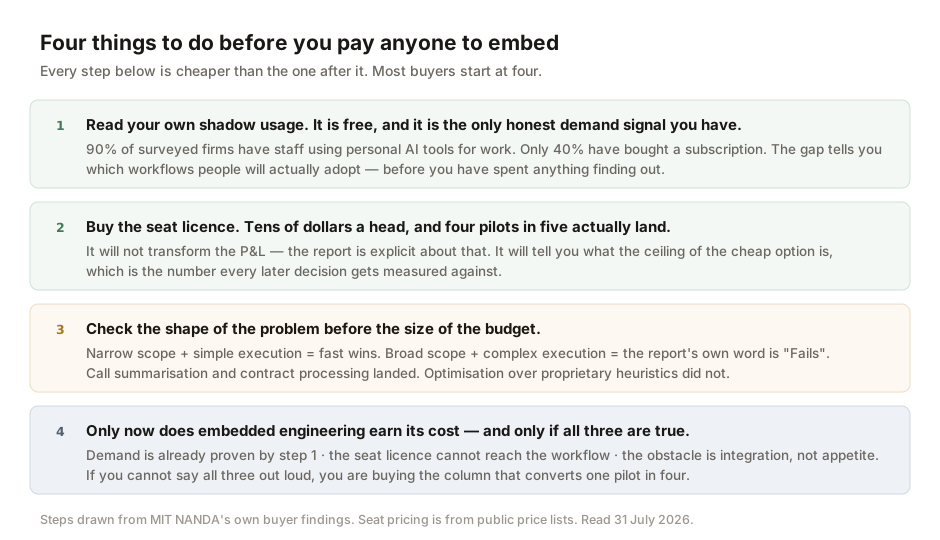
"While only 40% of companies say they purchased an official LLM subscription, workers from over 90% of the companies we surveyed reported regular use of personal AI tools for work tasks. In fact, almost every single person used an LLM in some form for their work."
The report calls this the shadow AI economy, and rather than treating it as a governance problem it treats it as intelligence: "Forward-thinking organizations are beginning to bridge this gap by learning from shadow usage and analyzing which personal tools deliver value before procuring enterprise alternatives."
Think about what that means for a buyer. Your staff have already run an uncontrolled pilot across every workflow in your company, on their own time, at their own expense, and the results are sitting there unread. Which teams found something that saved them time? Which tasks did people quietly automate? This is demand data nobody had to procure, and a better guide to adoption than any vendor's discovery workshop.
The report found the same pattern in the successful deployments: "Many of the strongest enterprise deployments began with power users, employees who had already experimented with tools like ChatGPT or Claude for personal productivity." Successful organisations let budget holders and domain managers surface the problems rather than routing everything through a central AI function.
The money is in the back office; the budget goes to the front
One of four patterns the paper names is "Investment bias: Budgets favor visible, top-line functions over high-ROI back office." The numbers bear this out: around 50% of AI budgets flow to sales and marketing, while "some of the most dramatic cost savings we documented came from back-office automation."
The documented back-office wins are specific. They include eliminating $2–10 million in annual business process outsourcing for customer service and documents, cutting agency spend on creative and content by 30%, and saving $1 million a year on outsourced risk management at a financial firm. And notably, "these gains came without material workforce reduction" — the savings came from cancelling external contracts rather than cutting internal staff.
That is worth pausing on if you are in ASEAN, where a great deal of back-office and BPO work is performed and purchased. The report's clearest ROI is in replacing outsourced processing. Whether you are the firm buying that outsourcing or the firm selling it, the same finding points at you from opposite directions.
What actually works has a shape, and it is small
The report is unusually concrete about which projects succeeded. In its sample the winners were voice AI for call summarisation and routing, document automation for contracts and forms, and code generation for repetitive engineering tasks. The losers were "complex internal logic, opaque decision support, or optimization based on proprietary heuristics."
Its rule of thumb was that successful tools shared two traits: "low configuration burden and immediate, visible value." Those requiring "extensive enterprise customization often stalled at pilot stage."
The paper reduces this to a two-by-two that is worth stealing. Narrow scope with simple execution gives fast wins — spend categorisation, contract review. Narrow scope with complex execution gives early pilots. Broad scope with simple execution gives partial pilots. Broad scope with complex execution gets one word in their table: Fails.
So when does embedding someone actually make sense?
Here is where I part company with the people selling this service, and the parting is on their own evidence.
Read the list of what buyers told the researchers they want, ranked from their interviews: a vendor we trust, deep understanding of our workflow, minimal disruption to current tools, clear data boundaries, the ability to improve over time, flexibility when things change. One of the direct quotes is "Most vendors don't get how our approvals or data flows work."
That is a precise description of what a Forward Deployed Engineer is for. The complaint from buyers describes the exact gap this role exists to close. it is a specific answer to a specific problem.
But for that to be true, the integration of a specific workflow must be the main obstacle. (If you are weighing whether a candidate — or you — clears what these employers actually publish, our FDE Readiness Checker scores against all ten bars.) You cannot know that until you have found out whether people want the thing at all, and whether something off the shelf already reaches it. Both of those are answerable for a rounding error compared with an embedded engineer's cost.
What it costs, with the assumption stated
The published base salary bands for this role are US$135,000–200,000 at Palantir and US$200,000–300,000 at Anthropic, with Indeed reporting an average around US$171,911. Those are base figures for the US market; I read the two postings in full for an earlier piece in this series.
Fully-loaded cost — employer contributions, benefits, equipment, overhead — conventionally runs about 1.3 times base. That multiplier is an assumption, not a finding, and I am flagging it rather than smuggling it in. On that assumption you are looking at something in the region of US$220,000 to US$390,000 a year for one person, before any vendor margin. A consultancy supplying that person charges more; I have no primary source for deployment day rates, so I am not going to invent a multiple.
Against which, a general-purpose assistant seat costs tens of dollars per user per month from a public price list you can check in a minute.
Never mind the precision. The option converting four pilots in five costs about one-thousandth of the one converting one in four, per user per year — and most buyers evaluate them in the opposite order.
The 95% figure is real, is about custom and vendor-sold enterprise systems specifically, and comes from a preliminary paper with 52 interviews behind it. Treat it as directional, which is what its authors ask.
Buy rather than build — but know the report says that correlation may not be causation. Being mid-sized is an advantage worth ninety days against nine months. Your shadow usage is free demand research nobody is reading. The savings are in the back office while the budget goes to sales and marketing. And narrow beats broad, every time, in their data and everyone else's.
An embedded engineer is the right answer to one specific problem: a workflow where integration is the main obstacle. It is an expensive answer to any other question, including the question of whether anybody wants the thing.
One clock that is genuinely ticking
I'm generally sceptical of vendor urgency, but one warning in this report has evidence attached.
"In the next few quarters, several enterprises will lock in vendor relationships that will be nearly impossible to unwind. This 18-month horizon reflects consensus from seventeen procurement leaders we interviewed, supported by analysis of public procurement disclosures showing enterprise RFP-to-implementation cycles ranging from two to eighteen months."
A CIO at a $5 billion financial services firm put the mechanism plainly: "Once we've invested time in training a system to understand our workflows, the switching costs become prohibitive."
That consideration cuts both ways. It argues for choosing carefully rather than quickly; the sequence above is how you do that without spending a great deal to find out. It is also, incidentally, the substance of a disagreement playing out in public: a Forbes piece in July carried executives from Anaplan and Kinaxis arguing over whether deeply customised deployment produces durable advantage or just durable lock-in. That one is opinion rather than data, on both sides.
If you are doing this from ASEAN
Three of the report's findings compound in this region rather than cancelling out. Mid-market firms convert faster than enterprises, and most companies here are mid-market. The clearest documented savings come from replacing outsourced back-office processing, and this region both buys and sells a great deal of that. And the winning project shape is narrow and integration-bound, which is a description of most operational problems in manufacturing, logistics, and financial services administration.
What does not transfer is the money. Every figure in that paper and every salary band in this one is US-denominated. Before any of it changes a decision, put your own numbers through something local — our Singapore take-home salary calculator will tell you what an offer at those bands actually means here, and it is usually a more sobering read than the headline. If the vocabulary in the vendor decks is the obstacle rather than the economics, our AI and LLM glossary covers retrieval, agents, evaluation and the rest in plain English.
The other two pieces in this series look at the same role from the other side of the table: what the job is and which of its famous numbers survive checking, and why nobody in this region is training the people it needs.
- MIT NANDA — The GenAI Divide: State of AI in Business 2025, by Aditya Challapally, Chris Pease, Ramesh Raskar and Pradyumna Chari, July 2025. The full 26-page PDF was downloaded and read on 31 July 2026. Every quotation above is verbatim from it, including the executive summary, the pilot-to-production exhibit, the shadow-AI figures, the buy-versus-build exhibit and its "Important Limitation" note, the buyer-priority rankings, the scope-and-execution table, the back-office savings figures and the 18-month lock-in horizon. The document describes itself as preliminary findings.
- Salary bands are from the Palantir and Anthropic job postings read in full on 31 July 2026 and cited in the first piece of this series, and from Indeed's reported average as carried in mid-May 2026 reporting. The 1.3× fully-loaded multiplier is a conventional planning assumption, stated as such in the text and not drawn from any source.
- Seat-licence pricing is from providers' public price lists, accessed 31 July 2026.
- The disagreement over whether deep customisation creates advantage or lock-in was reported by Forbes (Steve Banker, 10 July 2026), quoting executives at Anaplan and Kinaxis. Referenced as a disagreement that exists, not as evidence either way.
- Disclosure: this guide was drafted with a model made by Anthropic, one of the employers whose salary band is quoted, and one of the vendors whose products the report discusses.
Figures are as published on 31 July 2026. All monetary amounts are US-denominated unless stated. Nothing here is procurement advice for a specific purchase; the report's authors describe their own findings as directionally accurate rather than precise, and that caution applies to any decision taken on the strength of them.