

I ended the last piece in this series with a claim, and I want to open this one by admitting that part of it was wrong.
That guide argued that the best Forward Deployed Engineers may not be engineers — that the scarce input in enterprise AI is not a coder who lacks retrieval skills but a domain expert who lacks a technical bridge. In the closing section I wrote that every FDE training programme I could find was privately run and that I could locate no universities.
Then I went and read all of them properly, along with what Singapore's publicly funded system actually offers. The universities claim was wrong. There is one, it opened this year, and it screens harder than any of the private programmes. The rest of the argument, however, proved stronger than I expected, and the shape of the problem surprised me.
Every door says the same thing
I read the entry requirements of every Forward Deployed Engineer programme I could find, from each provider's own page rather than from anyone's summary of it.
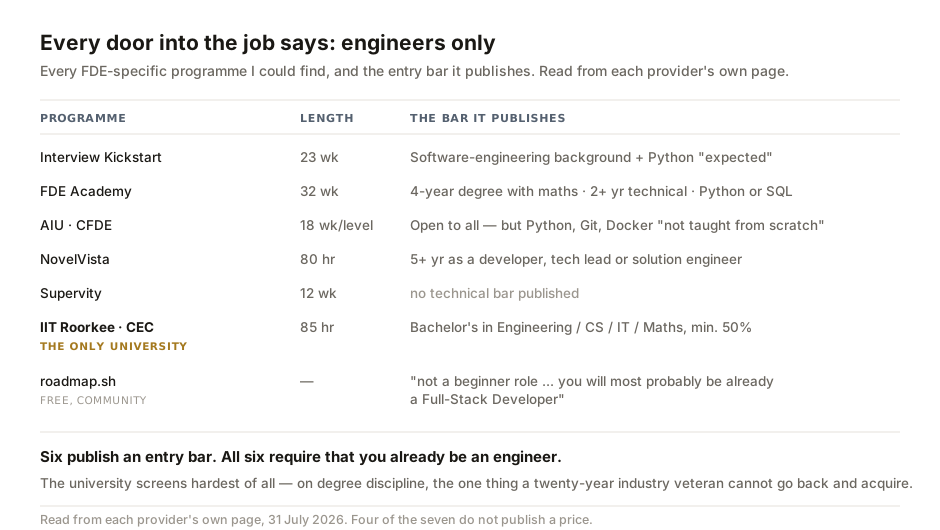
Six of the seven publish an entry bar, and every one of those six requires that you can already write software. If you want to know which of them you personally clear, our FDE Readiness Checker scores you against every bar quoted here.
Interview Kickstart's 23-week programme says plainly that "a software-engineering background and Python proficiency are expected." NovelVista is blunter: "5+ years as a developer, tech lead, or solution engineer — this is not an introductory AI course." FDE Academy asks for a four-year degree with maths, two years of technical experience and strong Python or SQL. Even the free community roadmap opens by telling you that forward deployed engineering "is not a beginner role" and that you will most probably already be a full-stack developer.
The most instructive one is AIU's Certified Forward Deployed Engineer, because it looks open and is not. The course itself, it says, "is open to anyone. There are no prerequisites to enrol." The certification exam behind it requires two or more years in software engineering, ML, data engineering, DevOps or solutions architecture. And the syllabus adds a line worth reading twice: "Working proficiency in Python, Git, Docker, and at least one cloud platform is expected. These are tools used throughout the programme, not taught from scratch."
This is the training gap in a nutshell. The programme declines to teach the very skills an industry veteran needs.
The correction, and why it makes the point worse
The Continuing Education Centre at IIT Roorkee now awards a Post Graduate Certificate in Forward Deployed AI Engineering — 85 hours, ₹45,000 plus GST, first cohort tentatively September 2026. A job title that existed only inside Palantir in 2011 now has a university curriculum. It's a significant institutional milestone, and I was wrong to say it didn't exist.
But look at who may enrol. It requires a bachelor's degree in engineering, computer science, IT, mathematics or a related discipline, minimum 50% marks, and is aimed at people with nought to three-plus years in software, data or analytics roles.
Of every programme I found, the university screens on the one criterion a domain expert can never retroactively satisfy. A plant manager with twenty years in specialty chemicals and a chemistry degree is ineligible on paper. The barrier is not her ability to do the work; it is the title on her degree certificate. The private bootcamps at least let you argue with a portfolio.
What twenty-three weeks actually contains
Length is not the interesting number. Shape is.
Interview Kickstart publishes its curriculum week by week, so you can see exactly where the time goes. Weeks 1 to 11 are what they call the AI Engineering Spine: agentic foundations, retrieval-augmented generation, multi-agent systems, agent communication protocols, hybrid search, observability, fine-tuning, capstone. Week 12 is pair programming with an assistant. Weeks 13 to 17 are the FDE spine — customer discovery and scoping, statements of work and pricing, building production agents, APIs and access control, evaluation and handover. Weeks 18 to 23 are interview preparation.
Eleven weeks of AI tooling run before the first hour of the job itself. Five weeks are the job. Six are getting through the interview.
This is not a scandal. it is a rational response to who is buying. If your intake is engineers who want to move into AI, the AI tooling is the value and the field skills are the differentiator you bolt on. But it tells you unambiguously who these programmes are for, and it is not the 行业大佬.
Then Singapore surprised me
I expected the public system to have nothing. It has a great deal — just not what you would predict.
Singapore Management University runs a two-day course whose full title is Vibe Coding For Business Professionals: Building AI-Enhanced Digital Products with Non-Technical Backgrounds. Sixteen hours. List price S$2,000, indicative payable fee after subsidy about S$100. Entry requirement: "There are no formal prerequisites for enrolment in this programme. It is open to all adult participants regardless of age, educational background, or prior work experience." Sixty-one ratings, five stars, seventy-one people through it.
It is not alone. SUTD runs Vibe Coding: Building Digital Solutions with AI at the same S$2,000 list and roughly S$100 payable. Singapore Polytechnic runs a generative-AI websites and chatbots course at S$480 list, potentially free after funding. SMU runs another on building autonomous agents without coding.
So the region is not ignoring non-engineers; it is subsidising them at roughly ninety-five per cent. But what does that subsidy buy?
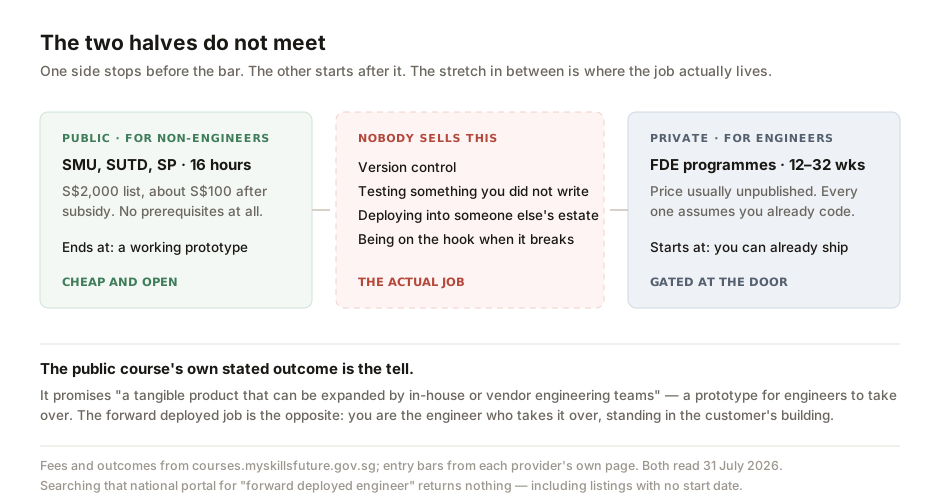
SMU publishes its own learning outcomes, and the last one is the tell. By the end, participants will be able to "deploy, test, and iterate — showcasing a tangible product that can be expanded by in-house or vendor engineering teams."
Read that again. The course is honest about where it stops. It takes you to a prototype and hands it to engineers.
The forward deployed job is the exact inverse. You are the engineer it gets handed to, except you are standing in the customer's building and there is nobody behind you. Version control, testing code you did not write, deploying into an estate you do not control, being on the phone when it breaks on a Friday: this whole stretch of the job falls between the two kinds of course. The cheap ones stop too soon; the expensive ones start too late.
The serious route, and its own contradiction
Singapore does run one thing at the right depth. AI Singapore's AI Apprenticeship Programme is six or nine months, pays a stipend of S$4,000 a month, and is open to citizens holding a NITEC, diploma or degree. At six or nine months, it's a serious commitment and should be the first stop for anyone weighing this path.
But two pages published by the same organisation say different things about who may apply.
The programme site says: "It doesn't matter if you come from a technical or non-technical background — AIAP is designed to equip you with everything you need to transition into industry-ready AI roles."
The organisation's own FAQ, answering what candidates it seeks, agrees that applicants "can come from any area of specialization" — and then lists as minimum requirements the ability to build machine learning models, handle data preprocessing, deploy models using Docker, work with cloud infrastructure, script in Linux and use SQL or Spark. It adds that "selection is competitive and the above are more likely our minimum requirements."
I am not going to resolve that; only AI Singapore can. I raise it because a domain expert reading the first page and not the second will spend weeks on an application they were never eligible for. The destination is also telling. The listed outcomes are AI Engineer, MLOps Engineer, DataOps Engineer and Data Scientist — all model-building roles, not the customer-facing deployment job this series is about.
One more measurement, and it is the cleanest in the piece. I searched the national training portal for the job title itself. "There are no courses matched to your search." I then applied the filter that includes listings with no scheduled start date, in case something dormant existed. Still nothing.
What the missing course would actually contain
Reading the job postings alongside the syllabuses makes the missing curriculum obvious. It is not a shorter version of the engineering programmes. It is a different subject.
- Skip the AI stack; it is the easy part. Both employers want production LLM experience, and the retrieval-and-agents layer is perhaps three weeks of an eleven-week spine. Our AI and LLM glossary covers the vocabulary in an afternoon. Nobody has a fifteen-year head start here.
- Teach the engineering hygiene instead. Version control, code review, testing, environments, secrets, logging, rollback. Unglamorous, universally assumed, and the actual reason a capable veteran's prototype cannot be deployed at a customer.
- Make them ship into someone else's estate. Not a demo on a laptop. A working thing installed in an environment the learner does not control, with the owner's constraints — their network, their approvals, their identity system. This is the assessment; everything else is preparation for it.
- Use the assistant deliberately, then take it away. Coding assistants are why this route became viable, and tools of that class should be used from week one. But a graduate who cannot read and correct what the assistant wrote has not cleared the bar — they have relocated it.
- Assume the domain, do not teach it. The intake already knows why the plant shuts on Tuesdays. Every hour spent teaching business context to people who have lived it is an hour wasted, and it is most of what the existing "AI for professionals" courses contain.
- Count their customer years honestly. Anthropic asks for four years in a technical customer-facing role, not four years of engineering. Most veterans already clear that and assume the clock starts when they learn to code. A programme built for them should say so on the front page.
The market has a cheap, open, publicly subsidised on-ramp that stops at a prototype, and an expensive, gated set of programmes that start after production competence. Nothing sells the stretch between them, which is the whole of the job. This is not a gap in AI education. it is a gap in software engineering education for people who are not going to become software engineers.
Who should build it
Not the private bootcamps. Their economics depend on an intake that already codes, because that is what makes a twelve-to-thirty-two week programme feasible and what lets them advertise placement rates.
The natural builder is a polytechnic or a continuing-education arm with public funding behind it — precisely the institutions already running the two-day prototype courses. They already have the right intake, the subsidy machinery, and the institutional honesty to admit where their current courses stop. What they would need is the nerve to run something twelve weeks long for people whose degrees are in mechanical engineering, accountancy, nursing and shipping, and to assess it on a deployment rather than a certificate.
The commercial argument is simple. The region has deep operational expertise and comparatively few frontier-AI engineers. If the scarce input is engineers, ASEAN is badly placed. But if it's people who know which problem is worth solving, the regional pool is far larger than anyone is counting. Right now, we hand them a two-day course that ends by telling them to find an engineer.
What I could not check
My Malaysian search was much shallower than my Singaporean one. MDEC names agentic architecture as a 2026 priority, Budget 2026 adds a further 50% tax deduction for smaller firms' AI and cybersecurity training, and the HRD Corp-claimable courses I found are addressed to developers and solutions architects rather than to domain experts. that is enough to suggest the pattern is the same, but not enough to assert the detail.
I also could not read three programmes' pages directly. One blocks automated fetching, and two I found only in search listings. They are excluded from the count rather than estimated. If one of them is the bridge I claim nobody is building, I would like to know.
And the compensation caveat from the last piece stands: the salary bands in these postings are US-based and do not transfer. Before anyone rearranges a career around them, run the number that actually matters where you live — our Singapore take-home salary calculator is a more sobering read than a headline range.
- Entry requirements, lengths and fees for all seven FDE programmes were read from each provider's own page on 31 July 2026: Interview Kickstart, FDE Academy, AIU (CFDE), NovelVista, Supervity, the Continuing Education Centre at IIT Roorkee, and the roadmap.sh community roadmap. Quoted wording is verbatim from those pages. AIU is a registered private company in England and Wales, not a university.
- Course fees, subsidised fee estimates, prerequisites and learning outcomes for the SMU, SUTD and Singapore Polytechnic courses, and the nil result for the search term "forward deployed engineer" both with and without the start-date filter, are from courses.myskillsfuture.gov.sg, the Singapore government training portal, 31 July 2026.
- AI Apprenticeship Programme duration, stipend, eligibility and outcome roles from AI Singapore's own programme site and its candidate-requirements FAQ, both read 31 July 2026. The divergence between the two pages is reported as found and is not resolved here.
- Job-posting requirements referred to in passing — Palantir's and Anthropic's — were read in full for the previous guide in this series on 31 July 2026 and are cited there.
- Malaysian training-policy detail is drawn from secondary sources only and is flagged as such in the text. Three FDE programmes could not be read from their own pages and are excluded from the counts rather than estimated.
- Disclosure: this guide was drafted with a model made by Anthropic, whose job posting is one of the two measured in the previous piece.
Fees, subsidies and entry requirements are as published on 31 July 2026. Singapore course subsidies depend on citizenship, age and employer sponsorship, and the figures above are the portal's indicative estimates rather than a quotation. Verify with the training provider before committing.