

An AI practitioner in Beijing put a claim to me recently that I did not want to be true, because it inconveniences almost everyone currently selling training for this job.
His observation, from deploying these systems rather than from theory, was that the best Forward Deployed Engineers he has worked with were not computer science graduates. They were 行业大佬 — industry veterans, people who had spent fifteen years inside the business before they came near the model.
I have spent a while trying to falsify that. What I found is that he is right about the destination and wrong about the entry ticket, and the gap between those two things is the most useful thing a career-changer in this region can understand right now.
First, why anyone cares about this job
The Forward Deployed Engineer is not a new invention. Palantir coined the title around 2011 — internally they were "Deltas" on the commercial side and "Echoes" on the government side — and until 2016 the company had more of them than it had software engineers. The idea was simple and slightly heretical. Instead of shipping software and hoping the customer succeeds, you embed an engineer to build the thing on site.
What changed in 2026 is that the AI industry discovered the same problem. Postings for the role are reported up several hundred per cent year on year. In May, the makers of ChatGPT launched a Deployment Company — a majority-owned subsidiary capitalised at more than US$4 billion, backed by TPG with McKinsey, Capgemini, Bain and others alongside — and bought a consultancy called Tomoro to staff it with roughly 150 FDEs from day one.
That is not a hiring spree. That is a company with the best models in the world concluding that the models are not the bottleneck.
One detail matters more than any other: Tomoro's APAC headquarters is in Singapore, announced by Singapore's Economic Development Board in May 2025 as the firm's regional command centre. That deployment capability is now part of OpenAI's, which means the demand for this skill is landing on our doorstep rather than passing overhead. (Clarified 31 July 2026: this paragraph originally said the deployment arm was being built partly out of this region. The Singapore headquarters predates the acquisition by a year — OpenAI inherited the foothold rather than creating it. The claims audit sets out the dates.)
So I read the job ads
The fastest way to test a claim about hiring is to read what the people hiring actually wrote. I read two postings in full: Palantir's, because they invented the role, and Anthropic's, the company behind Claude, because they are a frontier lab that was hiring for it at the time of writing. (Checked again 31 July 2026: this specific posting is no longer on Anthropic's job board — the quotes here are a dated snapshot of what it required, not a live vacancy.)
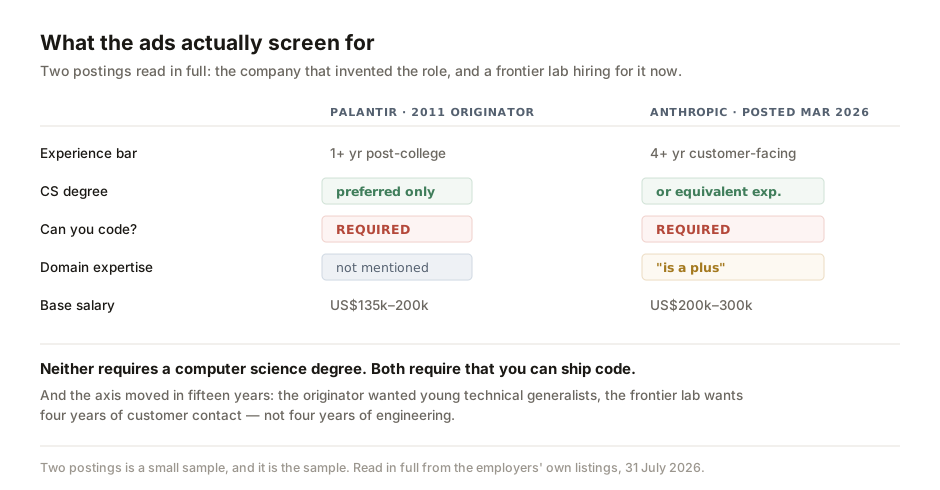
Three things fall out of that, and they do not all point the same way.
Neither employer requires a computer science degree. Palantir asks for a "strong engineering background, preferred in fields such as Computer Science, Mathematics, Software Engineering, Physics, and Data Science" — preferred, and a broad list. Anthropic requires "at least a Bachelor's degree in a related field or equivalent experience". The credential is not the gate. On this, the Beijing view is straightforwardly correct, and a lot of people are talking themselves out of a US$200,000 job over a qualification neither employer asked for.
Both require that you can ship code. Palantir wants a "strong coder with shown proficiency" in Python, Java, C++ or TypeScript. Anthropic wants "strong programming skills with proficiency in Python… and experience shipping production applications", plus production experience with LLMs. This is where the thesis fails if you read it as "you don't need to be technical". You do. It is not negotiable at either company.
And domain expertise is never a requirement. Palantir's posting does not mention it at all. Anthropic lists "a background in financial services, healthcare/life sciences, or another enterprise vertical" — as a plus, in the same breath as several other pluses.
Two postings is a small sample, but it's the sample that matters most — the company that invented the job and one of the companies redefining it.
The thing that moved
The interesting finding isn't in either posting on its own, but in the fifteen years between them.
Palantir's requirement is "1+ years of relevant, post-college work experience." That is close to a graduate role. Their model was to hire young, technically strong generalists and let them absorb the customer's world on site.
Anthropic's is "4+ years of experience in a technical, customer facing role… or as a Software Engineer with consulting experience." Read that carefully. It is not four years of software engineering. It is four years of being in front of customers, and the alternative route offered is explicitly consulting. They add that "former technical founders are also encouraged to apply".
The axis has shifted from raw engineering tenure toward time spent in rooms with customers. That is a move in the direction of the 行业大佬 — not all the way there, but unmistakably that direction, and it happened without anyone announcing it.
Which gap is cheaper to close?
Here is the question I think nobody is asking properly, and it is the one that decides whether the Beijing thesis is a nice observation or a career plan.
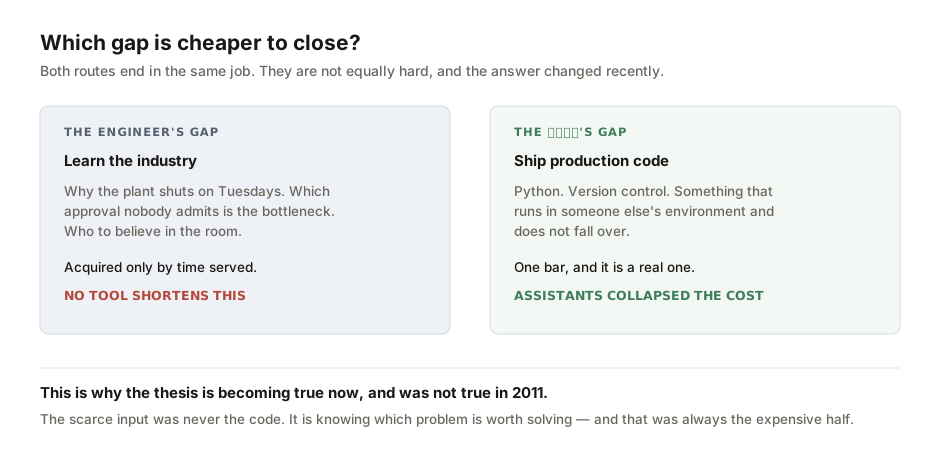
Both routes end in the same job. The engineer has to learn the industry, and the industry veteran has to learn to ship production code. These two gaps are not equally hard to close, and the relative difficulty has changed.
The engineer's gap is knowing which problem is worth solving: why the plant shuts on Tuesdays, which approval nobody will admit is the real bottleneck, whose objection in the room is the one that will kill the project in month four. That is acquired by time served and by nothing else. No course compresses it. It is the reason a technically flawless pilot dies quietly.
The veteran's gap is a single, clear bar: write Python, use version control, and ship something that runs in another environment without falling over. People underestimate this bar constantly. But it is one bar, it is well-mapped, and its cost has fallen sharply in about eighteen months, because coding assistants are very good at exactly the kind of competent-but-unremarkable integration code this job mostly requires.
That is why I think the thesis is becoming true now rather than having always been true. In 2011, teaching a supply chain director to ship production software was a multi-year project, so Palantir's approach — hire young engineers, immerse them — was correct. The relative price has changed.
Where I think the Beijing view is wrong
Stated as "the best FDEs are domain experts, not engineers", it is too strong, and believing it will cost someone a year.
The postings are unambiguous: you cannot skip the code. A 行业大佬 who cannot build will not get past the technical screen at either company I looked at, however well they understand their industry. This job is never pure advisory. The whole point of the role, the reason it isn't just a consultant, is that the same person who understands the problem also builds the solution.
The defensible version is narrower and more useful:
Among people who can build, the domain expert outperforms the career engineer — because the binding constraint in enterprise AI deployment is problem selection, not implementation. The code is the entry ticket, not the advantage.
What this means if you are 行业大佬 in ASEAN
This region is unusually well positioned for a reason that is rarely said out loud. We have deep operational expertise — manufacturing, shipping and ports, palm oil and commodities, banking, government administration, healthcare systems — and comparatively few frontier-AI engineers. If the scarce input were engineers, we would be badly placed. If the scarce input is people who understand a business well enough to know which problem is worth automating, we are sitting on a much larger talent pool than anyone is counting.
- Clear the one bar, deliberately. Python to the point of shipping something real, version control, and one production-grade application running in an environment you do not control. Not a certificate. An artefact someone else depends on. Our FDE Readiness Checker scores you against all ten published bars, each one quoted with the date it was read.
- Do not abandon the domain to do it. The instinct is to retrain into a generic AI engineer and start at the bottom of a field where you have no edge. That trades your only asymmetric advantage for a commodity one. Build the technical skill on top of the industry knowledge.
- Target your own sector. Anthropic lists vertical background as a plus. Your fifteen years in logistics is worth most to a company deploying into logistics — and worth very little to one deploying into biotech. Aim at the overlap.
- Learn the LLM layer specifically. Prompt engineering, agents, evaluation, retrieval — our AI and LLM glossary defines the lot in plain English. Both postings assume it. This layer is new. Nobody has a fifteen-year head start on you, which makes it the most level ground in the field.
- Count the customer years you already have. If you have spent four years in front of customers in any technical capacity, you already meet the experience bar Anthropic wrote. Most veterans assume the clock starts when they learn to code. It does not.
And a note on where the training market is pointing
Almost every Forward Deployed Engineer programme is privately run — bootcamps, certificate courses, cohort programmes. One university has since entered: IIT Roorkee's Continuing Education Centre now awards a postgraduate certificate in the subject. (Correction, 31 July 2026: this paragraph originally said I could locate no universities. That was wrong, and the follow-up piece linked below sets out what I found when I checked properly.)
What is surprising is the intake they are all designed for. The syllabuses are LangChain, RAG, vector databases, agents, MCP — an AI engineering stack, with a thin module on client engagement bolted on at the end. They are built to teach engineers the AI tooling.
If the argument above is right, these courses are aimed at the wrong half of the problem. The scarce input isn't an engineer who lacks RAG skills; it's a domain expert who lacks a technical bridge. And nobody is building that bridge, in this region or anywhere else I looked.
That is a gap I would expect somebody to fill within two years. If you run a training institution in Southeast Asia, it is sitting in front of you. I have since gone and read the entry requirements of every one of these programmes, and what Singapore's publicly funded system offers instead — the training gap, measured.
The Beijing thesis is half right. Postings from Palantir, who invented the role, and Anthropic, who are redefining it, confirm that a CS degree isn't the gate — neither requires one, and Anthropic accepts "equivalent experience" in its place. They also confirm you cannot skip the code.
But the axis moved while nobody was watching. Palantir asks for one year post-college; Anthropic asks for four years in a technical customer-facing role, or software engineering with consulting experience, and lists sector background as a plus. The hiring bar has drifted from engineering tenure toward customer contact. Add that coding assistants have collapsed the cost of clearing the one technical bar, while nothing has made industry knowledge faster to acquire, and the veteran's route looks better than it has ever looked. For ASEAN, this matters. The region is rich in the scarce input — domain expertise — and short on the one that is now cheapest to acquire.
This is the second piece in a series on the role. If you want the groundwork on how these systems actually behave once deployed, our guide on the new AI vocabulary in plain English covers agents, RAG and why prompt injection is structural, and where your data actually goes covers the jurisdiction question every enterprise deployment eventually hits.
- Palantir Technologies — Forward Deployed Software Engineer (New York, Delta), read in full from the company's own listing on 31 July 2026. The "What We Require" and "What We Value" text and the US$135,000–200,000 range are quoted from it.
- Anthropic — Forward Deployed Engineer, Applied AI, posted 9 March 2026, read in full. The 4+ years customer-facing requirement, the programming requirement, the vertical-background "plus", the degree-or-equivalent line and the US$200,000–300,000 range are quoted from it. Disclosure: this guide was drafted with a model made by Anthropic, one of the two employers whose posting it analyses.
- OpenAI — launch of the OpenAI Deployment Company, announced 11–12 May 2026: majority-owned subsidiary, more than US$4 billion in initial capital, led by TPG with 19 partner firms, and the acquisition of Tomoro (~150 FDEs, APAC headquarters in Singapore). Accessed 31 July 2026.
- Origin of the role at Palantir circa 2011, the internal "Deltas" and "Echoes" naming, and the observation that FDEs outnumbered software engineers until 2016: industry accounts and practitioner writing on the role. Accessed 31 July 2026.
- Reported growth in FDE job postings and frontier-lab compensation bands come from recruitment-industry sources rather than primary filings, and are described here as reported rather than established.
- The central thesis was put to us in conversation by an AI practitioner in Beijing, drawing on their own deployment experience. They are not named here and no part of their reasoning beyond the claim itself has been reconstructed.
Compensation figures are US-based and will not transfer directly to ASEAN markets. Job requirements are as posted on the dates given; both companies revise these listings, and a requirement is only current as of the day you read it.