
This is the last of four pieces on Forward Deployed Engineers. it is for the person on the other side of every previous article: the one who decides whether their company builds a deployment motion at all.
That person has a question nobody selling this model wants to answer. Software companies carry seventy to ninety per cent gross margin because the marginal cost of one more customer is close to nothing. Services companies carry twenty to forty because the marginal cost of one more customer is one more person. Putting engineers inside your customers looks, on its face, like converting the first business into the second while keeping the first one's valuation multiple.
It is a coherent fear. It is also testable, because one company has run this model at scale for about fifteen years and files quarterly accounts.
So I opened the filing
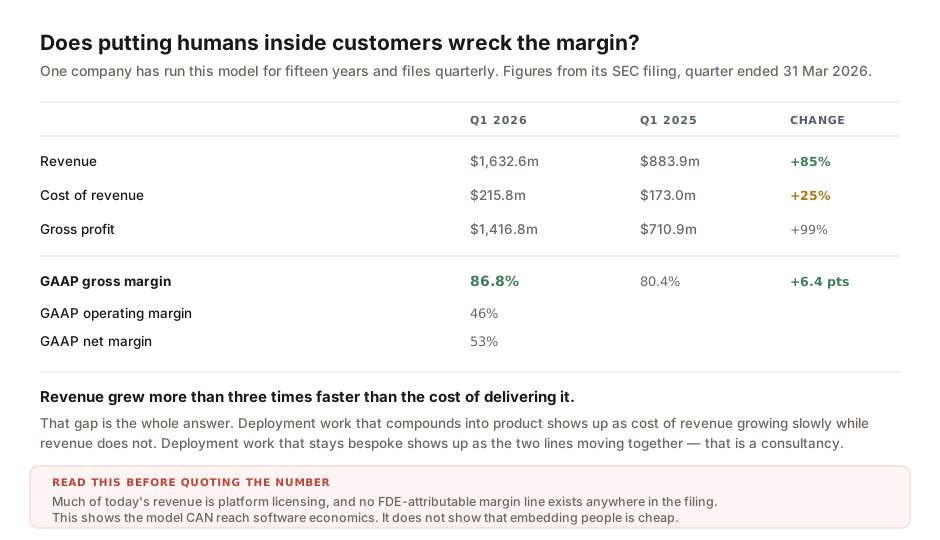
Palantir's Q1 2026 results, filed with the SEC on 4 May 2026 for the quarter ended 31 March, report revenue of $1.633 billion against cost of revenue of $215.8 million. That is a GAAP gross margin of 86.8%. A year earlier the same calculation gave 80.4%.
The margin did not merely survive the model. It went up by more than six points in a year, while revenue grew 85% — the company's highest-ever year-on-year rate. GAAP operating margin was 46%, net margin 53%, and the company reported a Rule of 40 score of 145%.
Whatever forward deployment does to a business, it does not automatically turn it into a consultancy.
The number that actually explains it
The mechanism is simpler than the headline margin it produces. Revenue grew 85%; cost of revenue grew only 25%.
Each new dollar of revenue cost far less to deliver than the one before it. That decoupling is the only part of this model a product principal should try to copy.
Deployment work that compounds into product shows up clearly on an income statement. The delivery line grows slowly while the revenue line does not, because what engineers built for customer one works for customers two through fifty. Deployment work that stays bespoke looks like the two lines moving together in lockstep. That second shape is a consultancy with a software company's org chart, and no amount of positioning changes what the accounts say.
The uncomfortable implication for anyone planning this motion is that you don't get the margin by hiring Forward Deployed Engineers. You get it by having somewhere for their work to go. If your product surface cannot absorb what they build in the field, you have bought a services business at software prices, and the accounts will tell you so in about six quarters.
One caution before anyone quotes the 86.8%. Palantir in 2026 is not Palantir in 2011. A great deal of current revenue is platform and licensing rather than bespoke deployment, and no filing anywhere breaks out an FDE-attributable margin, because no such line exists. These figures show the model can reach software economics. They do not show that embedding people is cheap, and reading them as "FDEs run at 87% margin" would be the exact mistake the earlier pieces in this series warned against.
OpenAI's structural answer to the same problem
There is a second way to handle the margin question, and the largest player in the market chose it in May.
Read as a financial decision rather than as a launch, the OpenAI Deployment Company is an unusually clean piece of structuring. It is a separate company, majority-owned and controlled by OpenAI, launched with more than US$4 billion of initial investment from OpenAI and nineteen outside investment firms, consultancies and system integrators, led by TPG.
Put the people-heavy business in its own vehicle. Fund it with somebody else's capital. Keep majority control so the customer relationship stays unified. This structure protects the parent company's margin profile from the headcount-linear costs of a delivery organisation.
Whether it works is unknown — the Tomoro acquisition that staffs it was still subject to closing conditions at announcement. As an answer to "how do I run this without wrecking my income statement," it is more honest than the usual vendor response of ignoring the question.
Now the part that will annoy you
Everything above is about whether you can afford to build the motion. The next two findings are about whether anyone will notice that you did.
These are from the MIT NANDA report I read in full for the buyer's piece in this series — the one everybody cites for its 95% headline and nobody seems to open.
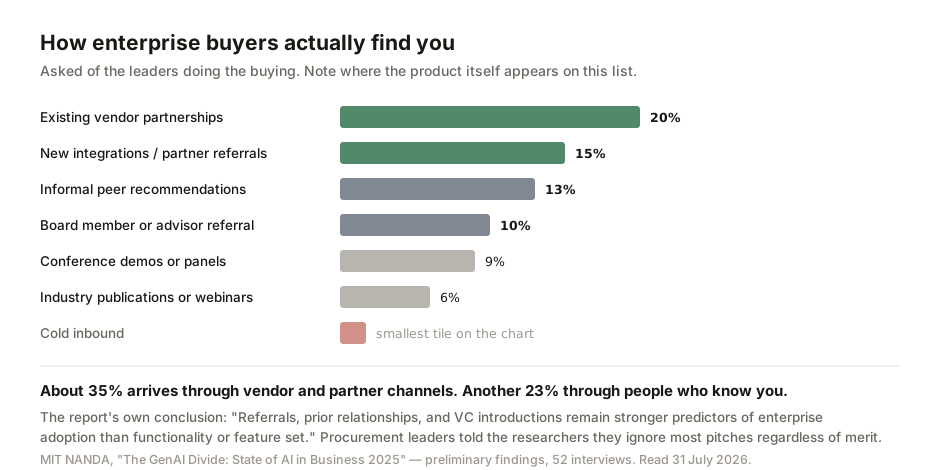
Roughly 35% of enterprise GenAI discovery arrives through existing vendor partnerships and partner referrals. Another 23% comes through informal peer recommendations and board or advisor introductions. Conference demos manage 9%. Industry publications and webinars, 6%. Cold inbound is the smallest tile on the chart.
The report's own conclusion is blunter than anything I would write: "product quality alone is rarely sufficient. Referrals, prior relationships, and VC introductions remain stronger predictors of enterprise adoption than functionality or feature set." A head of procurement at a major consumer goods firm put the buyer's side of it plainly — impressive demos arrive daily, establishing trust is the real problem, and so they lean on peer recommendation. Elsewhere the researchers note that many procurement leaders ignore most startup pitches regardless of innovation.
If you are a product principal, that is the distribution reality your deployment motion has to survive. When you come to hire for it, our FDE Readiness Checker lays out what the two employers in this market actually screen for. It also reframes what an FDE is for. An engineer embedded in a customer provides more than delivery capacity; they become the source of the reference that produces the next deal through the only channel that reliably works.
And the paragraph that should worry you
The report contains one anecdote I would pin above a product team's desk. A corporate lawyer at a mid-sized firm, whose organisation had spent $50,000 on a specialised contract analysis tool, explaining why she kept using ChatGPT instead:
"Our purchased AI tool provided rigid summaries with limited customization options. With ChatGPT, I can guide the conversation and iterate until I get exactly what I need. The fundamental quality difference is noticeable, ChatGPT consistently produces better outputs, even though our vendor claims to use the same underlying technology."
The researchers' gloss: "a $20-per-month general-purpose tool often outperforms bespoke enterprise systems costing orders of magnitude more, at least in terms of immediate usability and user satisfaction."
Same underlying model. Two thousand times the price. Worse outcome, in the user's judgement. Your real competitor is not the other vendor in the bake-off; it is the twenty-dollar subscription your buyer's staff already use, which the report found in over 90% of the companies it surveyed.
What the buyers say would actually change their minds
The same research asked what separates the tools that get adopted. The answers were unglamorous and specific.
- It has to learn. 66% of executives want systems that improve from feedback and 63% demand context retention. The report finds that pilots stall not because of model quality, but because the tools don't remember, adapt, or improve. A static tool loses to a chat window that at least does what it is told.
- Start at the edge, not the core. The winners embedded in adjacent or non-critical processes with heavy customisation, proved value, then moved inward. Tools demanding extensive enterprise customisation up front stalled at pilot.
- Narrow and boring beats broad and ambitious. What landed in their sample: call summarisation and routing, document automation for contracts and forms, code generation for repetitive tasks. What struggled: complex internal logic, opaque decision support, optimisation over proprietary heuristics.
- There is a hard ceiling on scope. Asked whether they would give a task to AI or a junior colleague, buyers chose AI 70/30 for quick work and humans 90/10 for complex multi-week projects. If your roadmap assumes enterprises will hand over long-horizon judgement work soon, their own answers say otherwise.
- Sell to the person with the problem. The strongest deployments began with power users who had already experimented on their own, and with budget holders and domain managers surfacing problems — not with a central AI function running a procurement exercise.
- Trust is the actual bottleneck. The highest-frequency barrier to scaling was unwillingness to adopt new tools, with output quality second. Even heavy ChatGPT users distrusted their own company's internal AI tools. That is a credibility problem, and no feature ships past it.
The fear about margins is coherent, but it is not what happened at the one company with a fifteen-year record and public accounts. Palantir's GAAP gross margin is 86.8% and rising, because revenue grew 85% while cost of revenue grew 25%.
That ratio is the thing to copy, not the job title. Forward deployment earns software economics only when what the engineers build in the field becomes product. If it does not, you have bought a services business at software prices. OpenAI's answer to the same problem was structural — a separate majority-owned company funded by outside capital.
And whatever you build, it reaches enterprises through partners, references and people who already know you. Cold inbound is the smallest channel on the chart, and your real competitor is a twenty-dollar subscription your buyer's staff already prefer.
What this means if you are building from ASEAN
Two of these findings are unusually favourable for ASEAN-based companies; one is unusually harsh.
The distribution model is favourable. It runs on partnerships and references, which is how business development already works across most of the region. The buyers who convert fastest are mid-market firms — which make up most of the market here. A vendor that wins three referenceable deployments in Malaysian manufacturing or Singaporean logistics has built the exact asset the report says predicts adoption, and it is an asset a better-funded competitor cannot simply outspend.
The margin mechanism is the harsh part, and it does not care where you are. If your deployment work does not compound into product, the accounts will look like a consultancy's regardless of how the company is positioned, and regional labour cost advantages only delay that arithmetic rather than changing it.
The rest of this series covers the same role from the other three sides: what the job is and which of its famous numbers survive checking, what the buyer should do before hiring anyone, and who actually turns out to be good at it. If the compensation numbers in any of them are shaping a hiring plan, run them through our Singapore take-home salary calculator first, because the US bands do not transfer. And our AI and LLM glossary covers the vocabulary the buyers in that report kept asking vendors to stop using.
- Palantir Technologies Inc. — Form 8-K, Exhibit 99.1, Q1 2026 earnings press release, filed 4 May 2026 for the quarter ended 31 March 2026. Fetched from SEC EDGAR and read directly on 31 July 2026. Revenue, cost of revenue, gross profit, income from operations and net income are as filed; the 86.8% and 80.4% GAAP gross margins are computed from those figures (gross profit ÷ revenue) and can be reproduced from the same statement. The 46% operating margin, 53% net margin, 85% revenue growth and Rule of 40 score of 145% are stated in the release. No FDE-attributable margin is disclosed and none is implied here.
- OpenAI — OpenAI launches the OpenAI Deployment Company, 11 May 2026, read in full from OpenAI's own site. The capital figure, the count of nineteen partners, the lead investor, the majority-ownership statement and the closing-conditions caveat are quoted from it.
- MIT NANDA — The GenAI Divide: State of AI in Business 2025, preliminary findings, July 2025. The 26-page PDF was read in full on 31 July 2026. The discovery-channel figures, the referrals conclusion, the procurement quotes, the $50,000 contract-tool anecdote and the $20-per-month comparison, the learning and context-retention percentages, the edge-then-core adoption pattern, the successful and struggling categories, the 70/30 and 90/10 task-delegation split and the barrier ranking are all verbatim from it. That document describes itself as preliminary and rests on 300+ initiatives, 52 interviews and 153 surveys.
- The software-versus-services gross margin ranges in the opening are conventional industry bands offered as context, not figures from any cited source.
- Disclosure: this guide was drafted with a model made by Anthropic, a competitor to both companies whose disclosures are analysed above.
Figures are as filed or published on the dates given and read on 31 July 2026. Nothing here is investment advice or a recommendation regarding any security; a single quarter of one company's results is context for an operating decision, not a basis for one about its shares.