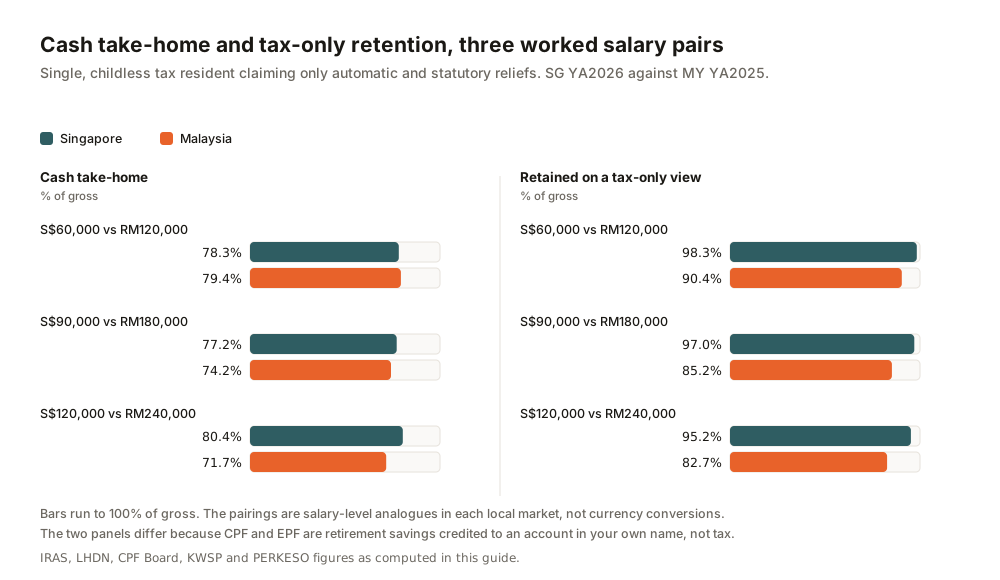
Ask a Singaporean and a Malaysian what fraction of their salary survives payday and you will get two numbers that look surprisingly alike — and hide two completely different stories. At a mid-career salary (S$60,000 in Singapore, RM120,000 in Malaysia), cash take-home is nearly identical: 78.3% versus 79.4%. But strip out the retirement contributions — CPF and EPF, which are savings credited to your own account rather than money the state keeps, while SOCSO and EIS stay on the tax side — and the picture inverts: on a tax-only view Singapore retains 98.3% of that salary against Malaysia's 90.4%. Singapore's payslip deduction is overwhelmingly CPF you get back later; Malaysia's is mostly genuine tax.
This guide computes that comparison properly for the 2025 earning year — which means Singapore's Year of Assessment 2026 (SG taxes the preceding year) against Malaysia's YA2025 (MY taxes the current year). That is the honest like-for-like pairing, and 2026 brings two wrinkles worth pricing in. Singapore offered a 60% personal income tax rebate (capped at $200) for YA2025; there is no rebate for YA2026, so identical income costs up to $200 more this filing season. Malaysia, meanwhile, introduced a 2% tax on individual dividend income above RM100,000 a year from YA2025 — the first crack in its no-dividend-tax position.
All figures below were verified against IRAS, LHDN, CPF Board, KWSP and PERKESO pages in July 2026. The three worked examples assume a single, childless tax resident under 55 (SG) or 60 (MY), paid twelve equal monthly wages, claiming only automatic and statutory reliefs.
The two rate ladders
Singapore — resident rates, YA2026
| Chargeable income | Rate | Cumulative tax at band top |
|---|---|---|
| First S$20,000 | 0% | S$0 |
| Next S$10,000 (to S$30,000) | 2% | S$200 |
| Next S$10,000 (to S$40,000) | 3.5% | S$550 |
| Next S$40,000 (to S$80,000) | 7% | S$3,350 |
| Next S$40,000 (to S$120,000) | 11.5% | S$7,950 |
| Next S$40,000 (to S$160,000) | 15% | S$13,950 |
| Next S$40,000 (to S$200,000) | 18% | S$21,150 |
| Next S$40,000 (to S$240,000) | 19% | S$28,750 |
| Next S$40,000 (to S$280,000) | 19.5% | S$36,550 |
| Next S$40,000 (to S$320,000) | 20% | S$44,550 |
| Next S$180,000 (to S$500,000) | 22% | S$84,150 |
| Next S$500,000 (to S$1,000,000) | 23% | S$199,150 |
| Above S$1,000,000 | 24% | — |
Singapore's ladder (IRAS resident rate table) starts astonishingly low — the first S$20,000 of chargeable income is tax-free and you do not cross a double-digit marginal rate until S$80,000 — but it climbs steadily to a 24% top rate above S$1 million. Reliefs are few: the examples below use only the automatic S$1,000 Earned Income Relief and CPF relief for the employee's own compulsory contributions.
Malaysia — resident rates, YA2025
| Chargeable income (RM) | Rate | Cumulative tax at band top (RM) |
|---|---|---|
| 0 – 5,000 | 0% | 0 |
| 5,001 – 20,000 | 1% | 150 |
| 20,001 – 35,000 | 3% | 600 |
| 35,001 – 50,000 | 6% | 1,500 |
| 50,001 – 70,000 | 11% | 3,700 |
| 70,001 – 100,000 | 19% | 9,400 |
| 100,001 – 400,000 | 25% | 84,400 |
| 400,001 – 600,000 | 26% | 136,400 |
| 600,001 – 2,000,000 | 28% | 528,400 |
| Above 2,000,000 | 30% | — |
Malaysia's schedule (LHDN tax rate page, unchanged across YA2023–2025) accelerates much faster: the 19% band arrives at RM70,001 and the long 25% band at RM100,001 — a threshold most senior professionals blow straight past. The system compensates with a far broader relief menu — RM9,000 automatic individual relief, capped EPF and SOCSO reliefs, plus lifestyle, medical, education, childcare and (for first homes bought 2025–2027) housing-loan interest reliefs on the LHDN relief list. Malaysian effective rates depend heavily on how many of those you can legitimately claim.
The deductions that actually hit your payslip
The real divergence between the two payslips comes from mandatory contributions, not income tax.
- Singapore — CPF. An employee under 55 contributes 20% of wages (the employer adds 17% on top), per the CPF Board contribution rates. Contributions apply only up to the Ordinary Wage ceiling — S$7,400/month for 2025 earnings, rising to S$8,000 from 1 January 2026 — so the CPF bite stops growing once salary passes roughly S$88,800 a year.
- Malaysia — EPF + SOCSO + EIS. EPF takes 11% of the employee's wages with no ceiling at these salary levels (employer: 12–13%). SOCSO and EIS are capped at a RM6,000/month wage ceiling since October 2024: at most RM29.75 + RM11.90 a month employee-side, or RM499.80 a year, per the PERKESO contribution schedules.
Here is the point this whole comparison turns on: CPF and EPF are not tax. Both are retirement savings credited to an account in your own name — CPF's Ordinary, Special and MediSave accounts with withdrawal rules from age 55; EPF's Accounts 1, 2 and 3 with the main withdrawal at 55. A comparison that treats them as money lost overstates both countries' burdens, and it overstates Singapore's far more, because 20% is locked up there against Malaysia's 11%. SOCSO and EIS are social-insurance premiums — closer in character to tax, but capped at under RM500 a year. That is why every case below reports two numbers: cash take-home (what lands in your bank account) and tax-only retention (what remains yours, counting retirement savings as yours). Both employers also pay their own contributions on top of gross — 17% CPF in Singapore, 12–13% EPF plus SOCSO/EIS in Malaysia — which is worth remembering when comparing total compensation; the EPF, SOCSO and EIS calculator splits out the Malaysian employee and employer sides line by line.
Three salaries, computed
The pairings below are salary-level analogues — roughly comparable seniority in each local market — not currency conversions. Each side is computed entirely in its own currency.
S$60,000 vs RM120,000 — mid-career
| Singapore (S$60,000) | Malaysia (RM120,000) | |
|---|---|---|
| Income tax | S$1,040.00 (1.7% of gross) | RM11,062.50 (9.2% of gross) |
| Employee contributions | S$12,000 (CPF) | RM13,699.80 (EPF + SOCSO + EIS) |
| Cash take-home | 78.3% | 79.4% |
| Tax-only retained | 98.3% | 90.4% |
Cash-in-hand is a wash; Malaysia even edges ahead by a point. The composition, however, is opposite. Of Singapore's 21.7% total deduction, S$12,000 of S$13,040 is CPF savings. Of Malaysia's 20.6%, more than RM11,000 of RM24,762 is tax. The Singaporean at this level pays about a month's worth less in actual tax.
S$90,000 vs RM180,000 — senior individual contributor
| Singapore (S$90,000) | Malaysia (RM180,000) | |
|---|---|---|
| Income tax | S$2,736.80 (3.0% of gross) | RM26,062.50 (14.5% of gross) |
| Employee contributions | S$17,760 (CPF, ceiling-capped) | RM20,299.80 |
| Cash take-home | 77.2% | 74.2% |
| Tax-only retained | 97.0% | 85.2% |
Cash take-home stays close (three points apart) because CPF is now eating 19.7% of the Singapore gross while the tax bill is still tiny. Tax-only, the gap is nearly twelve percentage points — Malaysia's 25% marginal band is doing real work by RM166,650 of chargeable income, while Singapore is still inside its 7% band.
S$120,000 vs RM240,000 — management
| Singapore (S$120,000) | Malaysia (RM240,000) | |
|---|---|---|
| Income tax | S$5,792.60 (4.8% of gross) | RM41,062.50 (17.1% of gross) |
| Employee contributions | S$17,760 (CPF, ceiling-capped) | RM26,899.80 |
| Cash take-home | 80.4% | 71.7% |
| Tax-only retained | 95.2% | 82.7% |
At this level, the comparison stops being close. Two forces compound in Singapore's favour. First, CPF contributions have frozen at the S$7,400 monthly ceiling, so every dollar above it arrives ceiling-free. Second, the marginal tax rate is still only 11.5% while Malaysia's is 25%. The honest numeric read across all three cases: at mid-level salaries the two systems deliver near-identical cash but Singapore quietly banks far more of the difference as your own savings; the higher you climb, the more decisively Singapore wins on both measures. If your offer is at the top end of these ranges or above, the tax arithmetic is not ambiguous.
What the headline numbers hide
- Currencies are not interchangeable. S$60,000 is not RM120,000 — at market rates around RM3.30 per Singapore dollar it is closer to RM198,000. These pairings compare similar roles in each local market, and Singapore's cost of living (rent above all) consumes much of the nominal advantage. Treat the percentages as system comparisons, not a relocation P&L.
- Investment income is taxed very differently. Singapore levies no capital gains tax and does not tax dividends received by resident individuals — IRAS confirms one-tier and foreign dividends are not taxable, and gains on shares and property are generally outside the net unless you are trading. Malaysia, from YA2025, taxes individual dividend income above RM100,000 a year at 2% (with exclusions including EPF and unit-trust distributions). Small rate, meaningful signal for anyone with a large dividend portfolio.
- The Malaysian numbers above are a worst reasonable case. Our examples claim only the automatic reliefs. A Malaysian filer with children, insurance premiums, medical and lifestyle spending, and a 2025-onwards first-home loan can push chargeable income substantially lower. Singapore's relief list is shorter — but its rates are low enough that there is less to optimise.
- Non-residency is a trap on both sides, and a worse one in Malaysia. Spend fewer than 182 days in Malaysia and you pay a flat 30% with no personal reliefs on Malaysian-source income. Singapore taxes non-resident employment income at 15% or resident progressive rates, whichever produces more tax; short stints of 60 days or less in a calendar year are exempt from employment-income tax (this concession does not extend to directors, public entertainers or professionals). If you are structuring a cross-border year, residency status moves more money than anything else in this article.
Run your own numbers
Every figure above assumes a single filer with no children and minimal reliefs — which is precisely nobody reading this. The Singapore–Malaysia Income Tax Calculator lets you run each system on your actual salary, contribution profile and reliefs — toggle between Singapore and Malaysia to compare. For the payslip view rather than the annual one, the Singapore take-home salary calculator and the Malaysia take-home salary calculator break a single month's gross into tax, contributions and cash. To understand the deductions feeding into it, see the CPF guide for Singapore's rates, ceilings and account structure, and the EPF/SOCSO/EIS guide for Malaysia's contribution mechanics.
What this comparison doesn't cover
Tax is one column of the relocation spreadsheet. This guide deliberately says nothing about cost of living and housing (which routinely dwarf tax differences between these two cities), employer benefits and equity packages, healthcare access and insurance, schooling, or exchange-rate risk on savings you intend to repatriate. It also uses statutory employee cases: bonuses (Additional Wages in CPF terms), self-employment and mixed-source income all shift the arithmetic.
Figures were verified against IRAS, LHDN, CPF Board, KWSP and PERKESO in July 2026 and reflect SG YA2026 and MY YA2025 rules; both governments deliver budgets before the next filing season, so check the source pages before acting. This is general information, not tax advice — for a decision with real money attached, engage a tax professional licensed in the relevant jurisdiction.

View author profile → · Editorial policy