27 SEP 2026 — An eruption dated by a Roman eyewitness has given geologists a rare test of argon-argon dating, and the method came within 0.4% of the true age. Because the date of the eruption that buried Pompeii is known from history, the result could be checked against it rather than against another laboratory measurement.
The paper, published in Science Advances on 25 September, also sharpens a constant used to date rocks across the whole of Earth's history.
A known date to test against
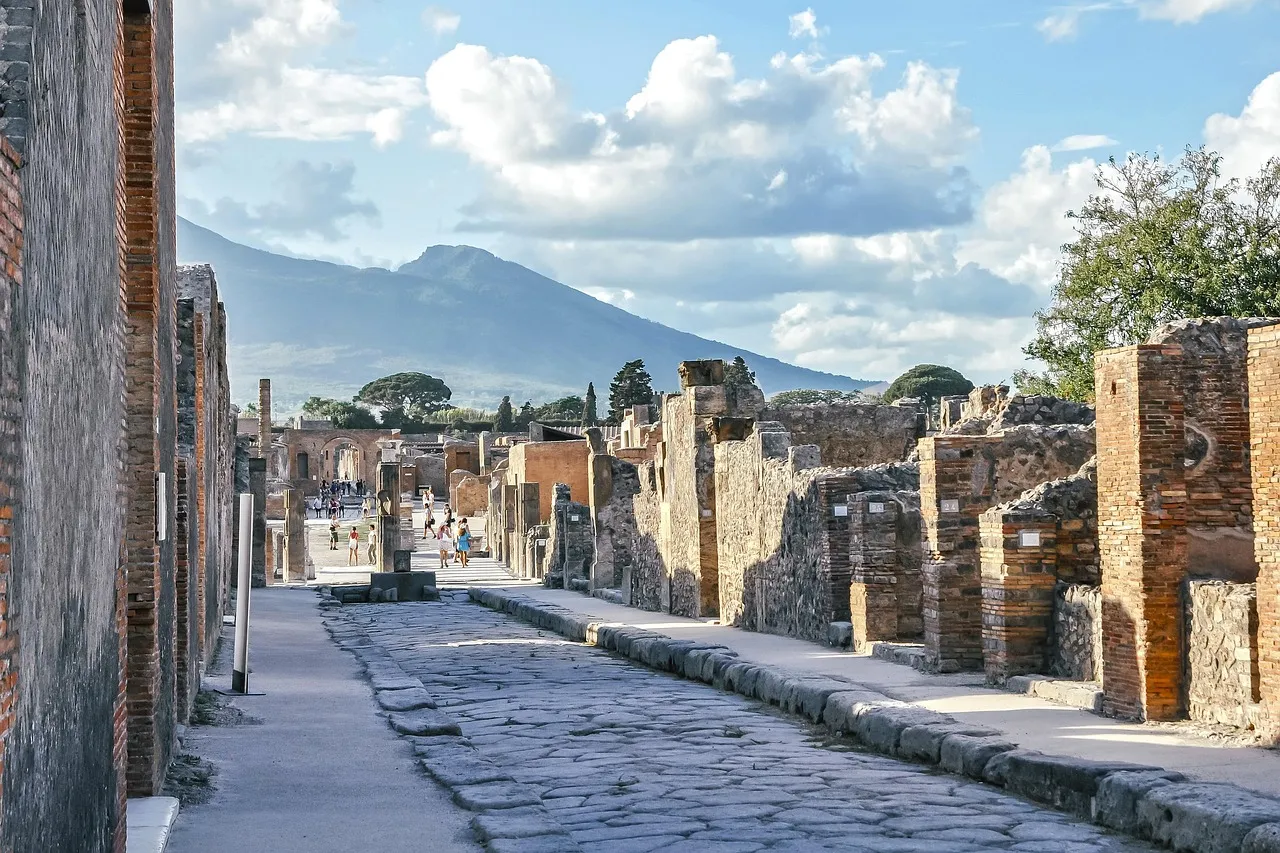
Pliny the Younger watched Vesuvius erupt in 79 CE and later wrote a first-hand account. His uncle, Pliny the Elder, died in the eruption. His account gives 24 August as the date.
That date has been questioned. A coin found at Pompeii has been used to argue for a later point in the year. Caroline Hasler, a graduate student on the team, compared it with other Roman coins of the period and concluded it was probably made before September, Berkeley News reports. The researchers allowed a two-month uncertainty to cover the dispute, which is small against a span of nearly two thousand years.
How argon dating works
Potassium-40, a radioactive form of potassium found in many volcanic minerals, slowly decays into argon-40. When a volcano erupts, the molten rock loses its argon. After the crystals cool, new argon builds up at a steady rate, so the amount present tells how long ago the eruption happened.
Argon-argon dating is the standard way to date volcanic rocks from thousands to billions of years old. The decay is slow — the half-life of this path is about 12 billion years — so young rocks are hard to date, because very little argon has had time to form. Our half-life decay calculator shows how small a fraction decays in two thousand years on that scale.
What the team measured
The samples came from pumice at Oplontis, near Pompeii, collected in 1998 by Andrea Marzoli of the University of Padua. They came from the earliest phase of the eruption, where layering in the magma chamber had concentrated potassium-rich magma, and they sat on a shelf for nearly three decades.
The team, led by Paul Renne of the Berkeley Geochronology Center and the University of California, Berkeley, analysed eight samples of sanidine, a potassium-bearing feldspar. The paper puts the eruption at 1,938 years before the measurements in 2025, give or take 13. The true figure is 1,946.
That works out to a precision of 0.7% and an accuracy of 0.4%. Renne's group had dated the same eruption in 1997, but that result was not precise enough to carry much weight. The authors credit better mass spectrometry, a different approach to the neutron irradiation the method requires, and better correction for interfering isotopes.
"If you want to put together the eruptive history of a volcano in relatively recent time, precision and accuracy really count," Renne said.
Why a Roman date helps dinosaurs
Because the true age was known, the team could run the calculation backwards and solve for the decay constant itself. That gave a half-life of 12.044 billion years, plus or minus 0.088 billion, for potassium-40 decaying to argon-40. The authors say it is twice as precise as the value obtained by counting decays directly.
Every argon-argon date depends on that constant, so tightening it improves ages throughout the geological record. Renne's earlier work used the method to place the asteroid impact, the Deccan volcanism in India and the extinction of the dinosaurs within a few tens of thousands of years of each other, 66 million years ago. On timelines like that, a small error in the constant grows into a large error in years.
The authors add that the result gives a reference point for calibrating argon dating against other methods, which rely on different decay constants.
Closer to home
The practical payoff is at the young end. Dating recent eruptions precisely lets volcanologists reconstruct how often a volcano has erupted and how its magma has changed. Berkeley names Naples, Mexico City and Yogyakarta as cities living under such volcanoes.
Yogyakarta sits beneath Merapi, one of Indonesia's most active volcanoes. A method that resolves eruptions a few thousand years old to within decades gives hazard planners there a sharper record.

View author profile → · Editorial policy