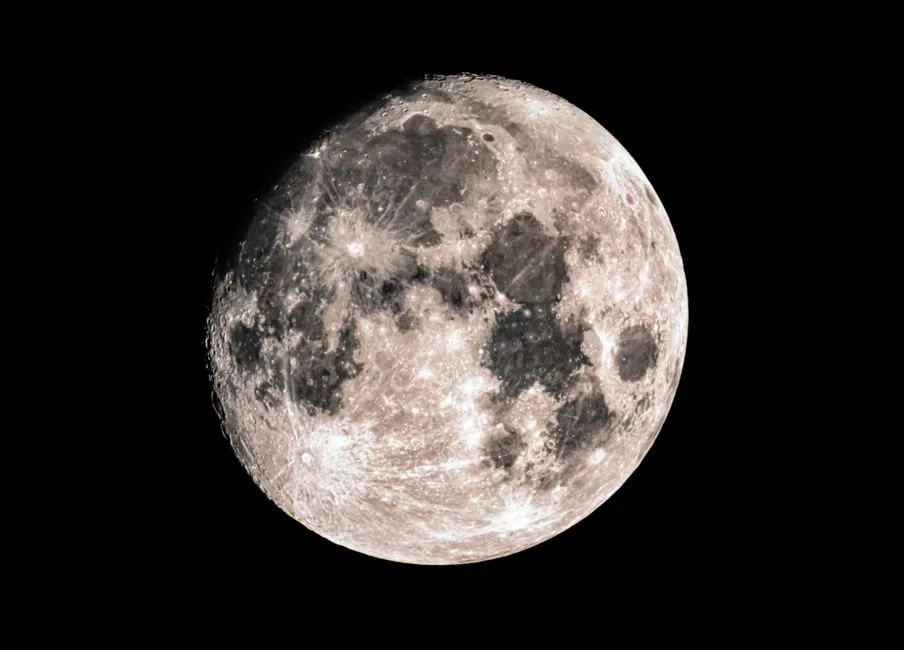
19 SEP 2026 — Something the size of a small office block hit the Moon in the spring of 2024 and left the largest fresh crater anyone has catalogued. Nobody noticed for about seventeen months.
The images were already in NASA's archive. Nobody had compared them.
What hit the Moon
The crater is 222 metres across and 43 metres deep, and it was cut by a comet or asteroid fragment comparable in size to a three- to six-storey building. The impact happened between 11 April and 22 May 2024, a window fixed by the last image showing undisturbed ground and the first showing the crater.
It has been named McGetchin, after Thomas McGetchin, a volcanologist who directed the Lunar and Planetary Institute from 1977 and whose 1973 model of how impact debris spreads still frames how crater ejecta is interpreted. The name fits for reasons the second paper makes clear.
Impacts this large are estimated to happen roughly once a century or so on the Moon. That is why the record matters: this is the biggest new crater the Lunar Reconnaissance Orbiter has found in its operating lifetime, by a factor of about three.
Seventeen months in the archive
The Wide Angle Camera photographed the area in 2024. The crater sat in that data unremarked until 24 October 2025, when Robert Wagner, an image-processing specialist at Intuitive Machines, was looking through images for new impacts.
"I just stopped, dropped everything, and started looking into what that spot was," Wagner said. The orbiter's Narrow-Angle Camera took the detailed follow-up on 5 December 2025, and the two papers describing it appeared in Science Advances on 16 September.
No telescope on Earth or in orbit caught the flash. An impact energetic enough to excavate a 222-metre hole passed unobserved in real time. We know it happened only because a spacecraft photographs the same ground repeatedly and somebody compared the pictures.
The cold ring around it
The second paper describes the wider consequences. Using LRO's Diviner radiometer, Tyler Powell and colleagues found a patch of ground about six kilometres wide surrounding the crater that runs roughly nine degrees Celsius colder than its surroundings during the lunar night.
The explanation is mechanical: the impact loosened the soil across that whole area. Looser soil holds less heat and cools faster once the Sun goes down. The crater is 222 metres wide; the ground it measurably disturbed is more than twenty times that across.
Distal regolith modification means the effect of an impact extends far beyond the hole it digs, and it shows up in temperature long after the visible damage is gone.
Why the thermal finding matters
Lunar surfaces are dated by counting craters. The assumption underneath that method is that the ground between craters is undisturbed, so the craters you count are the record of what happened.
A six-kilometre disturbance around a 222-metre crater complicates that assumption. If every modest impact modifies a patch of ground hundreds of times its own area, the surface between craters is not a neutral background. The thermal signature of past impacts may be more widespread than the visible one suggests.
We covered NASA and IBM's open lunar foundation model earlier this month, built to find features in exactly this kind of orbital imagery. A crater this large sitting unremarked for seventeen months shows the problem those tools are meant to address.
What this changes elsewhere
The immediate question is how many other large impacts are sitting unrecognised in the archive. If the biggest one on record went unnoticed in data already collected, that archive is worth re-reading rather than merely adding to.
The thermal method is the more portable result. Looking for cold spots rather than holes gives a way to find recent impacts whose craters are too small to resolve, and Diviner has been collecting that data for years.
Whether the once-a-century estimate survives is the longer question. It derives from how often craters of this size are observed to form, and the observation rate depends on somebody spotting them. In this case that took seventeen months and one person who stopped what he was doing.

View author profile → · Editorial policy