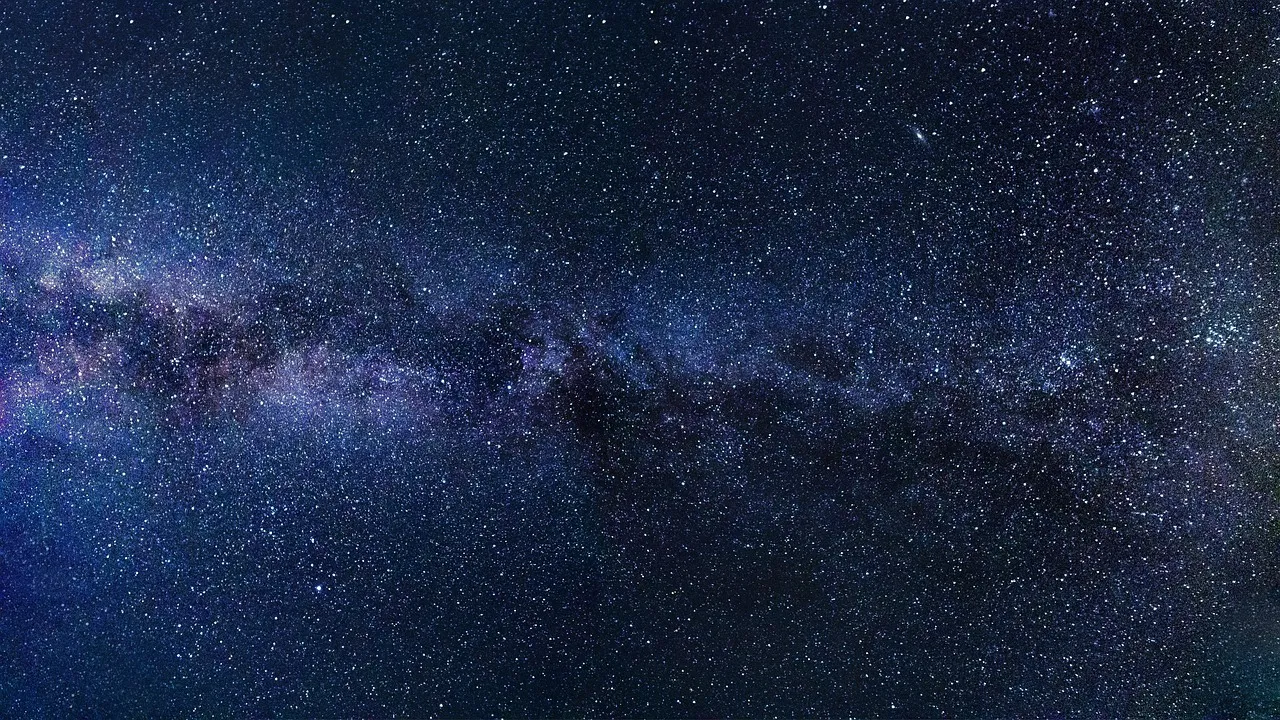
30 SEP 2026 — China's LHAASO observatory has detected high-energy gamma rays from five nearby clouds of gas in the Milky Way and used them to measure the cosmic rays passing through those clouds. The result, published in Nature Astronomy on 24 September, makes the clouds a way of sampling cosmic rays far from Earth.
It also takes a cautious step towards one of the field's open questions: where the cosmic-ray spectrum bends, and why.
Why gas clouds glow
Cosmic rays are charged particles, mostly protons, moving close to the speed of light. Magnetic fields bend their paths, so the ones that reach Earth cannot be traced back to a source, and a measurement here says little about their density elsewhere in the galaxy.
Giant molecular clouds get around that. When cosmic rays strike the gas, the collisions make gamma rays, which travel in straight lines. If the mass of a cloud is known, the gamma-ray glow reveals how many cosmic rays are passing through. The paper calls this "the most ideal tool" for measuring cosmic-ray density and energy on the spot.
What LHAASO saw
The Large High Altitude Air Shower Observatory combined four and a half years of observations of five nearby clouds, stacking them to pull a faint signal out of the background. It detected very-high-energy gamma rays, and the energy spectrum matched what cosmic rays striking interstellar gas should produce between 1 and 100 teraelectronvolts.
Why the match matters
That match is the main result. It supports the idea that the cosmic rays in these regions resemble those measured near Earth, and it gives astronomers reference points for mapping cosmic rays across the Milky Way.
The knee question
The cosmic-ray energy spectrum has a well-known bend, the knee, at around a million billion electronvolts, or one petaelectronvolt. Above it, cosmic rays become rarer more quickly. The knee is thought to mark the upper limit of what the galaxy's particle accelerators can produce, so pinning it down matters for identifying those accelerators.
The team looked for the same bend in the gamma rays and did not find a clear one. The measurements are broadly compatible with a proton knee around or above 0.9 PeV, the paper says, though somewhat lower values cannot be ruled out with current uncertainties. That is consistent with recent ground-based cosmic-ray measurements.
A long road to publication
The work first appeared as a preprint in November 2025. The journal lists it as received in August 2025 and accepted in August 2026. The published version is more cautious about the knee than the preprint, which described the data as strongly favouring a knee above 0.9 PeV.
The observatory is run by the Institute of High Energy Physics of the Chinese Academy of Sciences. More years of data from the same clouds should narrow the uncertainty on the knee, the open part of this result.

View author profile → · Editorial policy