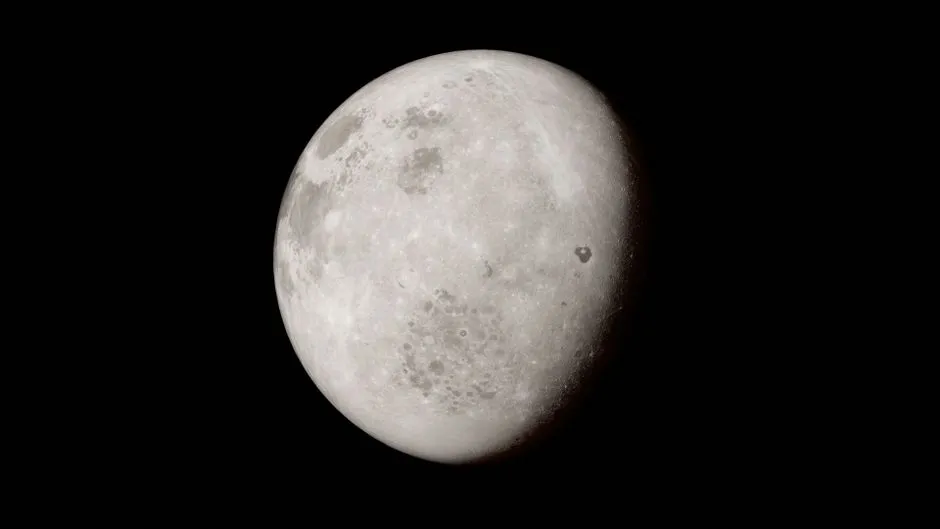
SEOUL, 11 AUG 2026 — A spent Falcon 9 upper stage hit the Moon last Wednesday, and South Korea's Danuri orbiter was overhead to photograph the result. The Korea Aerospace Administration released before-and-after images the following day showing a fresh dark mark and disturbed ground near the Einstein crater.
The impact itself was not remarkable. To put the event in context, NASA administrator Jared Isaacman noted that meteoroids strike the lunar surface hourly and that impacts comparable to this upper stage happen roughly every six days.
What was new is that this one had a name, a predicted time, and a spacecraft waiting for it.
What Danuri did
The observation was planned, not lucky. Danuri began imaging about thirty minutes before the collision and made eight passes in total, having adjusted its orbit so that it would cross the predicted impact point repeatedly. Reference images of the same ground had been secured the previous month.
Taking a baseline in advance, changing an orbit for the event, and then making a series of passes is what turns a simple photograph into a measurement. Without the earlier reference frames there would be a dark smudge and no way to prove it was not always there.
Whose rocket, and what SpaceX said
The stage had delivered Firefly Aerospace's Blue Ghost Mission 1 and ispace's RESILIENCE toward the Moon in 2025, then remained in a high orbit until its path intersected the surface.
In its acknowledgement, SpaceX noted that while "impacts like this are rare, they can happen with objects in these types of orbits", adding that "a controlled disposal maneuver is not always possible".
That is straightforwardly true and it is the crux of the problem. A stage that has done its job in a high or escape trajectory may not have propellant, attitude control or communications left to be aimed anywhere. Once it is out there on a chaotic path pulled about by the Earth and the Moon, where it ends up is arithmetic, not a decision.
Why attribution changes the question
If a comparable impact occurs naturally every six days, one more crater is not a physical problem. The Moon has taken this kind of beating for four billion years.
The change is that this crater has an owner. That converts a question about lunar geology into a question about conduct: who is responsible for hardware left in cislunar space, what constitutes adequate disposal, and who decides when a region of the surface is worth protecting.
Those questions are becoming concrete rather than theoretical. There are landers operating, sites of scientific interest, and permanently shadowed craters near the poles whose ice deposits are both a research subject and a proposed resource. An uncontrolled arrival is a low-probability threat to any one of them, but low probability multiplied by rising traffic is the classic recipe for a debris problem.
The observation is the achievement
The debris argument aside, the observation was a straightforward technical success.
Danuri is South Korea's first lunar mission. Being asked to observe a predicted impact — and having enough orbital margin, planning lead time and imaging capability to say yes and deliver eight passes — is a demonstration of operational maturity that a launch alone does not prove.
KASA administrator Oh Tae-seok framed it in exactly those terms: "The achievement will provide an important foundation for expanding the country's lunar research and future space exploration strategy."
It also fills a real gap. There are few spacecraft in lunar orbit capable of imaging a specific patch of ground on short notice, and events like this are only studied if something is positioned to look.
What we could not pin down
The reporting on this disagrees on two points and we have not resolved them.
On timing, one Korean account dates the impact to Wednesday and to 6 August; 6 August was a Thursday, and the stated time of 3:34 p.m. Korean time matches other reporting placing the impact on Wednesday 5 August. We have used 5 August. On location, sources describe the site as the western limb of the near side and as the far side. Einstein crater sits on the limb, which is the kind of place that gets described both ways depending on libration, but we cannot say which is meant.
What to watch
Whether crater dimensions get published. A measured diameter turns this from an image into a calibration point for impact physics, because the mass and velocity of the impactor are known — which is almost never true of a natural strike.
Whether disposal expectations tighten for upper stages sent beyond Earth orbit. There is no binding rule, and SpaceX's point about controlled disposal not always being possible is an argument for planning it into the mission rather than a reason to accept the outcome.
And whether anyone builds a standing capability to observe these. Danuri managed it because someone asked in time and the orbit could be adjusted. That will not always be so.

View author profile → · Editorial policy