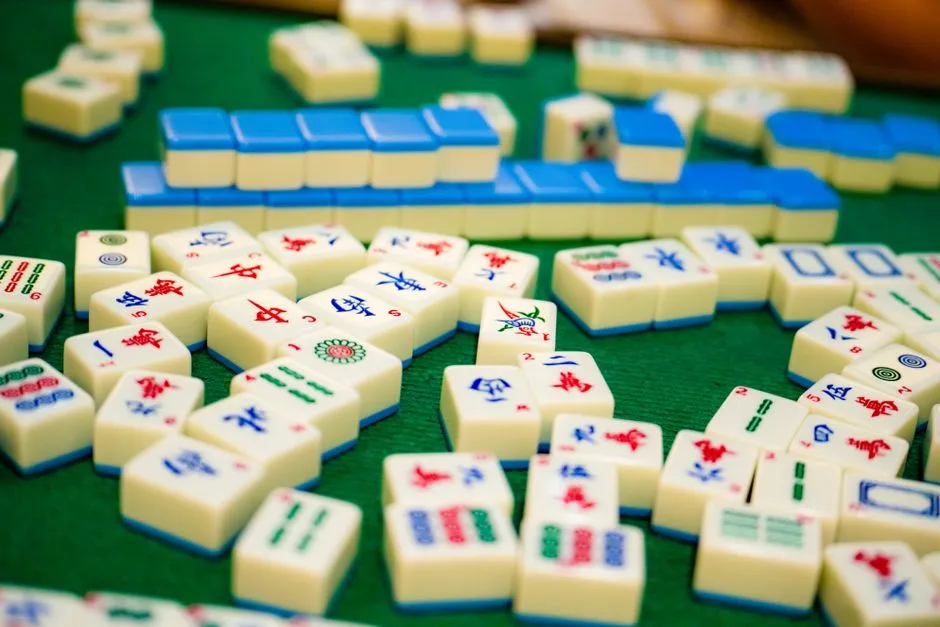
In Hong Kong mahjong (香港麻雀), a winning hand scores fan (番): you add up every pattern the hand contains. All chows (平糊) is 1 fan, all pungs (對對糊) 3, a half flush (混一色) 3 and a full flush (清一色) 7, and each pung of dragons or of your own wind adds 1. Most tables need at least 3 fan to win and stop counting at 8, 10 or 13. Those everyday values are the same in every table we checked. What differs from table to table is the rarer hands, and above all how fan are turned into points.
Take a hand that is all pungs in one suit plus honours, with one pung of red dragons, won by drawing the last tile yourself. That is 對對糊 3, 混一色 3, a dragon pung 1 and self-draw (自摸) 1: 8 fan on all five tables we compared below. On a table that doubles for every fan (辣辣上, "full spicy") it is worth 256 points. On a table that plays half spicy (半辣上), the traditional scale and the one the Hong Kong Mahjong Association uses, the same hand is worth 64. Our Hong Kong mahjong calculator does both, with the minimum fan, the cap and who pays.
Adding up the fan, and what a big hand already includes
Every pattern in the hand is added, but three of the named hands already contain smaller ones, and counting both is the commonest mistake.
- Small three dragons (小三元, two dragon pungs and a dragon pair) is 5 fan, and that includes the two dragon pungs. Do not add them again.
- Big three dragons (大三元, all three dragon pungs) is 8, including all three pungs.
- Terminals and honours (花么九, only 1s, 9s and honour tiles) is always all pungs, and its 4 fan is 1 for the pattern plus the 3 for all pungs.
A wind pung scores only if it is your seat wind or the wind of the round. A pung of your seat wind is 1 fan and a pung of the round's wind is 1; when the two are the same wind, the pung counts twice (雙番東 when both are east). Self-draw is 1, and a concealed hand (門前清, nothing claimed from another player's discard) is another 1. Winning on the last tile of the wall (海底撈月), on a kong's replacement tile (槓上開花) or by robbing another player's kong (搶槓) adds 1 more.
Rules for flowers vary widely between home games and published rule sets. In Hong Kong scoring, only a flower tile matching your seat number scores (正花, 1 fan each). A hand with no flowers at all (無花) also scores 1 fan, and collecting all four of one set (一檯花) scores 2. A stray flower is worth nothing. The rule that every flower is worth a fan belongs to Taiwanese mahjong. The Association's tournament rules leave flowers out altogether.
The hands the tables disagree about
We laid five published tables side by side: the Hong Kong Mahjong Association's tournament rulebook (revised May 2023), the Chinese and English Wikipedia pages on Hong Kong scoring, Tom Sloper's Sloperama FAQ and the user-edited mahjong.wikidot table. They agree on the everyday hands and on little else.
| Hand | Most tables | Where they differ |
|---|---|---|
| All chows 平糊 | 1 | — |
| All pungs 對對糊 | 3 | Sloperama notes some players give 1 |
| Half flush 混一色 | 3 | — |
| Full flush 清一色 | 7 | 6 in Sloperama |
| Small three dragons 小三元 | 5 | 4 in Sloperama |
| Big three dragons 大三元 | 8 | a limit hand in Sloperama |
| Small four winds 小四喜 | 6 on Wikipedia | 10 on wikidot; a limit hand for the Association |
| Seven pairs 七對子 | not a Hong Kong hand | 4 or 5 as a house rule |
So there is no single official table. The nearest thing, the Association's rulebook, is written for tournaments: it needs 3 fan to win, caps every hand at 10, counts every limit hand (例牌) as 10 and uses no flowers. Home tables borrow some of that and keep their own habits for the rest, which is why two groups can score the same hand differently and both be following "the rules".
The mahjong most often played in Singapore and Malaysia is a related but separate game, with animal tiles and scoring in tai, so none of these values apply to it.
Why a winning hand needs 3 fan
We counted every complete fourteen-tile hand possible with a 136-tile set. This includes 11,353,128,141,498 ways to form four sets and a pair (weighted by how many ways the actual tiles can be picked) and 1,308,622,848 ways to form thirteen orphans. A random fourteen-tile draw will be a complete hand about once in 374,330 tries. Our total, which also accounts for seven pairs in the Japanese style, matches a published Japanese calculation for a complete dealer's hand to the last digit (1 in 330,530), confirming the count.
By shape, most complete hands are plain. 59% are all chows. Scored on shape alone, with the winds and dragons in it but nothing for self-draw, a concealed hand or flowers, fewer than 1 complete hand in 400 reaches 3 fan. That is what the 3-fan minimum does: it stops a table from paying out on the ordinary hand, and it is why everyone at a 3-fan table ends up chasing half flushes and all pungs. The chicken hand (雞糊), a complete hand with no scoring pattern, is worth 0 fan and cannot win at most tables; an older Hong Kong game, 雞四, allowed it and topped out at 4 fan.
Full spicy or half spicy
Fan are not points. They are converted with one of two scales, and it matters far more than any disagreement over a single hand.
| Fan | 3 | 4 | 5 | 6 | 7 | 8 | 9 | 10 |
|---|---|---|---|---|---|---|---|---|
| Full spicy (辣辣上) | 8 | 16 | 32 | 64 | 128 | 256 | 512 | 1,024 |
| Half spicy (半辣上) | 8 | 16 | 24 | 32 | 48 | 64 | 96 | 128 |
Full spicy doubles with every fan. Half spicy doubles only every second fan once you pass 4. The two agree up to 4 fan and then separate fast: at a 10-fan cap the top hand is worth eight times as much on the full scale.
Who pays depends on how the hand was won. On a self-draw, each of the other three players pays half the table amount, so the winner collects one and a half times the figure. On a win from someone's discard, some tables make the discarder pay the whole amount (全銃, the Association's rule); others have the discarder pay half and the other two a quarter each. In the example at the top, 8 fan on half spicy is 64 points: won by self-draw, each opponent pays 32.
How rare each hand is, by shape
The same count gives the share of complete hands that have each shape. These are the chances of a hand looking like this if every complete hand were equally likely. They are not the odds of winning with it, because players steer toward the hands that score.
| Hand | Share of complete hands, by shape |
|---|---|
| All chows 平糊 | 59% |
| Half flush 混一色 | 1 in 534 |
| All pungs 對對糊 | 1 in 5,313 |
| Full flush 清一色 | 1 in 8,590 |
| Thirteen orphans 十三么 | 1 in 8,677 |
| Small three dragons 小三元 | 1 in 42,765 |
| Big three dragons 大三元 | 1 in 703,618 |
| Nine gates 九子連環 | 1 in 1.31 million |
| Small four winds 小四喜 | 1 in 5.05 million |
| All honours 字一色 | 1 in 70.4 million |
| Big four winds 大四喜 / all terminals 清么九 | 1 in 246 million each |
By shape, thirteen orphans is about as common as a full flush, and it is far from the rarest limit hand: all honours, big four winds and all terminals are thousands of times rarer. Real games look different. No public record of Hong Kong games exists, but the largest record of wins in Japanese riichi mahjong, a different game with different rules, shows the direction: among 1,511,570 wins on the Tenhou site's top tables in 2023, full flushes outnumbered thirteen orphans about 28 to 1, because players build toward a flush and rarely toward thirteen orphans.
Five things to settle before the first tile
- The minimum. 3 fan is usual; some tables play lower.
- The cap. 8, 10 or 13 fan, and whether a limit hand is worth the cap.
- The scale. Full spicy or half spicy.
- Who pays on a discard. The discarder alone, or the discarder half and the others a quarter each.
- The house hands. Whether flowers count, and whether seven pairs or any other extra hand is allowed.
The values here follow the Hong Kong tables on Chinese Wikipedia and English Wikipedia and the Hong Kong Mahjong Association's tournament rulebook. The hand count is ours, checked against the Japanese calculation above; the riichi figures are from a published tally of Tenhou's 2023 top-table games.

View author profile → · Editorial policy