Malaysia scrapped GST in 2018 and brought back the Sales and Service Tax — but "SST" is a misleading name, because it is not one tax. It is two separate taxes that never meet: sales tax, charged once when goods leave a Malaysian factory or clear customs at import, and service tax, charged at the counter when you pay a registered business for a taxable service. One is baked into shelf prices before you ever see them; the other shows up as a line on your restaurant, telco or streaming bill.
If your mental model of SST dates from 2019, it is now wrong in several expensive ways. The service tax rate went from 6% to 8% for most services on 1 March 2024. On 1 July 2025 the Ministry of Finance expanded the net again — commercial rent, construction, financial services, private healthcare and private education all became taxable. Then, from 1 January 2026, the rental rate was cut back from 8% to 6% and the small-tenant exemption was widened.
This guide sets out what each tax covers in 2026, walks through three receipts line by line, and flags the mistakes that cost real money — including one that some restaurant POS systems still get wrong.
Sales tax: 5% or 10%, once
Sales tax applies to taxable goods manufactured in or imported into Malaysia, at 5% or 10% depending on the tariff line in the Sales Tax (Rates of Tax) Order — 10% is the default, 5% applies to a listed set of goods. The July 2025 "targeted revision" kept essential goods where they were and moved discretionary items to 5% or 10%. After public feedback, the government exempted imported apples, oranges, mandarin oranges and dates on 28 June 2025; rice, chicken, beef, vegetables, eggs and local fish were already exempt and stayed that way. From January 2026, sales-tax relief was also extended to animal feed, fertilisers and pesticides for registered manufacturers.
That word "once" is important. Sales tax is single-stage: it is levied at the manufacturer or importer, and never again. The wholesaler and retailer do not add it back — it is already inside their cost price, and they mark up on that tax-inclusive cost. This is why "sales tax" is never itemised on a supermarket receipt; it’s already embedded in the shelf price.
One exception reaches consumers directly: imported low-value goods. Since 1 January 2024, anything priced RM500 or below, bought online and shipped into Malaysia, carries 10% sales tax. The old under-RM500 de-minimis for online parcels is gone. Sellers — local or foreign platforms — with more than RM500,000 a year of such sales into Malaysia must register and charge it.
Service tax: 6% or 8%, and it depends what for
There is no single service tax rate in 2026. The 1 March 2024 hike took most services to 8% but deliberately kept everyday categories at 6%, and the 2025 expansion added new categories at both rates. Here is the map:
| Category | Rate in 2026 | Notes |
|---|---|---|
| Food & beverage (restaurants, cafés) | 6% | Stayed at 6% through the 2024 hike; only operators above RM1.5m turnover charge it |
| Telecommunications, parking, logistics | 6% | Kept at 6% in March 2024 to shield daily spending |
| Most other services (professional, insurance, hotels, maintenance & repair, brokerage) | 8% | Standard rate since 1 March 2024 |
| Digital services (Netflix, Spotify, cloud, app stores) | 8% | Charged by foreign registered providers since 2020; 8% since March 2024 |
| Commercial rental / leasing (new July 2025) | 6% from 1 Jan 2026 | Was 8% during 2025; landlord registration threshold RM1m; residential rental exempt; MSME tenants with sales ≤ RM1.5m exempt |
| Construction work services (new July 2025) | 6% | Threshold RM1.5m; pre-July-2025 non-reviewable contracts exempt until 30 Jun 2027 |
| Financial services (new July 2025) | 8% | Fee/commission-based services only — not interest; threshold RM1m |
| Private healthcare (new July 2025) | 6% | Non-Malaysian citizens only; Malaysians pay no service tax on private healthcare |
| Private education (new July 2025) | 6% | Where fees exceed RM60,000 per student per year; higher education for international students |
| Credit / charge cards | RM25 flat | Per card per year, principal and supplementary — never 6% or 8% |
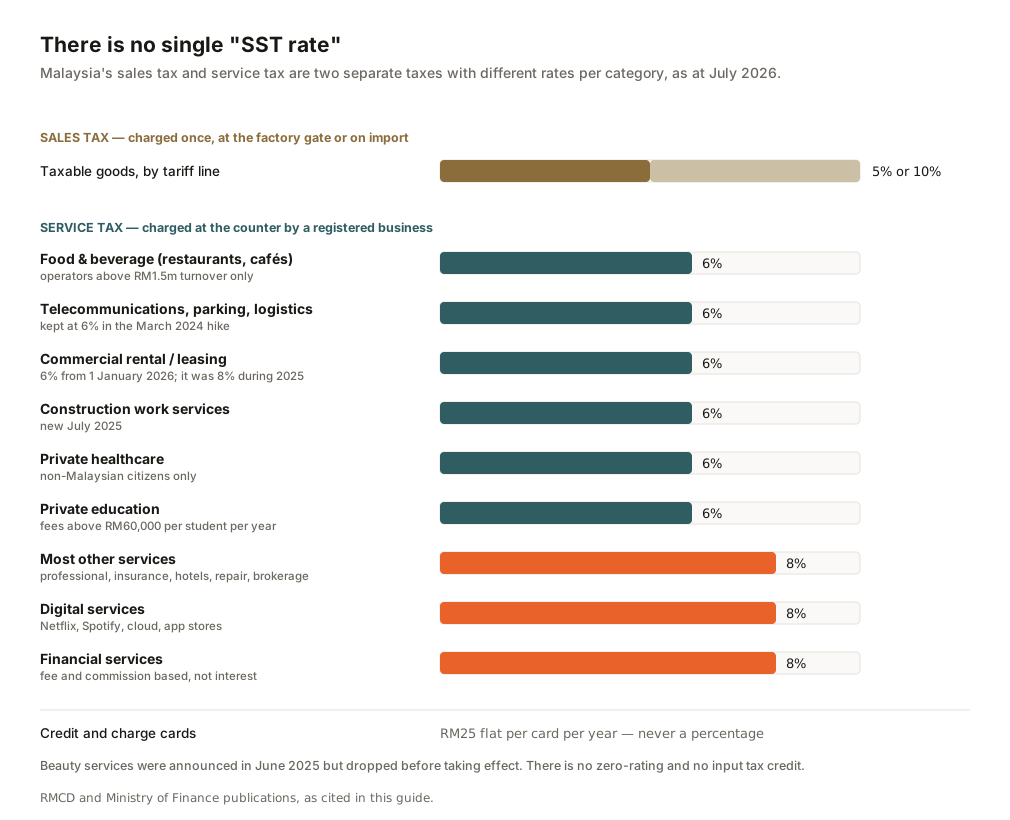
Two footnotes to that table. Beauty services were announced in the June 2025 package but dropped before taking effect, so your haircut carries no service tax. And the rental cut from 8% to 6% took effect 1 January 2026 alongside a higher tenant-relief threshold: a business tenant with annual sales of RM1.5 million or less (up from RM1 million in 2025) is exempt from service tax on its rent — the landlord applies the exemption against the tenant's declaration. The grace period for the new 2025 categories ended on 31 December 2025; enforcement is now in full effect.
Three receipts, computed
(a) The RM200 restaurant bill
You order RM200 of food at a service-tax-registered restaurant that adds a 10% service charge. Per the RMCD Guide on Food & Beverage, service tax is calculated on the actual price excluding service charge — and service charge itself is not subject to service tax. Both charges therefore hit the same RM200 base:
| Line item | Amount |
|---|---|
| Food & beverages | RM200.00 |
| Service charge @ 10% × RM200 (kept by the restaurant — not a tax) | RM20.00 |
| Service tax @ 6% × RM200 (remitted to Customs) | RM12.00 |
| Total | RM232.00 |
The wrong version — 6% computed on RM220, i.e. tax on top of the service charge — gives RM233.20. That contradicts RMCD's own guide, yet some POS systems are configured that way, overcharging RM1.20 on this bill. If your receipt shows service tax on the post-service-charge subtotal, the restaurant has it wrong — our SST calculator applies the correct base, so you can put a disputed bill through it before raising the question. And if a small kopitiam charges you no service tax at all, that is correct too: only F&B operators above RM1.5 million turnover charge the 6% in the first place.
(b) A business buys RM50,000 of taxable goods
A registered manufacturer sells your company RM50,000 of goods taxable at 10%. The invoice reads RM50,000 + RM5,000 sales tax = RM55,000. Under SST there is no input tax credit, so that RM5,000 is not reclaimable. It becomes a cost you absorb or pass on. When you resell the goods, you do not charge sales tax again; single-stage means the tax stuck once, at the factory gate. The relief valve exists upstream instead: registered manufacturers can buy raw materials tax-free for manufacturing taxable goods, under the Sales Tax (Persons Exempted From Payment Of Tax) Order 2018.
(c) The SME landlord crossing RM1 million in rent
Your company rents out commercial shoplots, and rolling 12-month rental income passes RM1,000,000. You now have three obligations:
- Register on the MySST portal — liability arises once taxable rental income exceeds RM1m over 12 months (historical or projected), and registration takes effect from the first day of the following month.
- Charge 6% service tax on commercial rent from your effective date (the rate since 1 January 2026; it was 8% during 2025).
- Do not charge it on residential property, or to tenants who qualify for the MSME exemption (annual sales ≤ RM1.5m) — collect each exempt tenant's declaration and keep it on file.
- File SST-02 returns every two months and pay by the last day of the month after each taxable period; keep records for seven years.
The penalty-free grace period ended 31 December 2025, so late registration now carries real consequences.
Want to check your own numbers — a restaurant bill, an invoice, a rental charge — without doing the arithmetic by hand? Our GST/SST Calculator handles Malaysia's service tax and sales tax rates, plus regional GST/VAT presets. And if you are an SME owner working out staff costs alongside SST, our payroll deductions guide covers EPF, SOCSO and EIS the same way — line by line.
Five things people get wrong
- "Service charge is a government tax." No. The 10% service charge is a private charge kept by the establishment and its staff. Only the 6% service tax goes to Customs — and as shown above, the tax is computed on the price excluding the service charge.
- "So is SST 6% or 8%?" Neither and both. Goods carry sales tax at 5% or 10%; services carry 8% as standard, with 6% for F&B, telco, parking, logistics, construction, rental (from 2026), private healthcare and education; credit cards are RM25 flat. There is no single "SST rate".
- "Foreign apps and subscriptions are tax-free." Foreign digital services have carried Malaysian service tax since January 2020 — at 8% since March 2024. Businesses importing taxable services from abroad must self-account for the 8% even if not otherwise registered.
- "Exempt and zero-rated are the same thing." Under the old GST, zero-rating meant 0% with input credits. SST has no zero-rating and no credits at all — and "exemption" often attaches to a person (a registered manufacturer buying inputs, an MSME tenant) rather than the item.
- "It works like GST, just renamed." The deepest difference is structural. GST was multi-stage with input credits, so tax washed through businesses to land on the final consumer. SST is single-stage with no credits — a business's service tax on rent or professional fees is a real cost that can cascade quietly into prices. The narrow B2B exemptions in the 2025 expansion exist precisely to limit that cascading.
How Malaysia compares
Among its neighbours, Malaysia is the structural outlier — the only one of the four without a credit-method GST/VAT. Singapore's GST has been 9% since 1 January 2024; Indonesia's VAT is statutorily 12% but effectively 11% for everything except luxury goods; Thailand's VAT remains 7%, extended by royal decree through 30 September 2026. Comparing headline rates understates the difference: SST's base is narrower and it is collected at a single point, so a lower-looking Malaysian rate is not directly comparable to a 9% GST applied to nearly everything.
What this guide doesn't cover
Deliberately out of scope: the special rules for designated areas (Langkawi, Labuan, Tioman), industry-specific exemption orders, the detailed B2B exemption mechanics in financial services and construction, and item-by-item tariff classification under the Sales Tax (Rates of Tax) Order 2025 — if a specific product's rate matters to your business, check the tariff line or ask Customs directly via mysst.customs.gov.my.
Figures in this guide were verified in July 2026 against RMCD and Ministry of Finance publications, including the RMCD industry guides on mysst.customs.gov.my. The regime has changed four times in twenty-four months; re-check thresholds before making any registration decisions. This is general information, not tax advice — for anything with money riding on it, engage a licensed tax agent.

View author profile → · Editorial policy