Every Malaysian payslip has a line for PCB — Potongan Cukai Bulanan, or Monthly Tax Deduction (MTD). This is income tax, deducted by your employer before your salary hits your bank account. LHDN's own definition: a mechanism in which employers deduct employees' salaries on a monthly basis for the purpose of paying the employees' income tax (LHDN, MTD Payment). Your employer computes it using either LHDN's published schedule or the computerised calculation formula set out in the official MTD specification, and must remit it to LHDN by the 15th of the following month (LHDN, Employer's Responsibility).
Before we get to the formula, internalise this: PCB is an estimate of your annual tax, not your final bill. The formula projects what you will earn for the whole year, works out the tax on it, and deducts a slice each month. The final reckoning happens when you e-File, where the difference becomes a refund or a top-up.
For 2026, the numbers behind that estimate shifted slightly — but not where most people expect. Budget 2026 changed several tax reliefs (childcare, vaccinations, domestic tourism and more, listed below), while the tax rates, bands and the formula itself are unchanged. LHDN's 2026 MTD specification says so directly: "there is no amendment to the MTD formula" (2026 MTD Specification, p.7).
The formula, in plain words
Behind the symbols, the computerised calculation runs through four steps every month:
- Annualise your pay. It adds up what you have already earned this year, this month's salary, and an estimate of the remaining months at your current salary.
- Subtract the reliefs it knows about. Automatically: RM9,000 individual relief (every resident gets it), RM4,000 spouse relief if your spouse has no income, RM2,000 per qualifying child, and your EPF contributions capped at RM4,000 a year. Anything else — lifestyle, medical, insurance — only enters if you file Form TP1 through your employer.
- Apply the rate bands to what is left (your projected chargeable income) to get the tax for the whole year.
- Divide across the remaining months. Whatever tax the year still owes, after crediting the PCB you have already paid, is split evenly over the months left — including this one.
The formula from the 2026 MTD specification (p.10) is:
Monthly Tax Deduction for the current month = [(P − M) R + B − (Z + X)] ÷ (n + 1)
| Symbol | Meaning |
|---|---|
| P | Projected chargeable income for the full year (annualised pay minus reliefs) |
| M | The floor of the tax band P falls into |
| R | The tax rate for that band |
| B | Tax on M, with the individual (and spouse, if qualified) rebate already baked in — which is why B is negative in the lowest bands |
| Z | Zakat you have already paid this year |
| X | PCB you have already paid this year |
| n + 1 | Months remaining in the year, including the current one |
The specification (p.19) adds two mechanical quirks. Intermediate figures are truncated to two decimal places and the final amount is rounded up to the nearest 5 sen. If the computed PCB is under RM10, your employer is not required to deduct it at all.
The 2026 rate bands
These are the resident individual rates the 2026 MTD computation uses — identical to the published YA 2023–2025 table (LHDN, Tax Rate); the 2026 specification's band table carries the same floors and rates.
| Chargeable income (RM) | Rate | Tax on this band (RM) | Cumulative tax at top of band (RM) |
|---|---|---|---|
| 0 – 5,000 | 0% | 0 | 0 |
| 5,001 – 20,000 | 1% | 150 | 150 |
| 20,001 – 35,000 | 3% | 450 | 600 |
| 35,001 – 50,000 | 6% | 900 | 1,500 |
| 50,001 – 70,000 | 11% | 2,200 | 3,700 |
| 70,001 – 100,000 | 19% | 5,700 | 9,400 |
| 100,001 – 400,000 | 25% | 75,000 | 84,400 |
| 400,001 – 600,000 | 26% | 52,000 | 136,400 |
| 600,001 – 2,000,000 | 28% | 392,000 | 528,400 |
| Exceeding 2,000,000 | 30% | — | — |
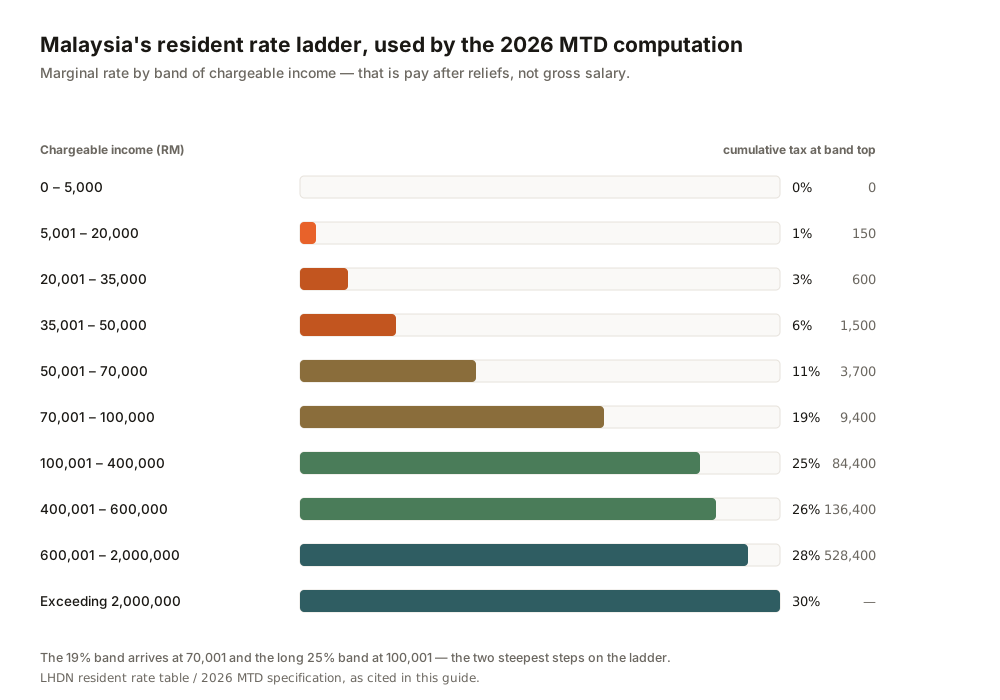
Remember these apply to chargeable income — pay after reliefs — not your gross salary. That gap is why the first RM13,000 or so of a typical single employee's salary is effectively untouched.
Worked example: RM6,000 a month, single
Resident, single, RM6,000 monthly salary, 11% employee EPF (RM660 a month), no other reliefs, no zakat, computed for January 2026 — so nothing earned yet, and 12 months to spread across.
Step 1 — EPF. This month's EPF is RM660, within the RM4,000 annual relief cap (2026 MTD Spec, p.25). For the remaining 11 months the formula spreads the leftover cap: (4,000 − 660) ÷ 11 = RM303.63 per month (truncated), taken because it is lower than RM660.
Step 2 — Chargeable income P. Annualised pay minus reliefs: (6,000 − 660) + (6,000 − 303.63) × 11, minus the RM9,000 individual relief (spec, p.26) = 5,340.00 + 62,660.07 − 9,000.00 = RM59,000.07. (The odd 7 sen is purely the truncation of 303.63.)
Step 3 — Band lookup. RM59,000.07 falls in the 50,001–70,000 band: M = 50,000, R = 11%, B = 1,500 (spec Table 1, p.11).
Step 4 — Monthly PCB. [(59,000.07 − 50,000) × 0.11 + 1,500] ÷ 12 = (990.00 + 1,500) ÷ 12 = 2,490.00 ÷ 12 = RM207.50 a month, or RM2,490.00 for the year — already a 5-sen multiple, so no rounding needed.
We verified this end to end against LHDN's own 2026 PCB calculator at calcpcbplus.hasil.gov.my, which returns the same P, the same band values and the same RM207.50. For a quick estimate of your own annual tax and monthly PCB, try our Malaysia PCB Calculator. Our calculator is a simplified estimator. It applies the annual rate bands directly rather than using the official month-by-month formula, so its result can land a few ringgit off your actual payslip. LHDN's own e-CP39/PCB calculator is the definitive source for the exact figure.
Why your PCB isn't your final tax
The default PCB computation only knows about the reliefs above. If you claim anything more at e-Filing — lifestyle, medical, insurance, PRS — your actual tax comes out lower than what was withheld, and you get a refund. If you have income PCB never saw — rental, dividends, a side business — or you changed employers mid-year, you may owe a top-up. Filing is where the estimate meets reality.
There is a narrow path where PCB is the final word: LHDN allows employees to skip filing only if every condition holds — employment income only (no benefits-in-kind or employer-provided accommodation), PCB was deducted on it, you worked twelve months with the same employer, your tax was not borne by the employer, and no joint assessment (LHDN FAQ, MTD As Final Tax). Miss any one, or want to claim reliefs PCB didn't capture, and you file as usual.
Two more reasons the payslip number moves around. Bonus months: A bonus, arrears or commission is handled with a separate formula. It annualises the extra income and withholds the entire year's tax on it in one go. The deduction looks brutal on that one payslip, but it is just your true marginal rate at work, not a penalty. Zakat: zakat paid through salary deduction offsets PCB ringgit for ringgit in the same month — it is a direct offset against the deduction, not a relief from income (spec, pp.10, 19–20).
What changed for 2026
Budget 2026 amended seven relief items, all entering the PCB computation via the 2026 TP1/TP3 forms (2026 MTD Spec, pp.4–8):
- Vaccination relief (within the RM1,000 sub-limit of the RM10,000 medical relief) expanded from a named list to all NPRA-registered vaccines, for self, spouse and child.
- Parents/grandparents medical relief (RM8,000): the RM1,000 check-up sub-limit now includes vaccination costs.
- Childcare fees relief: made a permanent single RM3,000, extended to JKM-registered daily care and after-school transit centres, and to children up to 12 (was 6).
- Life insurance/takaful relief (RM3,000) now covers children as insured persons.
- Learning-disability relief raised from RM6,000 to RM10,000 (within the RM10,000 medical total) for children 18 and under.
- Domestic tourism relief returns for YA 2026 only: up to RM1,000 for attraction admission fees and cultural or arts programmes.
- RM2,500 EV-charging relief (YA 2026–2027) extended to household food-waste grinders and home CCTV, claimable once per two years of assessment.
The tax rates, bands, and the MTD formula itself are all unchanged from last year. If your PCB moved in January 2026 without a salary change, the reason is likely in your TP1 claims, not the tax table.
Common confusions
"My colleague earns the same but pays different PCB." Almost always category or claims. The formula splits employees into Category 1 (single), Category 2 (married, spouse not working — extra RM4,000 spouse relief and a more generous B in the low bands) and Category 3 (married with a working spouse, divorced, or widowed). Add child relief counts, TP1 claims, zakat and prior-employer income, and two identical salaries rarely produce identical deductions.
"Ticking 'married' didn't change my PCB." If your spouse works, you are Category 3 — no spouse relief, and the same B values as a single employee. The married advantage in the formula exists only when the spouse has no income or you elect joint assessment.
"My EPF is 11% — why doesn't all of it reduce my tax?" You contribute 11% of salary, but the PCB formula caps the EPF relief at RM4,000 a year (spec, p.25). On RM6,000 a month you contribute RM7,920 a year; only RM4,000 of it shields income from tax. (How the 11% itself is computed — and SOCSO and EIS alongside it — is covered in the EPF/SOCSO/EIS guide.)
"I got a raise in July and my PCB jumped way more than the raise." The formula recomputes your full-year tax at the new salary, credits what you have already paid (X), and spreads the entire shortfall over just the remaining months. A mid-year raise triggers this catch-up withholding; the monthly deduction will settle back to a normal level the following January.
One aside for cross-border readers: if you are weighing a Malaysian package against a Singapore one, the withholding systems and effective rates differ substantially — compare take-home with the SG–MY tax calculator.
What this guide doesn't cover
This guide is for resident employees whose tax is calculated using the computerised PCB formula. It does not cover: non-residents (a flat 30% MTD applies — spec, p.9); the detailed valuation of benefits-in-kind and perquisites such as company cars or accommodation; freelancers and business owners, who prepay tax by instalments rather than PCB; or the mechanics of the employer-side e-PCB submission systems, which LHDN is consolidating into e-PCB Plus on MyTax.
Figures verified July 2026 against LHDN's 2026 MTD specification and the official Kalkulator PCB 2026. This is general information, not tax advice — for decisions about your own filing position, consult LHDN or a licensed tax agent.

View author profile → · Editorial policy