

If you have registered a company in Malaysia or Singapore, you have probably had your first few name choices rejected for reasons that seem arbitrary. They are not. Both registries run a mechanical test, both publish the rules, and almost nobody reads them before filing.
This guide covers what SSM and ACRA actually accept, and then the half that no registry deals with at all — the Chinese name, which in both countries is a trading identity with no registered standing, and which carries a stroke-counting tradition that turns out to be harder arithmetic than the people selling it usually admit.
The identical-name test strips your name before comparing it
The main reason carefully chosen names fail is that the registries do not compare the name you typed. They first reduce it to a stem, then compare the stems.
In Malaysia the rules are in paragraph 11 of SSM's Guidelines on Company Names. In Singapore they are in the Companies (Identical Names) Rules, made under the Companies Act. The two lists are strikingly similar:
| Disregarded when comparing | Malaysia — SSM | Singapore — ACRA |
|---|---|---|
| "The" as the first word | Yes | Yes |
| Entity suffixes | Sendirian, Sdn, Berhad, Bhd, PLT | Private, Pte, Sendirian, Sdn, Limited, Ltd, Berhad, Bhd |
| Trailing words | Company, Co, Syarikat, Corporation, Corp, Incorporated, Inc, Holding, Group, Kumpulan, Malaysia, (M), Msia, Consortium, Consolidated | company, and company, corporation, Incorporated, Asia, Asia Pacific, International, Singapore, South Asia, South East Asia, Worldwide |
| Plurals | Yes | Yes |
| Case, spacing, punctuation | Yes | Yes |
| "&" | Means "and" or "dan" | Means "and" |
| Root words | Yes — Trade / Trading / Trader are one word | Not listed |
Read that table again with your own rejected name in hand. Happy Hamsters and Happy! Hamsters are the same name. So are Faraway Tour and Far-Away Tour. In Malaysia, so are Summit Trading and Summit Traders, because the guidelines treat Trade, Trading and Trader as one root — and the same applies to Consultancy, Consultants and Consults, and to Technology, Technologies and Tech.
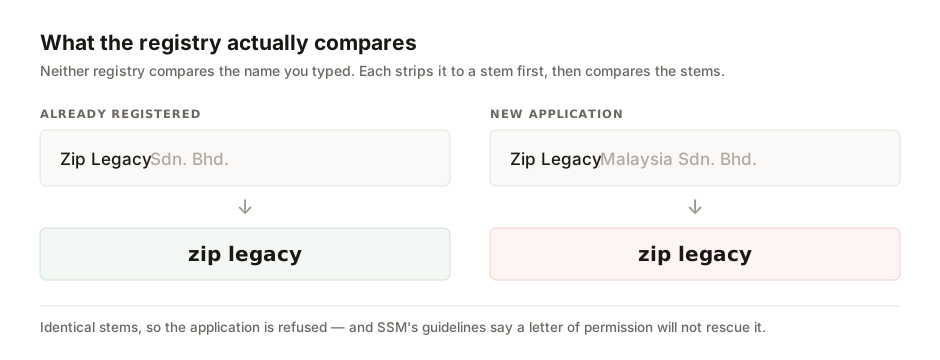
SSM's own worked example is the one worth memorising. Against an existing Zip Legacy Sdn. Bhd., a new application for Zip Legacy Malaysia Sdn. Bhd. is refused — and the guidelines state plainly that it "cannot be considered even if a letter of permission is attached". Adding your country to the end of somebody else's name is not differentiation.
What does distinguish, with consent: Holding, Group, Kumpulan, Consortium, Konsortium, Consolidated.
There is a quiet piece of shared history in Singapore's list. Its rules disregard Sendirian, Sdn, Berhad and Bhd, and the Companies Act still provides at section 27(7)–(9) for a Singapore company to end its name in "Berhad" or "Sendirian Berhad". Two registries that diverged in 1965 are still running on the same statutory chassis.
The words that need somebody else's permission
Beyond the identical test, a second filter catches words the registrar will not hand out on request.
Malaysia's list is set by ministerial direction and is long. Royal connection: Royal, King, Queen, Prince, Princess, Crown, Regent, Imperial. Government connection: Federal, State, National. International bodies: ASEAN, UNESCO, NATO, OPEC. And a straight word list that catches a surprising amount of ordinary commercial vocabulary: Bank, Bureau, Chartered, College, Consumer, Council, Credit, Exchange, Finance, Foundation, Fund, Guarantee, Institute, Insurance, Investment, Leasing, Prime, Registry, Treasury, Trust, University, among others. Appealing to the Minister for one of these costs RM300 and the Minister's decision is final.
There are sensible carve-outs. "King" is allowed where it refers to a place (Taman Mahkota), a product size, a brand such as Musang King, or a director's actual name on their identity card.
Beyond that, twenty-one referral authorities control their own vocabulary, and a name containing their words needs a letter from them before SSM will process it. Bank Negara holds Bank, Finance, Forex, Takaful, Remittance and Money Changer. JAKIM holds Islam, Halal, Masjid, Wasiat — and, less obviously, Crypto. MDEC holds Cyber, Siber and MSC. The accountancy institute holds Accountant, Auditor, Tax and Cukai.
Singapore runs the same idea with a shorter list. The Ministry of Law is consulted on law, legal, counsel, chamber, advocate, solicitor and LLC. MAS on bank and finance-company terms. The Ministry of Education on academy, college, institute and university. MINDEF on military and defence. The Professional Engineers Board on "professional engineering", "professional engineers" and even the two letters PE. The Tourism Board guards the Merlion.
- How long you get. In Malaysia a reserved name is held for 30 days, or longer at the Registrar's discretion. Singapore gives you 60 days, with one 60-day extension possible — the basis for ACRA's advertised 120-day holding period.
- How long a referral adds. ACRA's referral-authorities page says up to 15 working days. Its own name-choosing page says a referral can add 14 to 60 days. The two pages disagree; plan for the longer one.
What a name search does not tell you
A successful name search is not the end of the story. Three things still catch people out.
An approved name is not an approved company. Section 27(15) of Singapore's Companies Act says outright that reserving a name "does not in itself entitle" you to be registered under it. Reservation stops other people taking it. That is all it does.
Registration is not a trademark. These are separate systems run by separate agencies — MyIPO in Malaysia under the Trademarks Act 2019, IPOS in Singapore. IPOS puts it flatly: a business name registration with ACRA "does not equate to trade mark protection". If you want exclusive rights to use the name on your goods and services, that is a second application.
The risk runs the other way, too. Your company registration does not protect you from somebody else's trademark. Under section 27(2)(c) of the Companies Act, if a trademark holder wins an injunction against your name under the Trade Marks Act 1998, the Registrar can force you to change it.
Someone can object to your name after registration, but not forever. Anyone can ask the Registrar to order a rename where a name "so nearly resembles" another that it is likely to be mistaken for it. But under section 27(2A) that complaint must reach the Registrar within 12 months of the other company's incorporation. If a near-copy of your name incorporates next door, you have a year to object, and then you do not.
What happens if you get it wrong after you are registered
Both registries can order a change after the fact. In Singapore you get six weeks to comply, and failing to is an offence carrying a fine of up to S$2,000 plus a default penalty. In Malaysia you get 60 days — and if you do not comply, section 29(2) of the Companies Act 2016 lets the Registrar change your company's name to its registration number. Not a suggested alternative. Your number.
Waiting periods for reusing a dead company's name differ too, and the gap is wider than you would expect. After a striking-off, Malaysia makes you wait seven years; Singapore, six. After a winding-up, both say two.
The other name, the one nobody registers
Most Chinese-owned businesses in both countries run under two names. Only one of them is registered.
Malaysia at least acknowledges the second exists. Paragraph 8(c) of the SSM guidelines requires that where a name "contains words other than the Malay or English languages, the meaning of such words must be given" — so a romanised Chinese name must be explained to the registrar, and a coined word must have its meaning declared. Singapore's Act and rules operate throughout in Latin script and say nothing about other writing systems at all.
The practical consequence is the same in both places: the characters on your shopfront, your invoices and your red packets have no registered standing. They are not reserved, they are not searched against, and nothing stops the business two streets over from using them. Whatever protection they have comes from trademark registration, not company registration — which is a second argument for the second application.
It also means the two names can drift apart, and they often do. An English name chosen for the registry and a Chinese name chosen by the family are answering to different constraints, and nobody checks that they agree.
A third constraint gets forgotten entirely: a name is heard before it is read. The same characters are pronounced differently in Mandarin, Hokkien, Cantonese, Teochew and Hakka, and a name that is elegant in one can be unfortunate in another. If your customers are in Penang and your name was chosen in Mandarin, someone should say it aloud in Hokkien first. Where the name is built on a family surname — as a great many are — our Chinese surname origin lookup gives the Hokkien and Cantonese romanisations alongside the Mandarin, which is usually enough to hear the problem.
The stroke tradition — and the arithmetic nobody checks
Then there is 三才五格, the five-grid system, which a great many business owners in this region consult before settling a name. It counts the strokes in the characters, derives five numbers, and reads each against a table of 81. The system is a naming tradition developed by the Japanese scholar Kumasaki Kenmou in the 1920s and spread through Taiwan and Hong Kong. It is a cultural framework, not a predictive method, and this guide describes what it holds rather than what it will do to your business.
But it does make an arithmetic claim, and arithmetic can be checked. So we checked our own tools — and found them wrong.
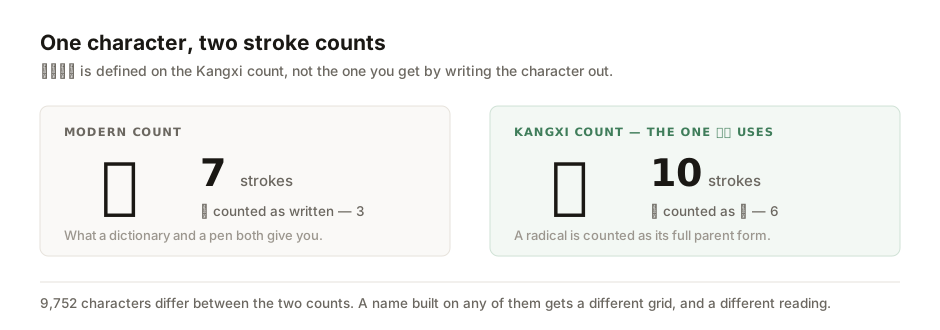
The system is not defined on the stroke count you get by writing the character out. It uses 康熙字典 counts, where a component radical is counted as its full parent form: 氵 counts as 水 (4), 艹 as 艸 (6), 忄 as 心 (4), 扌 as 手 (4). Simplified characters are counted as their traditional originals. Until 27 July 2026 all three of our five-grid tools counted strokes the modern way, which is wrong for this system — 9,752 characters came out differently, and 花 was off by three. Our sancai tool's own help text had been promising it used Kangxi counts for months while the code did not. That is fixed, and the correction is left in place on the tool page.
Rebuilding our tools properly taught us three things to check in any online calculator, including our own:
The biggest surprise is that the tradition is not internally consistent about simplified characters. 万 is counted as 萬 (15), but 于 stays 于 (3) rather than becoming 於 (8) — and both are genuine traditional characters. There is no rule that separates them. Getting our figures to match published surname tables required a hand-maintained list of twelve exceptions: 于 余 范 后 干 斗 里 郁 征 采 朴 咸. A system that presents itself as arithmetic turns out to need a list of things the arithmetic gets wrong.
You can reproduce all of this. Type a name into the Chinese name 5-grid analyzer and every character shows its Kangxi count with the modern count beside it wherever the two differ, along with the traditional form the count was taken through and a note where the reading is contested. For a company name rather than a personal one, the business name analyzer does the same and totals it; the 三才五格 analyzer gives the fuller five-grid reading. If you only want a plain stroke count with no tradition attached, use the stroke count lookup.
Use them the way the tradition is properly used — as one input among several, well behind whether the name is clear, pronounceable in your customers' dialect, available at the registry, and free of somebody else's trademark.
Both registries strip your name to a stem before comparing it, so suffixes, plurals, punctuation and your own country's name do not differentiate anything. Check your shortlist against the disregard lists before you file, not after. Budget for the controlled words: a great deal of ordinary commercial vocabulary needs a letter from a third agency. Remember that reserving a name is not being granted it, that registration is not a trademark, and that a trademark injunction can force you to rename while your registration protects you from nothing. If a near-copy incorporates, you have twelve months in Singapore to object. And your Chinese name, whatever it means to your customers, is registered nowhere. If it matters, trademark it. As for the strokes: it is a tradition, it is worth knowing, and it is worth knowing that most calculators offering it — ours included until this week — have been computing it with the wrong numbers.
If you are weighing up cross-border operations alongside the naming question, our coverage of the Malaysia–Singapore Digital Economy Framework sets out what is changing for businesses working across both jurisdictions.
- SSM — Guidelines on Company Names, dated 6 December 2022: the identical-name test (para 11), name-construction rules (para 8), ministerial prohibitions (para 12) and the 21 referral authorities (accessed 27 Jul 2026)
- Companies Act 1967 (Singapore), ss.27–28 — grounds for refusal, the 60+60-day reservation, the six-week rename direction, the S$2,000 penalty and the 12-month window under s.27(2A) (accessed 27 Jul 2026)
- Companies (Identical Names) Rules (Singapore) — the full list of what is disregarded in comparing two names (accessed 27 Jul 2026)
- ACRA — referral authorities and the words that trigger each one (accessed 27 Jul 2026)
- ACRA — choosing and reserving a business name, including the S$15 application fee (accessed 27 Jul 2026)
- IPOS — why an ACRA business-name registration does not equate to trade mark protection (accessed 27 Jul 2026)
- MyIPO — trademark basics under the Trademarks Act 2019 (accessed 27 Jul 2026)
- Unicode Unihan Database — the source of the Kangxi radical-stroke data behind our corrected five-grid figures (accessed 27 Jul 2026)
This guide explains registry rules and a cultural tradition. It is not legal advice, and statutory positions change — check the current position with SSM, ACRA or a qualified adviser before you file. The 三才五格 material is presented as what the tradition holds; it is not a prediction of commercial outcomes.