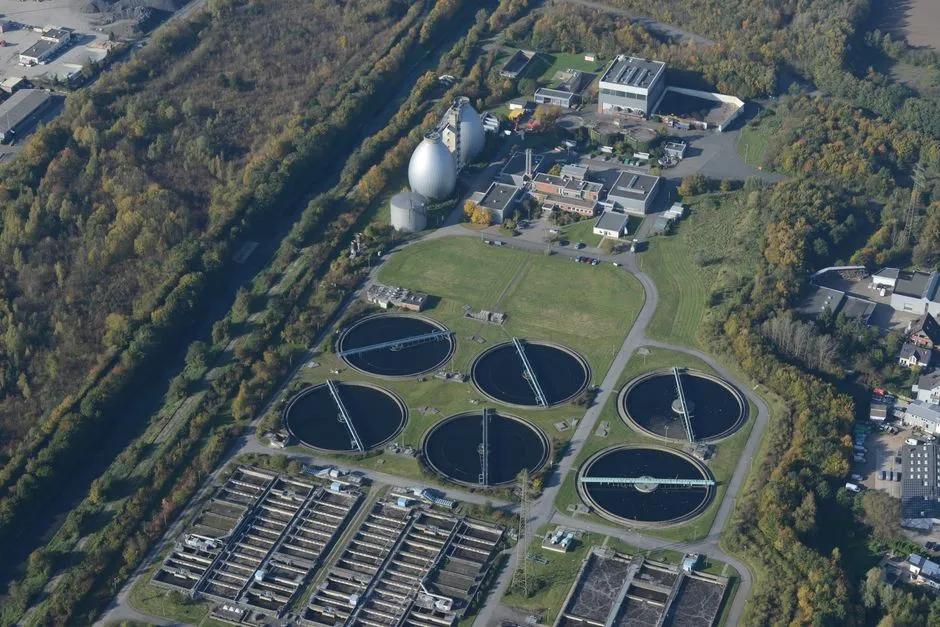
7 NOV 2026 — A study published in PNAS on 4 November by researchers at Peking University and four other institutions finds that sewage sludge has become one of China's largest sources of airborne mercury. The authors calculate that burning, co-processing and composting the sludge left over from municipal wastewater treatment put an estimated 42 tonnes of mercury into the air in 2024, more than coal-fired power plants and more than 10% of the country's emissions from human activity.
The paper is a peer-reviewed Brief Report by seven authors from Peking University, Tsinghua University, University College London, Duke University and a planning institute of China's Ministry of Water Resources. It is open access under a CC BY 4.0 licence. Their central estimate is 42 megagrams (one megagram is a tonne), with an uncertainty range of 32 to 60 tonnes. That places sludge third among China's sources, behind cement production at 141 tonnes and nonferrous metal smelting at 49 tonnes, and ahead of coal power at 32 tonnes.
Cleaner water, dirtier air
Wastewater treatment keeps mercury out of rivers and seafood, but the metal does not disappear. It collects in the sludge. The authors put mercury in Chinese municipal sludge at a mean of 3.5 micrograms per gram, against 0.22 for coal, and estimate that the country's sludge held 146 tonnes of mercury in 2024. Sludge production rose 320-fold between 1978 and 2024 to about 20 million tonnes a year.
For years most of it was stockpiled or sent to simple landfills. China has since pushed disposal towards energy and resource recovery, and the authors say those practices can release the mercury the sludge had held back into the air. Incineration was the largest pathway in 2024 at 18 tonnes. Co-disposal, which in China increasingly means feeding sludge into cement kilns, rose from under 1 tonne in 2000 to 14 tonnes. Composting added 10. The three routes add up to the 42-tonne total, so incineration alone accounts for about 43% of it on our arithmetic. Drying the sludge before it is burned released 5.8 tonnes on its own, and the authors note that sludge burns under high-moisture, reducing conditions that weaken conventional pollution-control equipment.
The study draws on a database of 6,132 wastewater treatment plants and 2,517 disposal facilities, with release rates partly from the authors' own flux-chamber measurements at composting sites. Emissions from sludge disposal have grown at an average of 29% a year since 2004. As an illustration only, that rate compounded over 20 years (1.29 multiplied by itself 20 times) comes to roughly a 160-fold increase. The paper does not state the 2004 figure, and an average rate does not mean every year grew evenly.
Missing from the national accounts
The authors say these releases are absent from international and national mercury budgets, including the UN Environment Programme's Global Mercury Assessment. Their figures for the other sectors come from a 2025 point-source inventory of China's emissions covering 1978 to 2021. We read that inventory's published text in full, and the word sludge does not appear in it. Adding sludge disposal as a source shows a modest rebound in China's total emissions after a low point around 2020, the PNAS team estimates. Earlier work had China's emissions falling since the 2010s, including a global analysis in Nature Communications in January 2025. Five of the seven PNAS authors were among its 15 authors, and that paper also does not mention sludge or wastewater. The gap the new paper aims to correct was in the group's earlier work too.
Their recommendation is aimed at the Minamata Convention, the 2013 treaty on mercury. They call for "revising Hg inventory toolkits to explicitly include sludge disposal as an emission source" and for the source to be prioritised in the next global assessment.
Concentrated in big cities
Cities holding 40% of the population served by municipal sewers, about 350 million people, produced 83% of the sludge emissions in 2024. Worked through, that puts per-person emissions in those cities roughly seven times the level in the rest of the served population (83 divided by 40, set against 17 divided by 60). The authors link this to large cities choosing incineration and co-disposal over landfill, and to sludge being moved across regions towards large central plants.
The paper does not measure anyone's exposure or health effects from sludge. Its health figure, about 30,000 premature deaths a year worldwide from mercury in seafood, comes from earlier work on mercury in general. On sludge itself, the authors say only that the source "may disproportionately impact residents in urban hubs". They also stress that treating wastewater and disposing of sludge remain necessary, since poorly managed sludge rich in pathogens and nutrients is itself a public health risk. Their proposed fixes are specific, such as routing drying exhaust into the main incinerator, adding scrubbers, and mixing biochar or lime into compost.

View author profile → · Editorial policy