Every formal payslip in Indonesia carries two sets of social-security deductions: BPJS Kesehatan, the national health insurance scheme (JKN), and BPJS Ketenagakerjaan, which bundles four employment programs — Jaminan Hari Tua (JHT, old-age savings), Jaminan Pensiun (JP, pension), Jaminan Kecelakaan Kerja (JKK, work-accident cover) and Jaminan Kematian (JKM, death benefit). A fifth benefit, Jaminan Kehilangan Pekerjaan (JKP, unemployment protection), exists but never appears as a deduction — it is funded by the central government and a recomposition of JKK contributions, so it costs neither you nor your employer anything extra.
The employee's share of the deductions comes to about 4% of wage, within caps: 1% for BPJS Kesehatan, 2% for JHT and 1% for JP. Everything else (health 4%, JHT 3.7%, JKK, JKM, the employer two-thirds of JP) is the employer's cost and never reduces take-home pay.
For 2026 the headline change is narrow but real: the wage ceiling for the JP pension program rose to Rp11,086,300 per month from March 2026, announced in BPJS Ketenagakerjaan circular No. B/1226/022026 of 25 February 2026. The rates themselves — every percentage in this guide — are the same ones set by the underlying regulations still in force.
BPJS Kesehatan: 5%, capped
For wage earners (Pekerja Penerima Upah, PPU), the health contribution is 5% of monthly wage: 4% paid by the employer, 1% deducted from the employee. The legal basis is Perpres 64/2020, which also fixes the contribution ceiling: the 5% is computed on at most Rp12,000,000 of wage. Someone earning Rp20,000,000 contributes as if they earned Rp12,000,000 — a maximum employee deduction of Rp120,000 a month. The floor is the applicable provincial or district minimum wage.
That 1% buys more than individual cover. It insures up to five people: the worker, one spouse and up to three children (unmarried, not earning their own income, up to age 21 — or 25 if still in formal education). Additional dependants — a fourth child, parents, parents-in-law — can be added for an extra 1% of wage per person, deducted from salary at the employee's request, per the Kemenkeu Treasury guidance.
One point of frequent confusion: KRIS (Kelas Rawat Inap Standar), the single standard inpatient ward that is replacing the old class 1/2/3 system under Perpres 59/2024, is a change to hospital room facilities only. It has not touched the payroll formula — still 5% with the Rp12 million ceiling — and rollout remains phased through 2026, with many hospitals still operating class 1/2/3 wards.
BPJS Ketenagakerjaan: four programs, four rules
BPJS Ketenagakerjaan looks like one line on some payslips, but it is four programs with different rates, different payers and different ceilings. The official rate summary is on bpjsketenagakerjaan.go.id.
| Program | Employer | Employee | Wage cap |
|---|---|---|---|
| JHT — old-age savings (PP 46/2015) | 3.7% | 2% | None — full wage |
| JP — pension (PP 45/2015) | 2% | 1% | Rp11,086,300/month from March 2026 |
| JKK — work accident (PP 44/2015) | 0.24%–1.74% by risk class | — | None |
| JKM — death benefit (PP 44/2015) | 0.3% | — | None |
JKK has five risk classes fixed by industry group — very low 0.24%, low 0.54%, medium 0.89%, high 1.27%, very high 1.74% — with office and administrative work sitting in the 0.24% class, per PP 44/2015. JKK and JKM are entirely employer-paid; an employee's BPJS Ketenagakerjaan deduction is only ever JHT 2% plus JP 1%.
The JP ceiling is the moving part. Under PP 45/2015 it adjusts every March by the prior year's GDP growth — 2025's 5.11% growth lifted it from Rp10,547,400 to Rp11,086,300. That puts the maximum employee JP deduction at Rp110,863 a month, and the maximum employer share at Rp221,726.
Which wages count
Both bodies compute contributions on the reported monthly upah: gaji pokok (basic wage) plus tunjangan tetap (fixed allowances) — allowances paid regularly regardless of attendance, such as a fixed position or housing allowance. This wording comes straight from PP 44/2015, PP 45/2015 and PP 46/2015, and the same concept applies to the BPJS Kesehatan base (floored at the regional minimum wage, capped at Rp12 million).
By the same logic, payroll practice conventionally excludes:
- Tunjangan tidak tetap — variable allowances tied to attendance, such as meal or transport money paid per day present
- Overtime pay
- Bonuses and commissions
- THR (the religious-holiday allowance)
A strong bonus month, therefore, does not raise your BPJS deductions.
Worked example: Rp10,000,000 a month
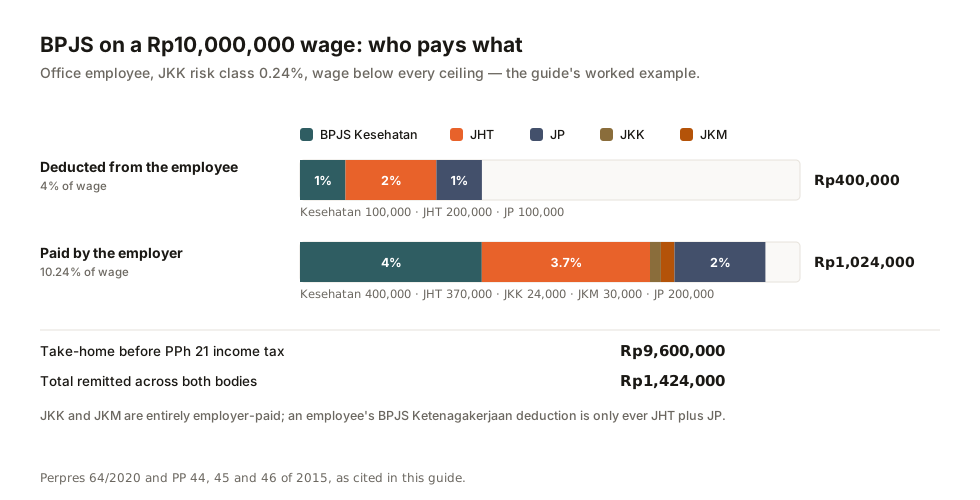
Take an office employee with a monthly wage (basic + fixed allowances) of Rp10,000,000, at a low-risk employer (JKK class 0.24%), with a standard family. The wage sits below every ceiling — the Rp12 million health cap and the Rp11,086,300 JP cap — so all five lines are computed on the full Rp10,000,000.
| Program | Rate (employee / employer) | Employee deduction | Employer cost |
|---|---|---|---|
| BPJS Kesehatan | 1% / 4% | Rp100,000 | Rp400,000 |
| JHT | 2% / 3.7% | Rp200,000 | Rp370,000 |
| JKK (0.24%) | — / 0.24% | — | Rp24,000 |
| JKM | — / 0.3% | — | Rp30,000 |
| JP | 1% / 2% | Rp100,000 | Rp200,000 |
| Total | 4% / 10.24% | Rp400,000 | Rp1,024,000 |
The employee's take-home effect: Rp10,000,000 gross minus Rp400,000 in BPJS deductions leaves Rp9,600,000 before PPh 21 income tax. (The deductions also affect income tax: employee-paid JHT (2%) and JP (1%) are deductible from taxable income, while the employer-paid health premium, JKK, and JKM count as taxable benefits.) The employer, meanwhile, remits Rp1,424,000 across both bodies — its own Rp1,024,000 (10.24% of wage at this salary and risk level) plus the Rp400,000 withheld from the employee.
At higher salaries, the different caps come into play. At Rp15,000,000, BPJS Kesehatan is computed on Rp12,000,000 (employee pays Rp120,000), JP on Rp11,086,300 (Rp110,863) — but JHT still runs on the full Rp15,000,000 (Rp300,000). Three different bases on one payslip.
To see these numbers for your own salary — including the PPh 21 step this guide deliberately leaves out — run it through our Indonesia Take-Home Salary Calculator, which applies the caps and splits above automatically.
Common confusions
The two caps are not the same cap
BPJS Kesehatan caps at Rp12,000,000, fixed by Perpres 64/2020 and unchanged since 2020. JP caps at Rp11,086,300 from March 2026 and moves every March with GDP growth. JHT, JKK and JKM have no cap at all. Payroll software that applies a single ceiling to all programs is miscalculating.
JHT is not locked until age 56
Under Permenaker 4/2022, JHT is claimable in full one month after resignation or termination — there is no need to wait for retirement age (56, permanent disability and death remain the standard triggers for those still working). While still employed, a partial withdrawal is allowed once after 10 years of membership: either 10% (retirement preparation) or 30% (housing) — one or the other, not both — and a partial claim can trigger progressive tax on the next one. BPJS Ketenagakerjaan sets out the partial-claim procedure in its official claim guide.
Freelancers get a different package
Self-employed workers — freelancers, traders, drivers, gig workers — join BPJS Ketenagakerjaan as BPU (Bukan Penerima Upah), described on the official BPU page. JKK and JKM are mandatory, JHT is voluntary, and JP is not available to BPU participants. Contributions run off a self-declared income bracket: JKK at 1% of declared income (Rp10,000–Rp207,000/month), JKM flat at Rp6,800/month, and optional JHT at 2% (Rp20,000–Rp414,000/month). For health cover, the self-employed enrol separately as mandiri (PBPU) payers: Rp150,000 (class 1), Rp100,000 (class 2) or Rp42,000 (class 3, Rp35,000 after the government subsidy).
Regional aside: if you also run payroll in Malaysia, the structure rhymes — statutory retirement savings plus separate accident and unemployment schemes — and we cover it in how Malaysia's EPF, SOCSO and EIS deductions work. The EPF, SOCSO and EIS calculator produces the Malaysian employee-and-employer split the same way the worked example above does for Indonesia.
What changed for 2026
- JP ceiling: Rp10,547,400 → Rp11,086,300, effective March 2026, per BPJS Ketenagakerjaan circular B/1226/022026 (25 February 2026), following the annual GDP-growth adjustment in PP 45/2015. Maximum employee JP deduction rose from Rp105,474 to Rp110,863.
- KRIS remains facilities-only. The single standard ward continues its phased rollout — the Perpres 59/2024 transition date of 30 June 2025 passed with class 1/2/3 wards still operating at many hospitals. A post-KRIS single tariff is under study, but as of July 2026, no new rates have been enacted and contribution formulas are unchanged.
- Everything else held steady: the JHT 5.7% split, the JKK risk classes, JKM's 0.3%, the JP 3% split, and BPJS Kesehatan's 5% with the Rp12 million cap are all identical to 2025.
What this guide doesn't cover
Deliberately out of scope: rules for expatriate employees, the interaction between contribution floors and each region's minimum wage (UMP/UMK), and income tax itself — PPh 21 is a separate calculation that runs after these deductions, with its own treatment of them, and deserves its own guide. Rules for specific labor-intensive industries granted temporary JKK relief are also omitted; they do not affect standard office payrolls.
Figures verified July 2026 against BPJS circulars and the underlying regulations (Perpres 64/2020; PP 44, 45 and 46 of 2015). This guide is general information, not financial or legal advice — confirm your own payroll treatment with BPJS or a qualified consultant.

View author profile → · Editorial policy