The temple's own list grades the 100 fortune sticks at Wong Tai Sin on five steps, from 上上 down to 下下, and Sik Sik Yuen, which runs the temple, publishes every stick's verse and grade in its online stick enquiry. Counted from that list, 18 sticks are graded 下下, more than the 3 graded 上上 and the 10 graded 上吉 together.
Drawing a stick, 求籤 or kau cim in Cantonese, happens at the temple in Kowloon. Sik Sik Yuen describes the temple as honouring the three teachings, Confucian, Buddhist and Taoist, and dedicated to the Taoist immortal Wong Tai Sin, 黃大仙.
The lowest grade outnumbers the two best together
| Grade, as the temple labels it | Temple's English label | Sticks |
|---|---|---|
| 上上 | The Best | 3 |
| 上吉 | Very Good | 10 |
| 中吉 | Moderately Good | 29 |
| 中平 | Average | 40 |
| 下下 | Poor | 18 |
The grades are the same in the temple's Traditional and Simplified Chinese versions of the list. Stick 1, one of the three graded 上上, carries the story title 姜公封相 and the verse 「靈籤求得第一枝 龍虎風雲際會時 一旦凌霄揚自樂 任君來往赴瑤池」. Every verse in the list is four lines of seven characters, and each stick carries a story title alongside it.
Sticks are drawn at the first worshipping platform
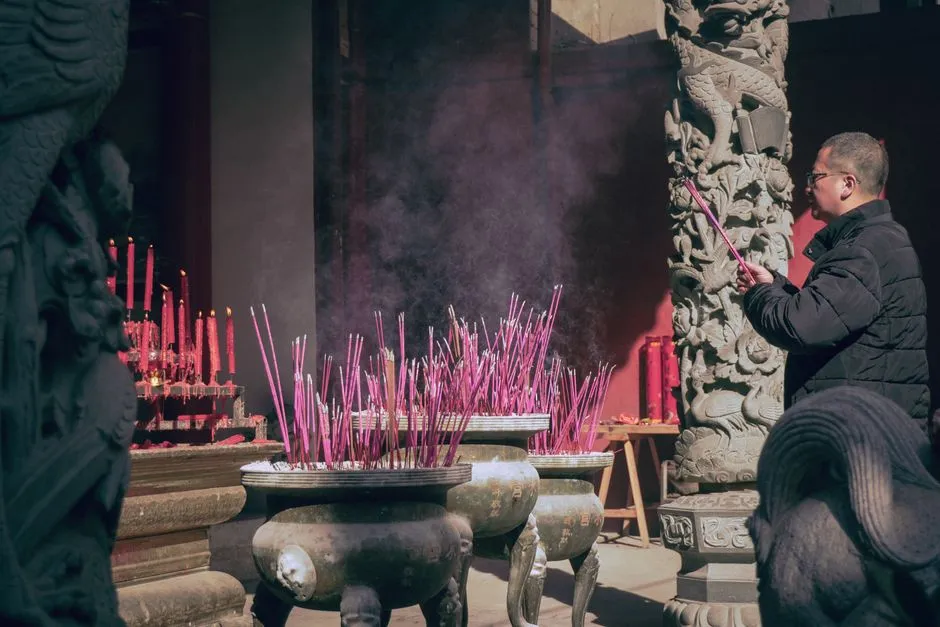
The temple's page on its buildings says the first worshipping platform, completed in 1973, is 「平日善信上香參拜、求籤的地方」, where worshippers offer incense and draw sticks on ordinary days. The temple's online service lets anyone look up a stick by number; it does not offer a draw. Some visitors also throw a pair of moon blocks to confirm a stick, a practice reported as optional at Wong Tai Sin and more common in Taiwan; no temple page we read describes it.
The busiest night has its own arrangements. For Lunar New Year's Eve in 2026, Hong Kong media reported, citing Sik Sik Yuen, that there would be no area for drawing sticks inside the temple that night, when the crowds come for the year's first incense.
Our own copy disagreed with the temple on most grades
We compared each stick in our Wong Tai Sin oracle with the temple's published stick pages. Until 2 October 2026, our grade badge matched the temple's on 11 of the 100 sticks. It used two grades, 中上 and 中中, that the temple does not use, and it showed stick 43, graded 下下 by the temple, in green as 上上. Stick 1 carried a verse found nowhere in the temple's list, and stick 80 repeated stick 95's verse, so it held 99 different verses, not 100. It now shows the temple's grade for each stick, credited to Sik Sik Yuen and linked to the temple's own page for that stick.
The draw itself was even. A million simulated presses of our page's button spread across the 100 numbers as evenly as chance allows; that tests our software, not the cylinder in a temple. Our guide to why random is not random covers how such draws work.
A few verses on the temple's site carry slips
Where the temple's list and our copy differed by a character or two, we checked each verse against the story it alludes to. More of them were errors in our copy than slips in the temple's, such as 伍子婿 for 伍子胥 and 差 for 槎, a raft. A handful of the temple's web pages have slips of their own, such as one that reads 姜笛 where the allusion has 羌笛, the Qiang flute, and some differences are simply two possible readings. Our tool uses the reading the allusion supports.
The temple began as a shrine in Wan Chai
According to Sik Sik Yuen's history of the institution, the Taoist priest Leung Yan-am and his son, of the 普慶壇 in Guangdong, brought a portrait of Wong Tai Sin to Hong Kong in 1915 and set up a shrine in Wan Chai. In 1921 they moved to the present site at Chuk Yuen in Kowloon. The temple, as it tells it, places the immortal's birth in 328 in the Jin dynasty and his story in Zhejiang, where as a shepherd boy he turned white stones into sheep.
In 1947 the temple could not open to the public under the Chinese Temples Ordinance of the day and opened only in the first lunar month; the temple says that is where the tradition of the year's first incense, 頭炷香, began. It opened to the public in 1956. Hong Kong's Antiquities and Monuments Office lists it as a Grade I historic building, a grading confirmed on 17 May 2010, and the beliefs and customs of Wong Tai Sin were added to the national list of intangible cultural heritage in 2014.
Medicine sticks were handed out until 2005
The sticks once answered questions about health as well as life. The temple's page on its intangible cultural heritage describes the 黃大仙靈簽 as 「供民眾問事及求藥方」, for people to ask about matters and to seek remedies. Its history page records that in 2005 「藥籤及仙方的派發正式隨時代畫上句號」, the giving out of medicine sticks and remedies formally came to an end with the times, and that the remedies are kept as a matter of cultural conservation.