You have built something good in ComfyUI and you would like to sell it, or put it in a client's project, or ship it inside a product. Somewhere in that workflow sit half a dozen custom nodes written by people you have never met. Are you allowed to?
The obvious place to look is the node's entry in the ComfyUI registry, which has a licence field. We checked what is in that field across all 5,230 registry nodes, and the short answer is that it will usually not tell you. The longer answer is more encouraging than that sounds, and it is worth knowing which is which.
The field that looks like an answer
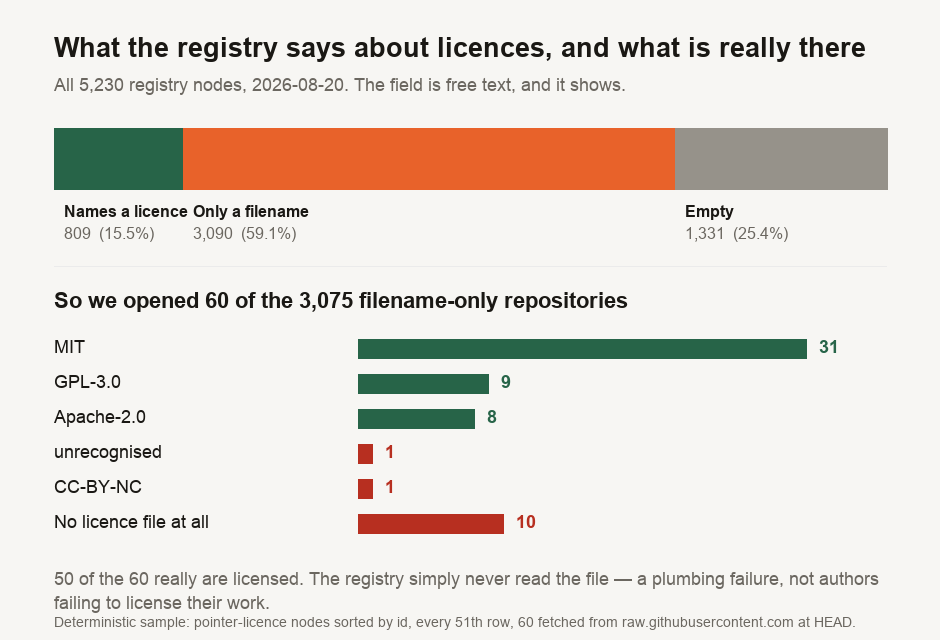
The registry's licence field, across its 5,230 nodes on 20 August 2026, holds three kinds of value.
- 809 (15.5%) name a licence — "MIT", "Apache-2.0", "GPL-3.0" and so on. In these cases the field does its job.
- 3,090 (59.1%) contain a filename instead — the literal text
LICENSE, orLICENSE.txt, orCOPYING. That names a file, which is not the same as naming a licence. - 1,331 (25.4%) are empty.
Put together, 84.5% of registry entries cannot answer the question on their own. That number is true, and publishing it as the headline would have been a cheap and misleading thing to do — so we went and checked what was behind it.
What is actually behind the filenames
A field saying LICENSE suggests the author did license their work and the registry simply never read it. To test that, we sampled 60 of those 3,075 filename-only nodes — every 51st of a stable sort — and fetched the file from each repository.
Of the 60 repositories, 50 did contain a licence file — 83.3% of them — and the text of 49 was identifiable on sight.
| What the file turned out to be | Of 60 sampled | What it asks of you |
|---|---|---|
| MIT | 31 | Keep the notice. Otherwise do as you like, commercially included. |
| GPL-3.0 | 9 | Copyleft. Distributing work built on it has obligations. |
| Apache-2.0 | 8 | Permissive, with an explicit patent grant. |
| Creative Commons BY-NC | 1 | Non-commercial. Not for the paid client project. |
| Present but not a standard text | 1 | Read it. |
| No licence file in the repository | 10 | The field claimed one. There is not one. |
So the ecosystem is in far better shape than the registry field suggests. Five in six of the filename-only nodes are properly licensed, and most of those are MIT. The problem is one of plumbing, not of authors failing to license their work, and it would be unfair to report it as the latter.
The same pattern holds among the 809 nodes that do name a licence: 671 are permissive licences of the MIT, Apache or BSD sort, 108 are GPL-family copyleft, and two are non-commercial.
The two cases that would cost someone
The two awkward categories are small, but both are invisible from the registry. That is what makes them worth naming.
Copyleft. GPL-family licences appeared 9 times in a 60-node sample and 108 times among nodes that name a licence outright. If you are running a workflow privately, this changes nothing at all. If you are distributing something built on that code, it carries obligations that are cheap to comply with and expensive to discover late. ComfyUI itself is GPL-3.0, which is worth knowing before this comes as a surprise.
Non-commercial. The single Creative Commons BY-NC in our sample is the case that ought to worry a freelancer. It was inside a node whose registry entry said nothing but LICENSE. Nothing anywhere in the install flow would have told the person using it that the output was not for a paying client. You only learn it by opening the repository.
This is a different question from the one we asked in the licences you did not choose. That guide is about the licences of the transitive dependencies a toolkit drags in behind you. This one is about the licence of the node you deliberately chose. It is the more answerable of the two, because there is exactly one repository to open.
How to check, in about a minute
- Open the node's repository. The registry entry and the Manager listing both link to it. This step is most of the work.
- Look for a licence file in the root —
LICENSE,LICENSE.txt,LICENCEorCOPYING. On GitHub, a recognised licence is also shown in the sidebar, which is faster than opening anything. - If it is MIT, Apache-2.0 or BSD, you are almost certainly fine for commercial use, keeping the copyright notice.
- If it is GPL or AGPL, note it and decide whether you are distributing or only running; the obligations differ.
- If you see "NonCommercial", "NC" or "research only", stop and find another node. This is the one that actually bites.
- If there is no file at all — which was 10 of our 60 — then no permission has been granted in either direction. Ask the author. Many will simply add a licence when asked.
Do this once per node, not once per project. The answer does not change until the node does.
If you want the rest of what a node does to your machine rather than to your rights, what happens when you click install in ComfyUI covers the code that runs when you install one.
What is measured here
The counts of what the registry licence field contains are measured across all 5,230 nodes from the ComfyUI registry API on 20 August 2026, by a script in our repository that refuses to emit results from a partial fetch. Licence values were classified into families by pattern, because the same licence is written several ways — "MIT", "MIT License" and "MIT license" are three of the twelve most common values.
What is behind the filename-only entries comes from a sample of 60 repositories out of 3,075, fetched at their default branch. It is every 51st entry of a stable sort rather than a chosen set, and every figure drawn from it is quoted with that denominator. A larger sample would tighten the percentages but not the finding: most of these nodes are properly licensed, and the registry does not show it.
We are not lawyers and this is not legal advice. What a licence obliges you to do depends on what you are doing with the work, and for anything commercial the licence text and a professional are the authorities, not us.

View author profile → · Editorial policy