In Southeast Asia, the start of a Hijri month is determined by published, computable criteria. But two of the most widely used sets of criteria are not the same, and for roughly one month in three, they point to different start dates.
This article computes both, for fourteen lunations starting October 2026, and shows where they part. It does not predict when any month will be declared. Announcements are made by the relevant religious authorities, sometimes with sighting reports that no calculation can anticipate, and nothing here is a substitute for them. What follows is arithmetic applied to rules those authorities have published.
What each rule asks of the evening sky
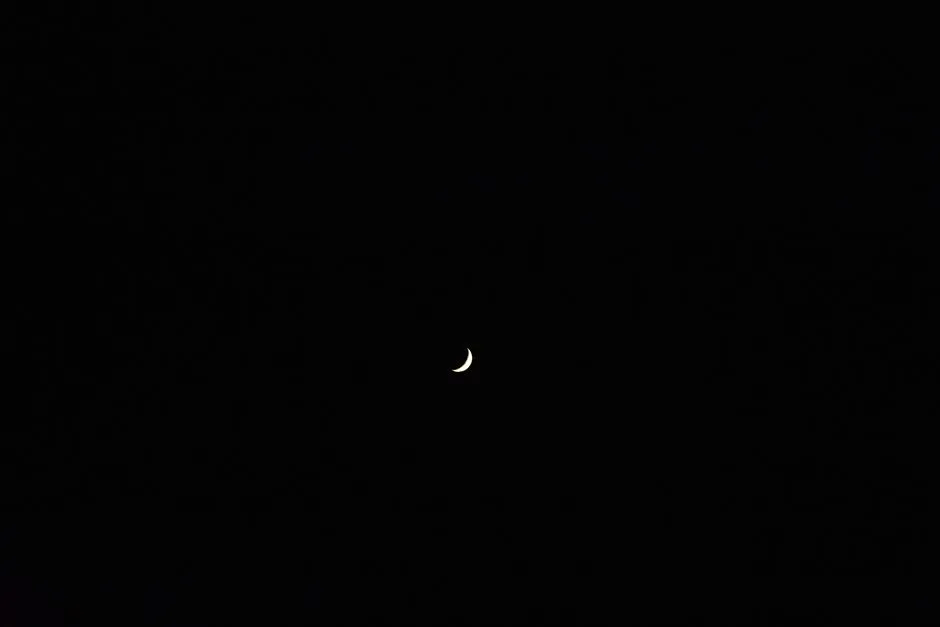
Both rules are evaluated at sunset on the evening after the moon's conjunction with the sun — the astronomical new moon. Both ask whether, at that moment, the new crescent is far enough from the sun to count.
The MABIMS criteria, used by the religious affairs ministries of Brunei, Indonesia, Malaysia and Singapore in their revised form, set two thresholds at sunset: the moon's altitude above the horizon must be at least 3 degrees, and its angular distance from the sun — the elongation — must be at least 6.4 degrees. Both must be met.
The rule used by Indonesia's Muhammadiyah organisation, known as wujudul hilal, asks something different and less demanding: that conjunction has already happened before sunset, and that the moon is still above the horizon when the sun goes down. It sets no minimum angle at all.
Read side by side, the difference is plain. One rule asks whether the crescent is plausibly visible. The other asks only whether it exists above the horizon. On most evenings the answer to both is the same. On the rest, a month can begin a day apart.
Checking the instrument before trusting it
These calculations turn on fractions of a degree, so the tool that produces them had to be tested against an authority first.
The positions here come from NASA's Jet Propulsion Laboratory planetary ephemeris, computed through a standard open-source astronomy library. Before running any criteria, the library was used to compute every new moon of 2026 and those instants were compared with the United States Naval Observatory's published phase data. They matched to the minute — including the new moons of 11 September 2026 at 03:27 and 10 October 2026 at 15:50, universal time.
The check nearly produced a false alarm, which came down to a simple data-entry error. A summary of the Naval Observatory's web page appeared to show a new moon a full week earlier than the computation. Measuring the moon's angle from the sun settled it: at the instant the summary called a new moon, the moon sat 90 degrees from the sun, which is a quarter. At the instant the computation named, it sat 1.68 degrees away. An angle near zero is what a new moon is. The raw data from the observatory then confirmed the computation exactly. The summary had misaligned the columns of a table.
Where the two rules part
Applying both rules at sunset in Kuala Lumpur and Jakarta, for each of the fourteen lunations from October 2026:
| Conjunction (UTC) | MABIMS: month begins | Wujudul hilal: month begins |
|---|---|---|
| 10 Oct 2026 | 12 Oct | 12 Oct |
| 9 Nov 2026 | 11 Nov | 11 Nov |
| 9 Dec 2026 | 11 Dec | 10 Dec |
| 7 Jan 2027 | 10 Jan | 9 Jan |
| 6 Feb 2027 | 8 Feb | 8 Feb |
| 8 Mar 2027 | 10 Mar | 10 Mar |
| 6 Apr 2027 | 9 Apr | 8 Apr |
| 6 May 2027 | 8 May | 8 May |
| 4 Jun 2027 | 6 Jun | 6 Jun |
| 4 Jul 2027 | 6 Jul | 5 Jul |
| 2 Aug 2027 | 4 Aug | 4 Aug |
| 31 Aug 2027 | 2 Sep | 2 Sep |
| 30 Sep 2027 | 2 Oct | 1 Oct |
| 29 Oct 2027 | 31 Oct | 31 Oct |
The two rules give a different start on five of the fourteen — roughly one month in three. Every time, they are exactly one day apart, and every time it is wujudul hilal that starts first, which follows directly from its asking less of the sky.
The dates shown are for the start of the civil day; the crescent itself is assessed on the evening before.
One detail is more interesting than the count. The split is identical in Kuala Lumpur and Jakarta — the same five months, the same one-day gap, in both cities. So the disagreement is not produced by where the observer stands. It is produced by the rule.
Two evenings on the edge
The divergent months are not all close calls, but two of them show the mechanism clearly, because they sit right on the thresholds.
9 December 2026, Jakarta. At sunset the moon stands 3.00 degrees above the horizon — clearing the MABIMS altitude bar exactly. Its elongation is 5.74 degrees, short of the 6.4 required. So MABIMS fails on the second criterion alone, and the month waits a day. Wujudul hilal, which only asks that the moon be above the horizon after conjunction, is satisfied, and the month begins that evening.
4 July 2027, Kuala Lumpur. The pattern repeats with a wider margin on one side and a narrower one on the other: altitude 3.39 degrees, comfortably clear; elongation 4.44 degrees, well short.
In both cases, the MABIMS rule fails on elongation, not altitude. This is by design. A new crescent can be several degrees above the horizon but still too close to the sun to be seen; the 6.4-degree elongation bar in MABIMS is there to exclude this very case.
Which altitude
"The moon's altitude" sounds unambiguous, and at a three-degree threshold it is not. There are several defensible ways to measure it, and they disagree by nearly a degree.
For the Jakarta case above, the moon's centre measured from the observer's actual position on Earth, without correcting for the atmosphere, is 3.00 degrees. Allowing for atmospheric refraction, which lifts objects near the horizon, raises it to about 3.21. Measuring to the moon's upper edge rather than its centre adds roughly a quarter of a degree more. Measuring from the Earth's centre rather than its surface adds close to another degree on top.
A published altitude criterion, then, silently includes a choice of measurement convention. A case near the 3-degree threshold can pass or fail depending on that choice. Although it didn't affect the Jakarta outcome — elongation failed regardless — it shows why these calculations require a stated method, not just a bare number. The figures in the table above use the moon's centre, measured from the observer's position, without refraction.
A third rule, for completeness
Saudi Arabia's Umm al-Qura calendar is a third system, mentioned here to show that "the Hijri calendar" is not monolithic. Its computational rule was not verified from a primary source for this article, so it is not described here and was not computed. Its own documentation is candid that it is intended for civil purposes, and that the first sighting of the crescent can come up to two days after the date it predicts.
How this was produced, and what it cannot tell you
Positions are from NASA JPL's DE421 planetary ephemeris, computed with an open-source astronomy library and validated against the United States Naval Observatory's phase data before any criterion was applied. Sunset is the standard instant when the sun's upper edge meets the horizon. The MABIMS thresholds are the revised figures of 3 degrees altitude and 6.4 degrees elongation; the wujudul hilal rule is conjunction before sunset with the moon above the horizon at sunset. The calculation script is published alongside this article so the table can be reproduced or checked. Computed on 21 September 2026.
What it cannot tell you is when a month will actually be declared. Some authorities combine calculation with sighting reports, and a sighting — or its absence, in cloud — can decide a case that the arithmetic leaves open. The table shows what two published rules say about the sky; it is not a forecast and says nothing about any official announcement.

View author profile → · Editorial policy