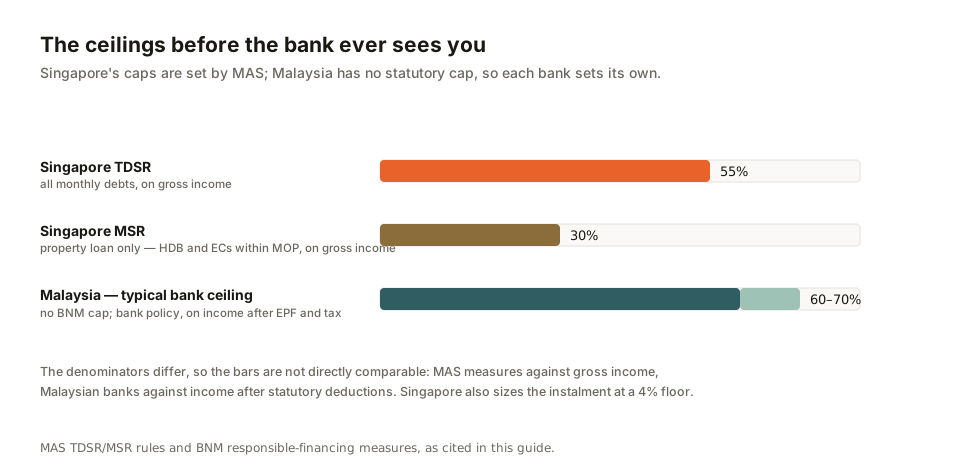
Before a bank in Singapore or Malaysia calculates your loan amount, it must follow rules set by a national regulator. The Monetary Authority of Singapore (MAS) caps your total debt repayments and makes every lender test your loan at a rate far above what you would actually pay today; Bank Negara Malaysia (BNM) sets no numeric cap but obliges every bank to prove you can afford the loan out of income after EPF and tax. These rules are guard-rails that stop a first-time buyer signing up to a payment that only works in a good year.
The short version for each market: Singapore: your total monthly debt must stay within 55% of gross income (TDSR), computed at a 4% stress-test floor even though market rates are far lower — and if you are buying an HDB flat or a young EC, a stricter 30% mortgage servicing ratio (MSR) applies on top (MAS: MSR and TDSR rules). Malaysia: there is no statutory debt-service cap; BNM's responsible-financing rules make each bank set its own prudent ceiling on your net income, and in practice most banks approve up to roughly 60–70% (BNM: responsible financing measures).
This guide walks through both rulebooks with July-2026 numbers, then runs one worked example per market to show where each limit bites.
Singapore: the three gates
Every housing loan in Singapore is assessed against three criteria; the most restrictive one determines your limit.
Gate 1 — TDSR: 55% of gross income
The Total Debt Servicing Ratio adds up everything you repay monthly — the new home loan plus car loans, student loans, renovation loans, and credit-card debt — and requires the total to stay at or below 55% of gross monthly income. Gross means before tax and excluding employer CPF, and variable income (commission, bonus, allowances) takes a mandatory haircut of at least 30%, averaged over the past 12 months (MAS: calculating TDSR). Commission earners qualify for less than their payslip suggests, by design.
Gate 2 — MSR: 30%, HDB and EC only
If the property is an HDB flat, or an EC still within its minimum occupation period, the Mortgage Servicing Ratio caps property-loan repayments at 30% of gross income. MSR ignores your car loan — but because it sits at 30% rather than 55%, it is almost always the binding constraint for HDB buyers. Passing TDSR comfortably does not mean you pass MSR.
Gate 3 — LTV: how much of the price you can borrow
A bank loan with no other outstanding housing loan is capped at 75% of the property value, dropping to 55% if the tenure runs past 30 years (25 for HDB flats) or beyond age 65; a minimum 5% must be paid in cash (MAS: loan tenure and LTV limits). An HDB concessionary loan is also capped at 75% — cut from 80% in August 2024, so any guide still promising "HDB lends you more" is stale.
The 4% floor: assessed rate vs actual rate
This distinction is crucial. Banks must compute your TDSR and MSR instalment at the higher of a 4% floor or the package's long-run rate — a rule in place since September 2022 (MAS/MND/HDB joint release, 29 Sep 2022). Meanwhile 3-month compounded SORA has collapsed to 1.082% (July 2026), putting all-in floating packages around 1.3–2.1% and fixed rates from about 1.3%. The gap between the assessment rate and the actual rate you pay is deliberately large right now. This is your buffer against rate rises, not extra spending headroom.
The HDB loan has its own versions of these numbers: the rate charged is 2.6% p.a. (unchanged since 1999, confirmed for Q3 2026 in the CPF Board's quarterly rate release), but the loan is sized at a 3% floor, over a maximum 25-year tenure, with the instalment capped at 30% of income and a household income ceiling of S$14,000 for families (HDB: housing loan from HDB). Its remaining advantages: no cash downpayment (fully CPF OA), a stable rate, and no early-repayment penalty. How OA balances build up in the first place is covered in our CPF guide.
Worked example: S$9,000 income, S$650k resale HDB
A couple with S$9,000 combined gross income, both salaried, both 35, no other debts, buying a S$650,000 resale flat priced at valuation, lease covering them to 95.
| Check | HDB loan route | Bank loan route |
|---|---|---|
| Eligibility | Open (S$9,000 ≤ S$14,000 ceiling) | Open |
| LTV cap (75%) | S$487,500 max loan | S$487,500 max loan |
| MSR cap (30% = S$2,700/mo) | Allows ≈S$569,400 at the 3% sizing floor, 25 yrs | Allows ≈S$511,500 at the 4% floor, 25 yrs |
| Binding constraint | LTV | LTV |
| TDSR check (55% = S$4,950) | — | S$2,573 at 4% → 28.6% Pass |
| Monthly at assessed rate | S$2,312 (3% floor) | S$2,573 (4% floor) |
| Monthly actually paid | S$2,212 (2.6%) | ≈S$2,027 (~1.83% floating) / S$1,973 (~1.6% 2-yr fixed) |
| Minimum cash | None — downpayment fully CPF OA | 5% of price = S$32,500 |
The table shows that the MSR cap of S$2,700 a month would support a loan larger than S$487,500 on either route. The binding constraint here is the 75% LTV limit, not income. TDSR barely registers at 28.6%; even a S$700 car loan only lifts it to 36.4%, which is why MSR or LTV, not TDSR, usually binds for HDB buyers.
At entry, the couple needs the S$162,500 downpayment (all CPF OA on the HDB route), plus Buyer's Stamp Duty of S$14,100 on the IRAS scale (CPF-payable), plus small fees — roughly S$177k of CPF and cash before grants, which can offset a substantial part for eligible first-timer families. Note the affordability gap: the bank sizes them at S$2,573 a month though a floating package currently costs about S$2,027 — that difference is the regulator forcing a buffer into the budget.
When the lease doesn't reach 95
The phrase lease covering them to 95 is doing heavy lifting in that setup. Drop it and the 75% falls apart. Where the remaining lease does not cover the youngest buyer to age 95, both the LTV limit and the CPF Valuation Limit are pro-rated by however far the lease does reach — the rule is set out in MND's Annex A: Updated Rules on CPF Usage and HDB Housing Loan (PDF). The multiplier is the remaining lease divided by the years left to 95, capped at 1. Both our buyers are 35, so they need 60 years of lease; a flat with 45 years left gives 45 ÷ 60 = 0.75, and the 75% LTV becomes 56.25%.
| Remaining lease | LTV after pro-rating | Max loan on S$650,000 | Downpayment (cash + CPF) |
|---|---|---|---|
| 60 yrs or more | 75.00% Full | S$487,500 | S$162,500 |
| 55 yrs | 68.75% | S$446,875 | S$203,125 |
| 50 yrs | 62.50% | S$406,250 | S$243,750 |
| 45 yrs | 56.25% | S$365,625 | S$284,375 |
| 40 yrs | 50.00% | S$325,000 | S$325,000 |
Same couple, same flat, same income: S$121,875 more to find at 45 years than at 60, and not one of the income gates moves. Nothing in the MSR or TDSR arithmetic hints at it.
The same multiplier cuts the CPF Valuation Limit — the ceiling on how much OA you may put into the flat across the downpayment and every instalment after it. On a short lease that ceiling arrives partway through the loan, and the repayments after it have to come from cash. Below that sits a hard floor: 20 years or less of remaining lease at the point of purchase and CPF cannot be used for the flat at all. Point of purchase means the flat application date for an HDB flat, and the date the Option to Purchase or the S&P is exercised for private property and ECs.
The lease caps the tenure too, which is the shortest of 25 years, 65 minus the average age of the buyers, and the remaining lease minus 20. For a couple both 35 the age arm is 30 years and never binds, but any lease under 45 years starts pulling the tenure below 25 — shrinking the income-based ceiling at the same time as the LTV one.
The pro-rating above is the HDB housing loan column of that annex. A bank loan has its own LTV reductions — the 55% tier in Gate 3, triggered by a long tenure or a loan running past 65 — and they are a separate calculation, not this one. The CPF and Valuation Limit pro-rating is not route-specific: the annex covers private and public housing alike, so it applies whoever lends. Our HDB Affordability Calculator asks for the remaining lease and the buyers' ages and applies the haircut for you. And the rule has a guide of its own, with the government's wording, the date arithmetic for working out what a flat's lease actually has left, and the clauses this section skips: the HDB lease and the age-95 rule.
Malaysia: how banks actually decide
Malaysia takes a different approach: no single statutory ratio, but a duty on every bank. BNM's Responsible Financing guidelines, in force since January 2012, require lenders to assess affordability using a "prudent debt service ratio" computed on income after statutory deductions for tax and EPF, counting all existing debt obligations (BNM, 18 Nov 2011). BNM reinforced in 2016 that banks must build in buffers for future rate rises and confirmed the maximum housing-loan tenure of 35 years (BNM, 20 Sep 2016).
In practice, banks' internal DSR ceilings commonly sit around 60–70% of net income, often more generous for high earners and tighter for lower ones. The same borrower can be rejected at one bank and approved at another. That is bank policy, not regulation, so shopping around genuinely matters.
On financing margin, the only BNM cap is a 70% LTV limit on your third and subsequent outstanding housing loan, in force since November 2010 (BNM, 3 Nov 2010). For a first or second home there is no BNM cap, and 90% margin is standard market practice. Rates are favourable in 2026: the OPR was cut to 2.75% in July 2025 and held at every meeting since (BNM OPR decisions), pulling the all-bank Standardised Base Rate to 2.75% and typical effective home-loan rates to roughly 3.8–4.1%, with promos lower.
One more 2026 tailwind: Budget 2026 extended the full stamp-duty exemption for first-time Malaysian buyers of homes up to RM500,000 — covering both the transfer instrument and the loan agreement — for sale-and-purchase agreements signed from 1 January 2026 to 31 December 2027.
Worked example: RM7,000 income, RM500k condo
A single Malaysian buyer, 30, salaried at RM7,000 gross, first home and first housing loan, buying a RM500,000 sub-sale condo, with existing commitments of RM1,150 a month (car, PTPTN, credit-card minimum).
| Step | Figure | Notes |
|---|---|---|
| Margin of financing (90%) | Loan RM450,000 | Downpayment RM50,000 |
| Net income for DSR | ≈RM5,900/mo | After 11% employee EPF and other statutory deductions — illustrative; varies with reliefs |
| Instalment, 35 yrs @ ~4.0% effective | RM1,992/mo | RM2,148 if taken over 30 yrs instead |
| DSR: (1,992 + 1,150) ÷ net | ≈53% Pass | Within a typical 60–70% internal ceiling; ≈34% with no other debts |
| Stamp duty (MOT + loan agreement) | RM0 Exempt | Budget 2026 first-timer exemption saves RM11,250 (normally RM9,000 + RM2,250) |
| Legal fees + valuation | ≈RM12,900–13,400 plus disbursements | SPA ~RM6,250 + loan docs ~RM5,625 (SRO 2023 scale) + valuation |
| Total entry cost | ≈RM63,000–64,000 | vs ~RM74,250–75,250 without the exemption |
The DSR passes with room to spare — but notice what the instalment hides. A condo adds service charge and sinking fund contributions (statutory under the Strata Management Act 2013), cukai taksiran (council assessment), cukai tanah or petak (quit or parcel rent), and fire plus MRTA/MLTA insurance. None appear in any DSR computation; all appear in your bank account monthly. Budget for them before deciding RM1,992 is comfortable.
Common budgeting mistakes
Budgeting at the teaser rate instead of the assessment rate. In Singapore, the bank must size your loan at 4% or more even when packages cost 1.3–2.1% — the S$2,573-vs-S$2,027 gap in our example is a rate-rise buffer, not spare cash. Malaysia has no statutory floor, so a 3.6% promo can pass DSR today and hurt at repricing; BNM's guidelines expressly expect banks to buffer for future rate increases, and you should too.
Counting variable pay in full. MAS mandates a haircut of at least 30% on commission, bonus, allowance and rental income; Malaysian banks assess net-of-EPF-and-tax income and typically haircut variable pay similarly. If half your income is commission, plan on the haircut number, not the payslip.
Forgetting MSR sits on top of TDSR. An HDB or young-EC buyer can clear 55% TDSR easily yet be capped at 30% MSR. The two ratios count different debts, so run both.
Ignoring the costs no ratio tests. S&CC or MCST fees, property tax and HPS or fire insurance in Singapore; service charge, sinking fund, cukai taksiran, cukai tanah and insurance in Malaysia. Regulators test your ability to service the loan; only you can test if the total costs fit your life.
Run your own numbers
Both worked examples can be re-run with your own income, debts and property price in our Mortgage Affordability Calculator, and you can compare repayment schedules at different rates and tenures with the Mortgage Calculator. Be clear about what a calculator is for: it estimates the regulatory ceilings and instalments so you walk into the bank informed, but the bank's own credit assessment — income verification, DSR policy, valuation — makes the final decision. For how to judge whether any online calculator deserves your trust in the first place, see our calculator-trust guide.
What this guide doesn't cover
Deliberate omissions: the full BSD and ABSD schedules for private property and second homes in Singapore; refinancing and repricing strategy; EC-specific nuances beyond the MSR rule; Malaysia's Islamic home-financing structures and the LPPSA scheme; and CPF grant eligibility in detail. Figures were verified in July 2026 against the MAS, HDB, CPF Board and BNM pages linked above — rules change, so check the sources before you commit. This is an educational guide, not financial advice; your own numbers, verified with your lender, should drive the decision.

View author profile → · Editorial policy