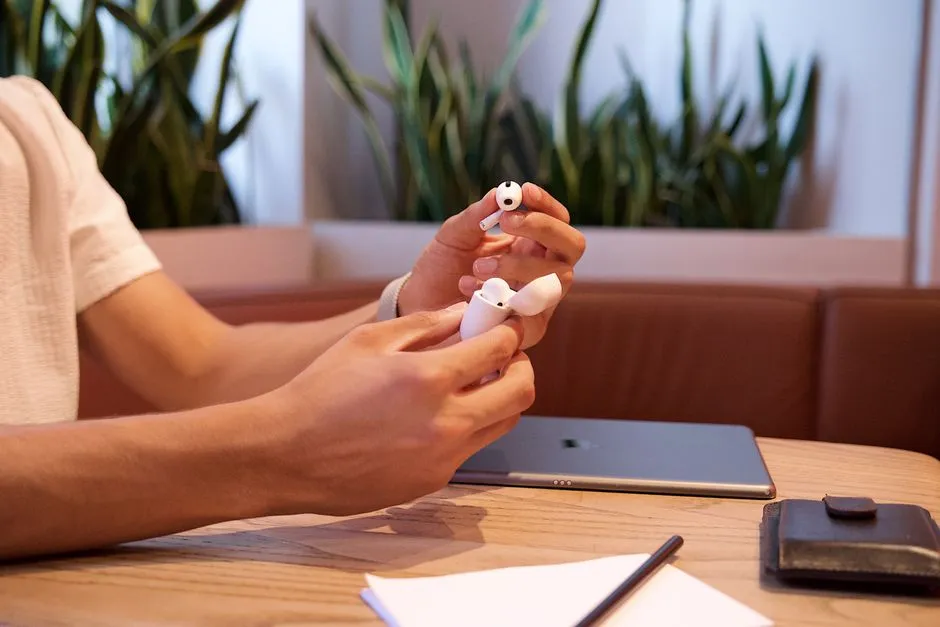
Apple sells the same earbuds everywhere, running the same silicon and the same firmware. In the United States it describes a feature on them as Hearing Protection, which helps prevent exposure to loud noise. In Singapore, Australia and Japan that feature is called Loud Sound Reduction, and it helps minimise exposure.
The technical sentence underneath is word-for-word identical in both places.
The two descriptions, side by side
United States: "Hearing Protection translates the sound signatures of what you hear to lower levels in environments as loud as 110 dBA. Machine learning on the H2 chip actively reduces louder, more intermittent noise at 48,000 times per second, and the ear tips provide passive noise reduction."
Singapore: "Loud Sound Reduction translates the sound signatures of what you hear to lower levels in environments as loud as 110 dBA. Machine learning on the H2 chip actively reduces louder, more intermittent noise at 48,000 times per second, and the ear tips provide a passive Noise Reduction Rating of 10 dBA."
The chip is the same, the 110 dBA ceiling is the same, and so are the 48,000 adjustments per second. What differs is the feature's name, and the verb that travels with it — prevent in the American copy, minimise in ours.
We counted the phrases across four of Apple's storefronts. "Hearing Protection" appears nine times on the American page and twelve on the British one, and zero times on the Singapore and Australian pages, which use "Loud Sound Reduction" six times each. The shared technical figures — 110 dBA, 48,000 times per second — appear on all four. Those shared figures act as the control. They establish that the pages describe one function, which is what makes the zeros real absences rather than a truncated download.
Japan needed a different check, because an English search on a Japanese page returns a zero that means nothing. Searching in Japanese, the page uses ヒアリングチェック (hearing test) ten times and 大きな音の低減 (loud sound reduction) five times, and the word 保護 — protection — never. Four positive controls in the same document make that zero trustworthy.
The part that will cost a buyer here real money
Apple publishes a global availability page listing which markets get which hearing features. It lists Hearing Protection as unavailable in Singapore.
A Singaporean who checks that page would conclude the feature is missing from the local model. It is not. It is running by default, described in the present tense with full specifications on Apple's own Singapore product page.
⚠️ Both pages are Apple's and both are current. Reconciling them requires already knowing that two names denote the same silicon, which is precisely what a shopper does not know. Of everything here, this is the part that can cost a buyer money.
What the feature actually buys you
Apple's own worked example is simple subtraction: "if the environmental noise level is 100 dBA and the attenuation is 20 dB, your noise exposure level is 80 dBA."
Run that against the exposure limits an occupational hygienist uses, at the top of the range Apple rates the feature for:
| At 110 dBA | NIOSH allows | OSHA allows |
|---|---|---|
| Unprotected | 1.5 minutes/day | 30 minutes/day |
| With Apple's implied 20 dB | 2.5 hours/day | 8 hours/day |
That is roughly a hundredfold extension of a NIOSH allowance — and still not a whole evening.
The Singapore and Japanese pages publish one number the American page omits: the ear tips have a passive Noise Reduction Rating of 10 dBA. Under OSHA's own published method for converting an NRR into real-world protection, you subtract 7 first:
NRR 10 dBA − 7 = 3 dB of estimated protection⚠️ That 3 dB is the seal alone, with the electronics off. Apple's total attenuation includes the active system and is derived from a different standard, ANSI/ASA S12.68-2007, and Apple's own example implies about 20 dB in total. The honest reading is that 3 dB is what remains when the battery dies, not that the feature provides only 3 dB of protection. Foam earplugs are typically NRR 29 to 33.
Canada is the mirror image, which is what makes this regulatory rather than regional
One obvious theory is that wealthy Western markets get the better version. The data does not support it.
| Market | Hearing Test | Hearing Aid | Hearing Protection |
|---|---|---|---|
| Singapore, Malaysia, Indonesia, Thailand, Vietnam, Philippines, Brunei | yes | yes | no |
| Japan, Hong Kong, Taiwan, South Korea | yes | yes | no |
| Australia, New Zealand | yes | yes | no |
| Canada | no | no | yes |
| United States, United Kingdom, Germany, Italy | yes | yes | yes |
Neither set contains the other. Canada gets the protection claim and gets neither the hearing test nor the hearing-aid function — the exact inverse of Singapore. The pattern is not a judgement about which countries deserve the feature.
There is a second, quieter inversion in the same data: the markets that receive the health claim receive less quantitative disclosure. The American and British pages say the tips "provide passive noise reduction" and give no number. Singapore and Japan publish the 10 dBA figure. We record it as an observation rather than a finding. Australia uses the reduction framing and also omits the number, so the pattern holds three times in four.
What this does not mean
None of this makes Apple deceptive. Apple is drawing a defensible line between a function and a claim. The signal processing ships everywhere; the health claim ships only where a regulator has cleared it. Using the words "Hearing Protection" in a market that has not authorised that claim would be a violation, and using "Loud Sound Reduction" in the United States would understate a feature Apple has evidence for. No single name for the feature would be accurate in every jurisdiction.
Nor is the feature withheld from Asia. It is running in Singapore right now, under another name, with a specification published in more detail than American buyers get.
What they are not is hearing protectors. Apple excludes impulse sounds — gunfire, fireworks, jackhammers — and anything sustained above 110 dBA, and says so on its own availability page. In Singapore it makes no protection claim at all.
What to do with it
If you are in Singapore, Malaysia, Japan or Australia, stop concluding from Apple's availability page that your earbuds lack the feature. Look for Loud Sound Reduction instead, and expect it to be on already.
If you rely on it in loud places, treat it as a comfort feature with a battery dependency, not as personal protective equipment. The distinction matters. A true protector, like a foam earplug, keeps working when it runs out of charge; only about 3 dB of this feature's effect is passive.
Where this comes from, and what will date it
Every quotation above was read from Apple's own product pages on 10 September 2026 — the American, British, Singaporean, Australian and Japanese editions of the AirPods Pro hearing-health page, Apple's global feature-availability page, and Apple's support article on using Hearing Protection. The Japanese page was searched in Japanese. The NRR arithmetic is OSHA's published method from 29 CFR 1910.95 Appendix B; the exposure limits are NIOSH's and OSHA's own formulas.
⚠️ Two limits worth stating. We could not establish why the naming differs: the plausible explanation is that a protection claim engages protective-equipment rules rather than medical-device rules, and we could not obtain the relevant European regulation to check, so we are not asserting it. And we did not search the Singaporean, Australian or Japanese device registers to see what, if anything, has been registered there.
Apple edits these availability lists without announcement; Italy, Romania and Czechia were added in May 2026. The likeliest death of this story is Apple obtaining the protection claim in Asia and unifying the naming, which could happen at any storefront refresh. The lists above are what they said on 10 September 2026, and the date matters more than the table.

View author profile → · Editorial policy