BASTROP, 31 AUG 2026 — Elon Musk has confirmed that SpaceX is building a foundry in Texas to cast gas turbine blades and vanes, and says it can pull turbine deliveries forward by up to 18 months. The bottleneck he is describing is not turbines. It is single-crystal casting, and almost nobody has it.
What was confirmed, and where
Musk said on Saturday that the limiting factor in natural gas turbine production is casting the blades and vanes, and that in-house casting at SpaceX can accelerate turbines coming online by up to 18 months, which he called a profound game-changer.
The site is in Bastrop, Texas, next to the existing Starlink factory, on roughly 830 acres bought between March and June. The output is intended for SpaceX's own AI data centres and, separately, for Starship engine production, which needs the same casting capability.
Why blades are the constraint and not the turbine
Most of a gas turbine is an assembly of parts any industrial economy can make. One component is the exception.
The first-stage blades and guide vanes sit in gas at roughly 1,650 to 1,980 degrees Celsius, which is several hundred degrees above the melting point of the nickel superalloy they are made from. They survive because of internal cooling passages that bleed compressor air through the blade, and a ceramic thermal barrier coating on the outside. The metal never reaches the gas temperature.
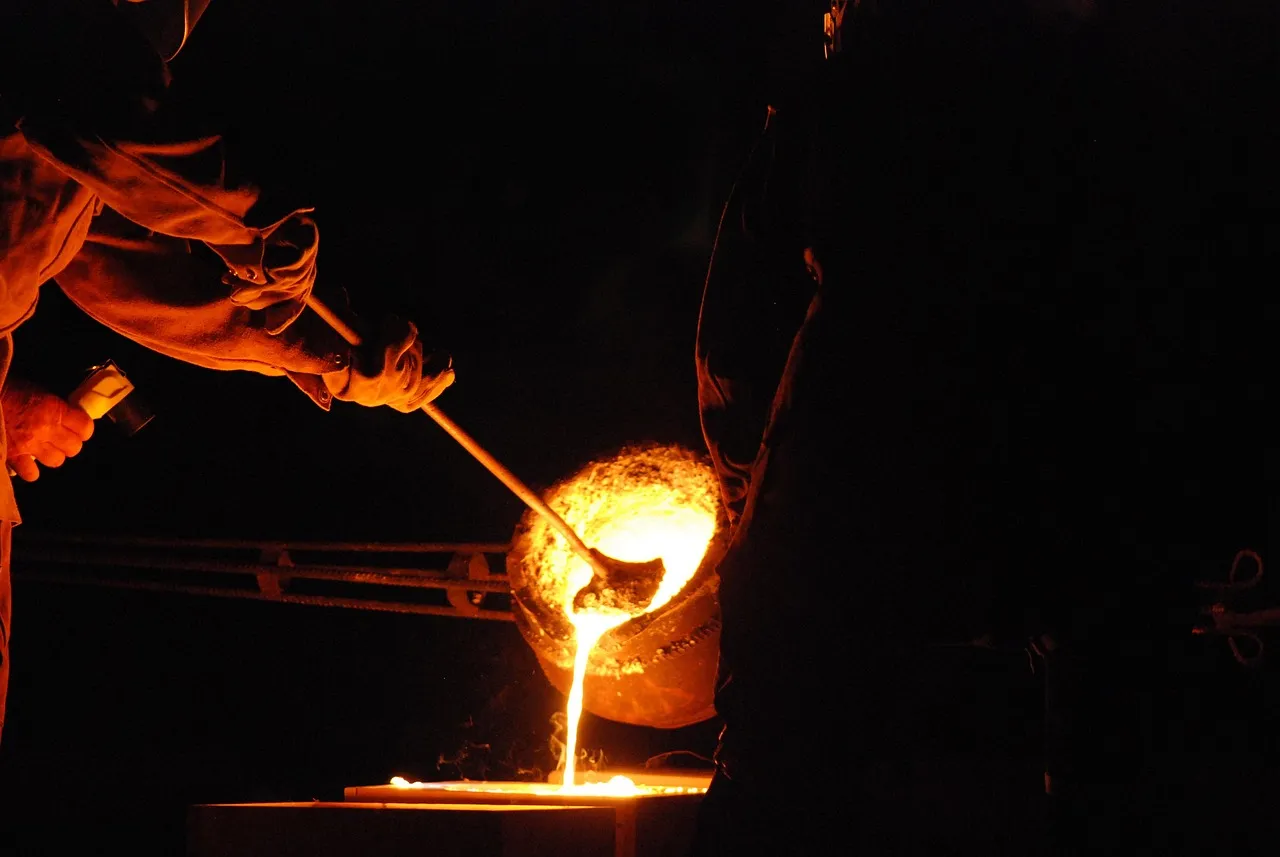
This works only if the blade has no grain boundaries, which are where creep and cracking start under sustained load at temperature. A conventionally cast part is a mass of crystal grains; these blades are grown as a single crystal. Molten superalloy is withdrawn slowly from a vacuum furnace through a temperature gradient, seeded so that one crystal propagates through the whole part, over hours. The internal cooling passages are formed by ceramic cores that are later leached out.
Yield on that process is the entire business. The capability is not a commodity, and buying a turbine means joining a queue.
How many foundries, and why the number is soft
Accounts of this story give different counts. One says the parts are produced by only four companies worldwide; another says three foundries, with order books running through 2029.
Both counts are plausible and neither is verifiable from the outside, because the number depends on where you draw the line. Counting firms that can cast a single-crystal blade at all gives one number. Counting those qualified to supply a specific engine model, at rate, with the metallurgical certification that a turbine maker will accept, gives a smaller one. Qualification is per-part and takes years. That fact matters more than the headcount.
It also sets a limit on the 18-month claim. A new foundry can be built quickly by a company that is good at building things. Getting a blade qualified into someone else's turbine is a different clock, and SpaceX sidesteps most of it only if the turbines are also its own.
What this speeds up, stated plainly
A rocket company is doing this because AI data centres need power faster than utilities can supply it, and on-site gas generation is the quickest way to a megawatt. The casting queue rations that route, and SpaceX is removing the ration.
A supply constraint that was slowing the build-out of gas-fired generation is being deliberately relieved. Whether that is good depends on what you think the constraint was doing.
It was not an environmental policy. Nobody chose it, no regulator set it, and it applied equally to efficient combined-cycle plant and to the simple-cycle turbines that data centres install for speed. A supply bottleneck is not a climate policy. The bottleneck was having that effect, and removing it will have the opposite one.
The pollution figures deserve care
Coverage of this announcement carries a modelled estimate that should not harden into a fact through repetition.
A Piedmont Environmental Council study of Virginia's data centre corridor found that emissions from eight gas turbines at a single facility could reach 2.5 million people across several counties, producing an estimated 3.4 to 6.5 additional premature deaths a year and 53 to 99 million dollars in annual health damages.
Those are outputs of an air dispersion and health-impact model, not a count of deaths. Ranges that wide are the model telling you how uncertain it is. The underlying pollutants are real and well characterised — nitrogen oxides that form smog, and hazardous air pollutants including formaldehyde, linked to asthma and respiratory disease — and the local objections in Memphis about turbines running without required permits are a separate and more concrete matter. The weakest number in the story is the modelled mortality figure, and it is the one most likely to be repeated without its range.
Why this reaches Southeast Asia
The same queue is why data centre pipelines in this region convert to operating capacity so slowly, and the same fix is not available here.
We reported that Malaysia's 6GW pipeline is announcements rather than connections, with grid interconnection as the binding step. On-site gas is the workaround operators reach for when the grid queue is long, and it needs the same turbines from the same three or four suppliers. A buyer in Johor is in that queue behind hyperscalers with better terms.
Nobody in the region is going to build a single-crystal casting line to get out of it. This depth of vertical integration widens the gap between operators who can manufacture their way past a shortage and those who can only wait. A national incentive package does not close that gap.

View author profile → · Editorial policy