TOKYO, 11 AUG 2026 — NEC has created a corporate division with seventeen employees and no people in it. It has a division head, a board, managers and staff, and every one of those roles is filled by an AI agent.
Disclosure: RECATOOLS is written with the assistance of Claude, made by Anthropic, which is also named in this article. Readers should weigh that interest.
The Corporate AI & Workforce Division took effect on 1 August and was announced on the 10th. NEC has positioned it as a formal department, ranked alongside human resources and legal affairs rather than run as a pilot inside somebody else's budget.
The org chart is the artefact
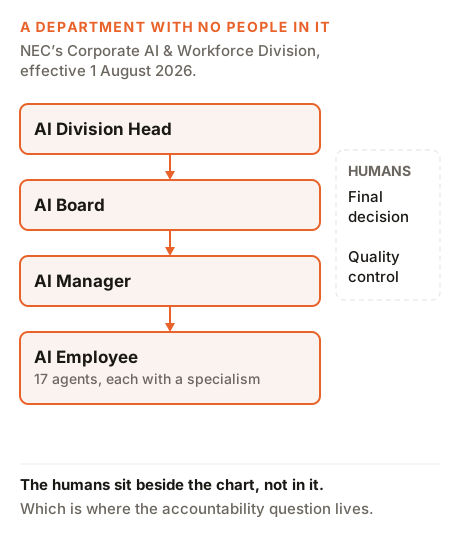
Most companies deploying agents give them tasks. NEC has given them a structure: AI Division Head, AI Board, AI Manager, AI Employee. The seventeen agents carry specialisms — sales support, meeting-minutes analysis, and others — and execute tasks autonomously within that hierarchy.
Two functions are reserved for people: final decision-making, and quality control.
NEC's structure answers a real question: does an agent need a manager? Their answer is yes. The decision implies a theory of how these systems will fail. It will not be a single bad output from one agent, but a series of outputs that need a manager to reconcile, prioritise, and check against each other.
The number to hold carefully
NEC ran a proof of concept for about a month from July. In it, AI handled management analysis, simulations and early risk detection for executive meetings, and cut the time that work took to roughly one-seventh.
That figure is doing a lot of promotional work and deserves a close read. It describes one category of task, in one month, inside a company that builds AI systems for a living and had every incentive for the trial to succeed. It is a plausible speed-up for exactly the work described — assembling and cross-checking material for a meeting — and it is not a claim about the division's output as a whole.
What makes it more interesting than a vendor number is what NEC says it concluded from the same trial: that final human checks matter. When a company reports a sevenfold speed-up but also formalises a human quality-control function, the second finding is the one to notice.
Where this sits against the week
NEC's division of labour is a direct counterpoint to other recent moves in the industry.
Anthropic is removing the per-action approval prompt from Claude Code by default, on evidence that people reviewing those prompts caught 13.6% of dangerous commands and got worse with fatigue. NEC is doing the opposite: keeping humans explicitly in the loop, and building an organisational structure around where they sit.
Both can be right, because they are answering different questions. The Claude Code finding is about approving individual tool calls at high frequency, a task humans are famously bad at. NEC has put its humans at the end — final decision and quality control on completed work — which is a lower-frequency, higher-context judgement that fatigue does not erode the same way.
The distinction matters. Human review fails when it is a per-action gate on a stream. It works better as a checkpoint on a finished piece of work.
Naming it a department is the decision
The structural choice matters more than the technology. It is also the part other companies will copy first, because a new org chart is free.
A department has a head, a budget, a mandate and somebody accountable for its output. Calling this a division gives the work an owner in the org chart. The question "who is responsible when the agent is wrong" now has an answer other than "the team that happened to be using it".
It also creates a category error waiting to happen. An AI Division Head is a label on a piece of software; it cannot be accountable, cannot be dismissed, and cannot be asked why. Whoever actually answers for this division's output is a human being somewhere outside the diagram, and the diagram does not show them.
What a manager should take from it
The most transferable idea here is the explicit split in responsibilities. Most organisations deploying agents have not written down which decisions remain human, and the result is that the boundary is set accidentally by whoever configured the tool.
NEC has written it down: agents execute, humans decide and check. That is a policy anybody can adopt on Monday without buying anything, and it is worth more than the seventeen agents.
The second idea is that specialisation beat generality. Seventeen agents with defined jobs, not one agent asked to run a department. That matches what the evidence keeps showing about where these systems are reliable, and it is a quieter finding than the headline.
What to watch
Whether the division publishes anything measurable after a quarter. A one-month proof of concept inside an enthusiastic company is a starting point, not a result, and NEC is unusually well placed to report real numbers if it chooses to.
Whether the human quality-control function grows or shrinks. If checking the agents turns out to need more people than the agents replaced, that is the finding everyone deploying this technology needs and almost nobody publishes.
And watch whether other Japanese firms follow the structure rather than the tooling. Japan has both an acute labour shortage and a corporate culture that takes organisational form seriously, which makes it a more likely place for this pattern to spread than the announcement alone suggests.

View author profile → · Editorial policy