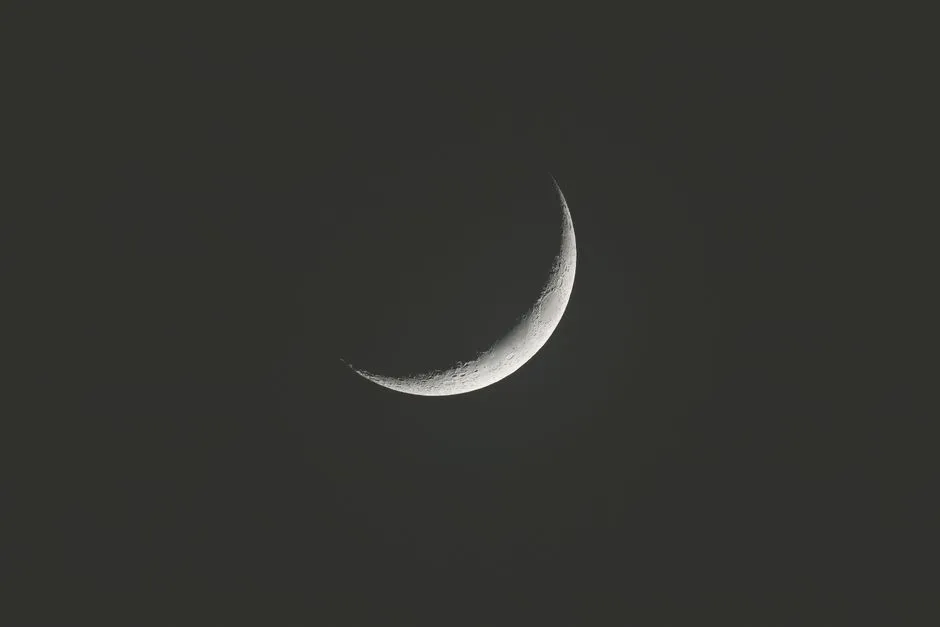
Lunar New Year's Day is the first day of the first lunar month, and a lunar month begins on the day that contains the new moon. Of the 200 New Years on the Hong Kong Observatory's table, 1901 to 2100, the new moon for 2027 sits closest to midnight, at 3 minutes 52 seconds on our computation. Next comes 1954, at 4 minutes 40. The moment itself is 15:56 UTC on 6 February. On the UTC+8 clock of Singapore, Hong Kong and Taipei that is 23:56 on the 6th. In Seoul, on UTC+9, it is 00:56 on the 7th. So the first day of the year is 6 February on Singapore's list and 7 February on the Korean institute's table. The new moon of 2028 splits the two clocks the same way.
A February 2027 new moon belongs to different days in Singapore and Seoul
The instant is agreed. The US Naval Observatory's moon phase data gives 15:56 UT, and the 2027 sheet from Taiwan's Central Weather Administration (CWA) prints 23:56 on the 6th, crediting Naval Observatory software, so the two count as one source. Three searches, in English, Chinese and Korean, found pages giving the time and none ranking it against other years, which proves nothing about absence.
Holiday listings blur the lunar date and the day off. The Korea Astronomy and Space Science Institute (KASI) puts lunar 1/1 on 7 February and lists the 설날 holiday as 6 to 8 February, with 9 February as a substitute day. Singapore's Ministry of Manpower lists Chinese New Year as 6 and 7 February. So Saturday 6 February is a public holiday on both lists.
We checked all 37 first-of-month rows on KASI's tables for 2026, 2027 and 2028, one leap month included. All 37 match a calculation on UTC+9, and 34 match UTC+8. These are the three that split:
| Lunar month | New moon, UTC+8 | New moon, UTC+9 |
|---|---|---|
| Ninth month, 2026 | 10 Oct, 23:50 | 11 Oct, 00:50 |
| First month, 2027 | 6 Feb, 23:56 | 7 Feb, 00:56 |
| First month, 2028 | 26 Jan, 23:12 | 27 Jan, 00:12 |
One calendar belongs to Hong Kong and Taipei alike
Hong Kong and Taipei keep the same clock, so no time-zone line runs between them. We tested that on 2,190 of the 2,556 days in seven CWA annual sheets against the Observatory's table, reading each lunar date by its position in the PDF. There were no differences. The other 366 days are solar-term cells or rows our parser could not align.
That agreement is expected, so it is no independent proof of the calendar. Helmer Aslaksen's paper The Mathematics of the Chinese Calendar, a draft dated 2010, says that after 1978 both places followed the same calendar as the mainland. For Singapore we hold no lunar table, only the ministry's holiday dates for 2027.
Month-starts pass to other dates on a clock an hour away
On fixed clocks, a shift of one hour in either direction moves the first day of about 75 of the 2,127 months from 10 February 1929 to the end of 2100, roughly 3.5% each way. New Year itself moves in 8 of the lunar years 1930 to 2100 at UTC+7 and in 11 at UTC+9. Every UTC+9 change is later and every UTC+7 change earlier. After 2028 the next UTC+9 split is 2061. Fixed clocks are arithmetic, and they are not the history of Korea or Vietnam.
Vietnam's side, which can reach a whole month, is in our guide to Tet. For 2027 UTC+7 stays on the 6th, at 22:56 by our arithmetic.
Our Chinese lunisolar calendar shows this if you enter 6 February 2027, leave the hour unknown and set the calendar to Singapore. It gives the first day of the first month and a note that a clock one hour ahead starts the month on 7 February. It has no Korea option, so Seoul's date comes from KASI. Until 1 November 2026 the page said a month with no major solar term is the leap month, wrongly credited Aslaksen with calling 2033 the rule's first such trap since 1645, and gave one warning for all 52 months near midnight, 29 past and 23 to come. The revision of that date counts 77 such months against 73 leap months, keeps the warning that a date could still shift for the three of those 23 that the Observatory names, and adds a month-by-month table.
The leap month goes with the clock in a few computed years
A new moon that crosses midnight can also change which month misses a major solar term (中氣), and with it the leap month. Our runs for the lunar years 1930 to 2100 find three such shifts at UTC+9 and three at UTC+7. At UTC+8, 2012 has a leap fourth month and 2017 a leap sixth; our UTC+9 run gives a leap third and a leap fifth. KASI's pages for those two years returned no table, so these are computed results, and we do not state them as Korea's calendar. The one Korean leap row we could read, the fifth month of 2028, agrees with both clocks.
The rule itself is in our guide to 2033. The Observatory's tables show four empty months that are not leap months, in 1985, 2033, 2034 and 2053, and Aslaksen's paper tabulates months of this kind too.
Caveats attach to three new moons still to come
The Hong Kong Observatory says "the uncertainty in the calculation of the time of moon phases and solar terms decades ahead may be up to a few minutes". It adds that dates near midnight "may have a discrepancy of one day", and names new moons on 28 September 2057, 4 September 2089 and 7 August 2097, along with four solar terms.
On our computation those three are the closest new moons to midnight still ahead. We compute 2057 at 23:59:52 and 2097 at 23:59:57 on UTC+8, and treat neither month start as settled.
CWA's 2021 sheet prints that year's winter solstice at 23:59 on the 21st, and it is on the Observatory's list too. New Year 2027 is not, though no New Year in two centuries lands nearer the line.

View author profile → · Editorial policy