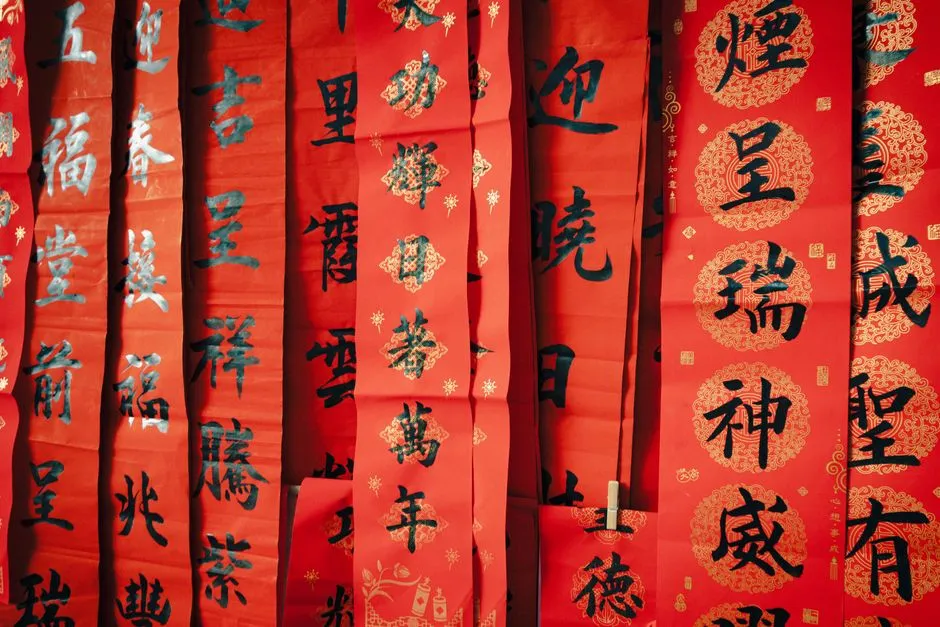
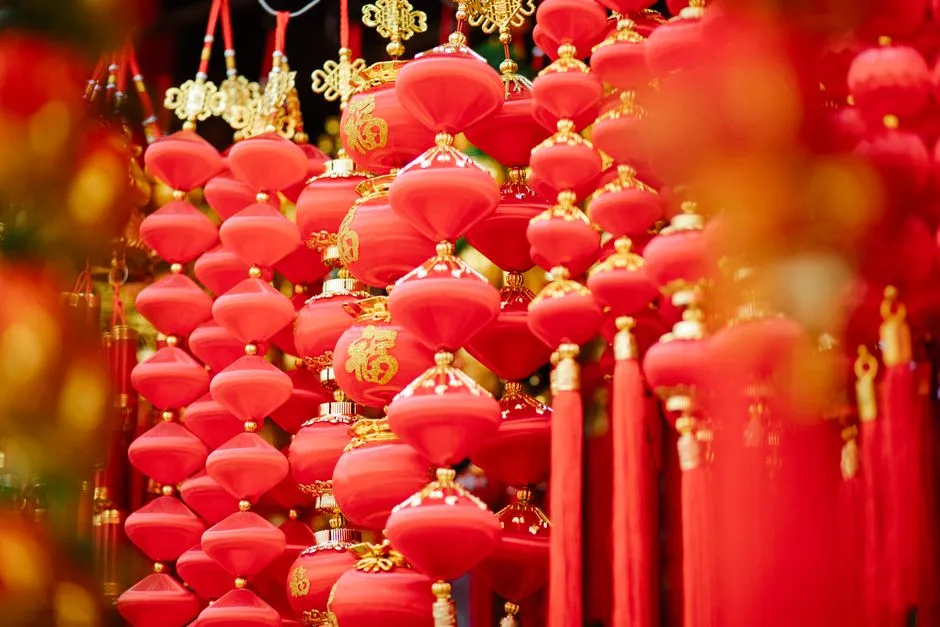
恭喜發財, a wish for prosperity said at Chinese New Year, is one string of four characters that sounds different from one Chinese language to the next. When we searched Taiwan's Ministry of Education dictionary of Taiwanese Hokkien on 4 November 2026, it had 恭喜 (kiong-hí) and 發財 (huat-tsâi) as separate headwords. It had no entry for the whole phrase. No example sentence in the dictionary contained it either. The Cantonese dictionary words.hk gives the phrase as gung1 hei2 faat3 coi4 in Jyutping, the sound the spelling Kung Hei Fat Choi writes down. The open Mandarin dictionary CC-CEDICT gives gōngxǐ fācái.
Traditional script gives the same characters under OpenCC's Hong Kong and Taiwan tables
Hong Kong and Taiwan both write Traditional characters, with some standard forms of their own. The open-source converter OpenCC keeps a separate table for each place. We ran the 93 distinct greetings in our own generator's list (98 entries over ten occasions, five of them repeats) from Simplified through both tables.
All 93 came out in identical characters, by our count. Against OpenCC's own generic Traditional standard, one differed: 粽叶飘香, a Dragon Boat line about the scent of dumpling leaves, became 粽葉飄香 under the Taiwan table and took 糉 for its first character under the generic one. 年年有余 came out as 年年有餘 under both, keeping the character for surplus.
That result describes OpenCC's tables; we did not survey what people write on shop signs or red-packet envelopes in Kowloon or Taipei.
Taiwanese Hokkien lists 恭喜 and 發財 but not the four-character phrase
The Ministry's 臺灣台語常用詞辭典 is a dictionary of common Taiwanese Hokkien words, published under a Creative Commons licence that allows quotation without adaptation. Its entry for 恭喜 gives the reading kiong-hí and the definition 「祝賀喜事之詞。祝賀。」, roughly "words of congratulation on a happy event; to congratulate". Its entry for 發財 gives huat-tsâi and marks it 臺華共同詞, a word Taiwanese and Mandarin share, with no separate sense listed.
Searches for 恭喜發財, 新年快樂 and 新年恭喜 returned no exact and no partial match. A dictionary of common words leaving out a set phrase is no evidence that nobody says it. But the full-phrase Hokkien spellings repeated on greeting lists online have no entry here to check against, and we found no other primary source giving one.
The phrase is a headword in the other two dictionaries. The words.hk entry for 恭喜發財 carries gung1 hei2 faat3 coi4. CC-CEDICT's export dated 3 November 2026, from MDBG, carries gong1 xi3 fa1 cai2 and calls it a New Year's greeting.
Hong Kong Cantonese adds 新年進步 to the usual wishes
The words.hk entry for 新年 lists 新年進步, a wish for progress in the coming year, beside 新年快樂. Read character by character from the Unicode Unihan database, it is san1 nin4 zeon3 bou6 in Jyutping. Because words.hk describes itself as built around Hong Kong Cantonese, its entry attests the phrase's use there. It does not say the phrase is used only in Hong Kong. CC-CEDICT has no headword for it.
Until 4 November 2026 our Chinese greeting generator did not list it. Its page promised help choosing greetings across four places in the region, yet none of its 95 entries carried a place, a Cantonese reading or a source. Its FAQ said it listed both 端午安康 and 端午快乐 when it held only the first. It also said the 瓦 of 弄瓦 was a clay tile.
The revision dated that day adds 新年進步 marked Hong Kong and 捞起 marked Singapore, each with its source named, and gives 恭喜發財 the two Ministry headwords verbatim. It shows Jyutping on 80 of 98 entries, 75 of the 93 distinct greetings. A reading appears only where Unihan 18.0 and the open-source to-jyutping library agree on every character, and where the greeting uses the character's Unihan Mandarin reading. If those conditions are not met, the card shows no reading. Choose the New Year occasion with the tone filter on All and both additions appear among its 16 greetings. The generator's hand-written pinyin reads 生意兴隆 with xīng and 日进斗金 with dǒu, as CC-CEDICT does, where a converter library we tested did not; the polyphones guide covers such errors.
Cantonese gives Singapore's yusheng toss its shout of 捞起
The Promote Mandarin Council's Singapore Mandarin Database (新加坡华语资料库) covers 捞起 under its entry for the raw-fish salad 鱼生. The database says the word belongs to Singapore's Cantonese community, who call it out while tossing the salad. The dish's other names, lou hei or lo hei, are just the Cantonese reading of the same word. The entry files it as an auspicious phrase, which is not the same thing as a greeting said to a person. On how the dish reached Singapore it hedges, naming Cantonese and Teochew migrants of the late 1800s as the likely route.
In Mandarin the two characters are lāo qǐ. The entry gives the Cantonese only as lou hei or lo hei, without tones, and its account of the shout concerns Singapore; it says nothing either way about other places. CC-CEDICT has no headword for 捞起 as a phrase.
Whether the sound-play behind New Year wishes carries from Mandarin into Cantonese is the subject of our guide to rebus puns.
Classical Chinese supplies 弄璋 and 弄瓦 from a poem that ranks sons above daughters
Two congratulations on a birth, 弄璋之喜 for a boy and 弄瓦之喜 for a girl, come from the ode 斯干 in the Book of Songs. A son is laid on a bed and given a jade 璋 to play with: 「乃生男子,載寢之牀……載弄之璋」. A daughter is laid on the floor and given a 瓦: 「乃生女子,載寢之地……載弄之瓦」.
The Mao commentary, read in 毛詩正義, chapter 11, glosses the 瓦 as 「紡塼也」, a spindle whorl rather than a roof tile. Zheng Xuan's note on her bed on the floor says 「臥於地,卑之也」: she is laid low to mark her as lower. The ranking is the poem's and its commentators', and the two phrases carry it. CC-CEDICT labels 弄璋 and 弄瓦 as literary. It glosses 早生贵子, a wedding wish, as "give birth to a son soon".
Standard Mandarin in CC-CEDICT tags under a third of the greetings as idioms
Of the 93 distinct greetings in our list, 48 (52%) are CC-CEDICT headwords, by our count against the 3 November 2026 export. The other 45 are not, among them 身体健康, 母子平安 and 端午安康. By our count 22 of the 45 split cleanly into two two-character words the dictionary does list, as 身体 and 健康 do.
Twenty-six of the 48 carry the label "(idiom)", 28% of the 93. The label is the dictionary contributors' tag, applied entry by entry, and four characters do not earn it on their own: 新年快乐 and 生日快乐 are headwords with no tag, and 恭喜发财 is glossed as a New Year's greeting rather than an idiom. A gloss can also carry a sense a greeting card leaves out. 龙马精神, offered as a New Year wish for vigour, is glossed in CC-CEDICT as "old but still full of vitality".