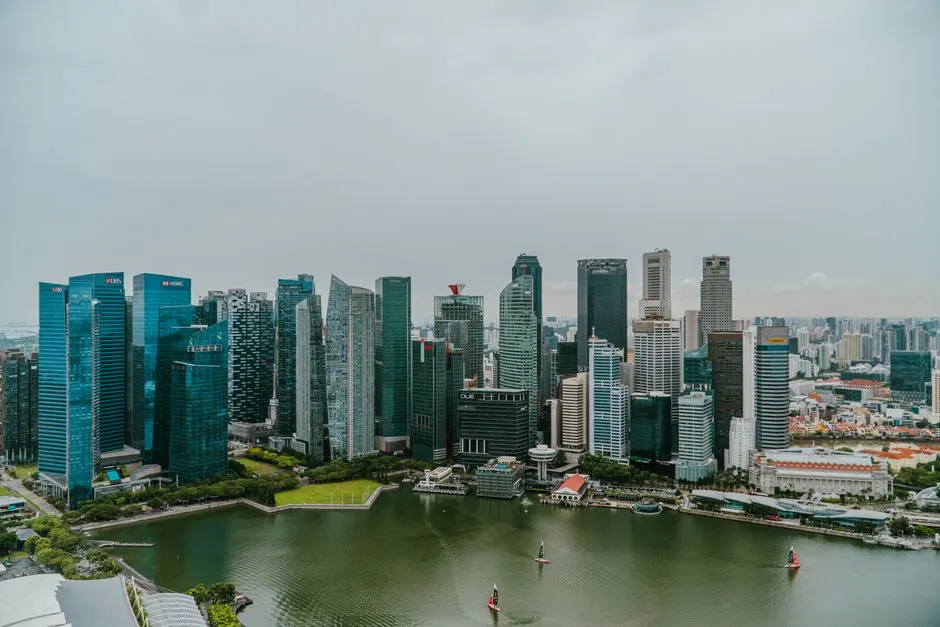
3 OCT 2026 — Crypto markets spent much of the past year in a downturn, and the Central and Southeast Asia and Oceania region that Chainalysis tracks shrank with them, by 6.8%. Singapore went the other way. In its annual report, released on 30 September, Chainalysis puts the city-state's crypto activity up 55.4% to $284 billion in the year to June, the largest in the region.
Most of that growth came from a small number of large institutional players, not the public.
What drove Singapore's growth
Activity on institutional platforms in Singapore (market makers, prime brokers, over-the-counter desks, custodians and institutional-only exchanges, as Chainalysis defines them) rose 94% to $60 billion, according to the report's regional chapter. Much of it was concentrated among a few market makers, over-the-counter trading firms and brokerages. Flows into centralised exchanges rose 30%, and into decentralised exchanges 69%.
Australia was second at $173.1 billion, down 5.6% overall, though its institutional flows rose 33.3% to $39.9 billion. India fell 14.7% to $135 billion.
The rest of Southeast Asia
Vietnam ranked fourth in the region at $122.2 billion, followed by Indonesia at $83.2 billion, Thailand at $82.8 billion and the Philippines at $44.5 billion, according to TechNode Global's coverage of the full report.
Small payments in three countries
The Philippines, Thailand and Vietnam stand out for everyday use. Together they made 5.4 million small peer-to-peer transfers under $10,000 each, 14.4% of the world's total, although the three account for only 2.5% of global crypto activity. More than four in five of their domestic transfers were under $1,000, and the average was $618, against $1,210 elsewhere.
Stablecoins move across borders
In every market Chainalysis analysed, stablecoin activity across borders exceeded activity within them. Malaysia had the widest gap, with cross-border flows 29.5 times domestic ones, against 3.2 times for the region. Thailand and Vietnam have large domestic stablecoin markets of $10.4 billion and $6.9 billion, but their cross-border markets were still larger by half or more.
Industry figures quoted in the report explain why. David Low, chief executive of the Malaysian exchange Hata, said stablecoins have "a relatively weak value proposition for everyday domestic payments" where local payment systems already work well, but are more useful for cross-border settlement. Nichel Gaba, founder of the Philippine exchange PDAX, estimated that "probably around 5-10% of inbound remittances are being settled with stablecoins" in the Philippines.
How to read the figures
The country totals are Chainalysis's own estimates from blockchain data, not figures reported by governments or exchanges. A large total for a financial centre such as Singapore also reflects the trading firms based there, which the report itself says account for much of the growth, rather than how many residents use crypto.
The regional chapter follows Chainalysis's global adoption index, published on 23 September, which said the world's crypto economy "held firm through the bear market." Because the firm groups India and Pakistan with Southeast Asia and Oceania, regional totals cover more than ASEAN. Pakistan's 736% jump in everyday use started from $69 million and followed its April decision to lift a seven-year ban on banks dealing with crypto companies.