The periodic table is not ordered by weight. Walk our own element data from hydrogen to oganesson and the weight falls, rather than rises, in 7 places.
4 of those are the reason the table is arranged the way it is. The other 3 are not about elements at all.
Mendeleev's problem
The original table was ordered by atomic weight, which in the 1860s was the only property measurable for every element. The system worked, but it had exceptions. Put tellurium and iodine in weight order and tellurium comes second — but its chemistry belongs with sulphur and selenium, and iodine's belongs with chlorine and bromine. The weights said one thing and the behaviour said another.
Mendeleev put them in the chemically correct order and left the weights looking wrong. He was right, though the reason would not be clear for another fifty years. The property that governs chemistry is the number of protons, which atomic weight only approximates.
What our own table contains
Our interactive periodic table runs on a list of 118 elements. Ordering them by atomic number and comparing each weight with the one before gives 7 inversions, and they are not all the same kind of thing.
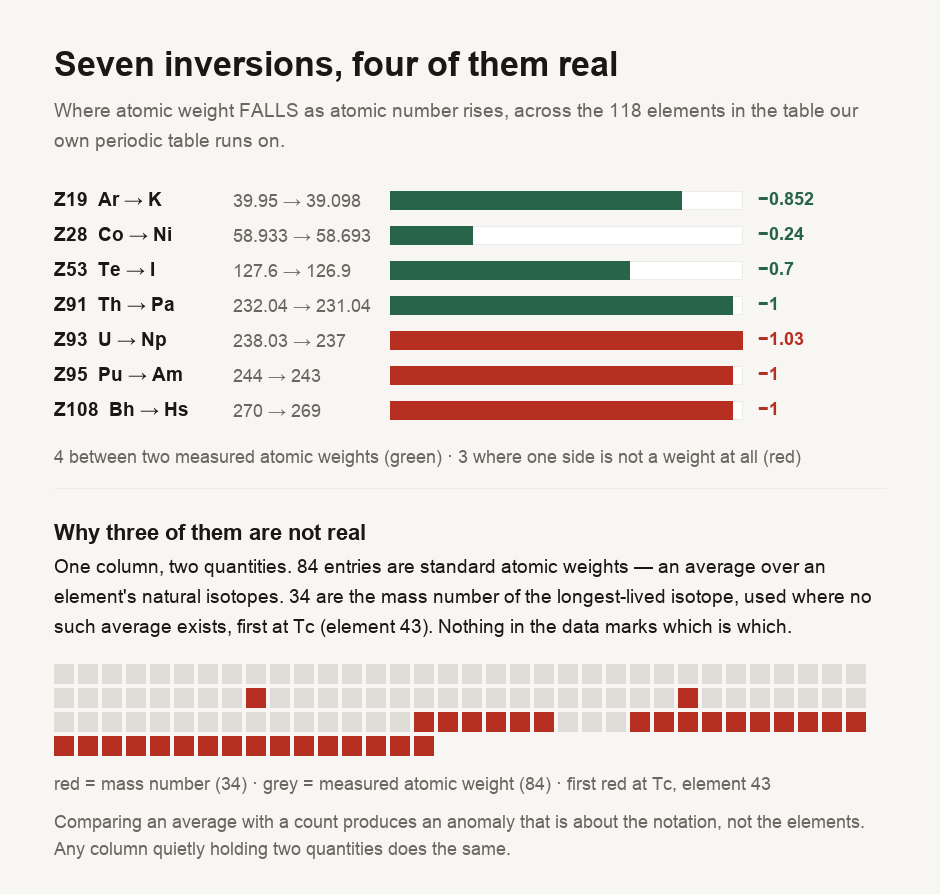
Four sit between two measured atomic weights — argon into potassium, cobalt into nickel, tellurium into iodine, thorium into protactinium. Argon is the largest fall, 0.852, and the most consequential — potassium is essential to every cell you have, and it sits after a heavier noble gas.
For these pairs, ordering by weight and ordering by proton count give different answers. Argon has 18 protons and potassium 19; argon's commonest isotope simply carries more neutrons than potassium's.
The other three are a notation problem
The remaining inversions — uranium into neptunium, plutonium into americium, bohrium into hassium — are not comparisons between two atomic weights, because one side is not an atomic weight.
A standard atomic weight is an average over the isotopes an element actually occurs as on Earth. Some elements have no such average: they are radioactive with no stable composition, so there is nothing to take a mean over. For these elements, the convention is to use the mass number of the longest-lived isotope. That is a whole number, counting protons and neutrons in one particular isotope. Printed tables put it in brackets to mark it as a different kind of quantity.
Of the 118 entries in our table, 84 are standard atomic weights and 34 are mass numbers. The first appears at technetium, element 43. And they are all stored as bare numbers, with nothing marking which is which.
So the three remaining inversions are comparisons between an average and a count. They are real numbers in the right order, describing two different things. Put brackets back on the mass numbers and those three stop looking like anomalies, while the four genuine ones remain exactly as they were.
What we are not claiming
Storing a mass number where no standard weight exists is normal. Every printed periodic table does it, and the alternative — a blank — is worse. The gap in ours is that the distinction is invisible. Reading the data, you cannot tell an average from a count without a heuristic.
The heuristic we used is that mass numbers land as whole numbers. That happens to be exact for this table, and it is a fact about how the data was typed rather than a definition. Somebody storing a measured weight as a round figure would break it, quietly.
Reading a table like this
The lesson here is not about chemistry. Any column of numbers that mixes two kinds of quantity will produce anomalies that look like findings, when the error is in the data, not the world. Three of our seven were exactly that.
The tell is a unit or a definition that changes partway down a column while the column heading stays the same. Weight and mass number are both "about how heavy an atom is", which is what makes them easy to store together and misleading to compare.
Order our own 118-element table by atomic number and the weight falls rather than rises in 7 places. Four of those are real disagreements between weight order and proton order, the largest being argon into potassium at 0.852. They are why the modern table is arranged by proton count, which Mendeleev arrived at without being able to say why. The other three are an artefact of storage. 34 of the 118 entries are not atomic weights but mass numbers of the longest-lived isotope, sitting as bare numbers beside 84 measured weights with nothing to tell them apart. Comparing an average to a count produces an anomaly that is about the notation rather than the elements — which is the transferable part, because any column that quietly holds two quantities will do the same.
Related reading
Our interactive periodic table is built on the same 118-element data this guide measures. For the wider habit of not trusting a printed figure, the digits your calculator invents covers significant figures and spurious precision. For another case of measuring our own data and finding fault with the instrument rather than the subject, read how much of a framework a script can check.
- Every figure comes from a script committed alongside this guide, which loads
chemistry.atomicWeightsout of the kernel our interactive periodic table runs on and walks it in atomic-number order. It re-runs rather than reading a stored copy, so the guide goes red if the table changes. - ⚠️ THE ORDER IS ASSERTED, NOT ASSUMED. The whole measurement depends on the data being in atomic-number order, which is an insertion-order assumption about a plain object. The script checks known symbols against known positions first and exits non-zero if that ever stops holding, because every count would otherwise be silently meaningless.
- ⚠️ INTEGER-VERSUS-DECIMAL IS A PROXY FOR THE IUPAC RULE, NOT THE RULE. Elements with no characteristic terrestrial composition get the mass number of their longest-lived isotope instead of a standard atomic weight, and those land as whole numbers here. The proxy is exact for this table, but it describes how the data was typed rather than what the convention says.
- ⚠️ THE INVERSIONS ARE TEXTBOOK, NOT A DISCOVERY. That atomic weight runs backwards in a few places is why the table is ordered by proton number, and has been understood since Moseley. What is measured here is how many this particular table contains and how many are an artefact of storing two quantities in one column.
- ⚠️ NO CLAIM IS MADE THAT THE KERNEL IS WRONG. Storing a mass number where no standard weight exists is the ordinary convention and the alternative is a blank. The observation is only that nothing marks which entries those are.
This describes a measurement of the element data behind one of our own tools, and the reason the periodic table is ordered as it is. It is not chemistry teaching material, not a reference for laboratory work, and not a source for isotope data.

View author profile → · Editorial policy