You have a coffee in the afternoon and lie awake at midnight wondering how long the caffeine actually lasts. The answer you will usually find is that a substance is gone after ten half-lives.
That number is a convention, not a measurement. It is a round figure somebody settled on, and whether it is right for you depends on two things it never asks about: how much you had, and how little counts as none.
Run the numbers on two ordinary coffee scenarios and the same decay curve gives two different answers: 4 half-lives in one case, nearly 12 in the other. The caffeine is the same; the question is different.
Why ten half-lives?
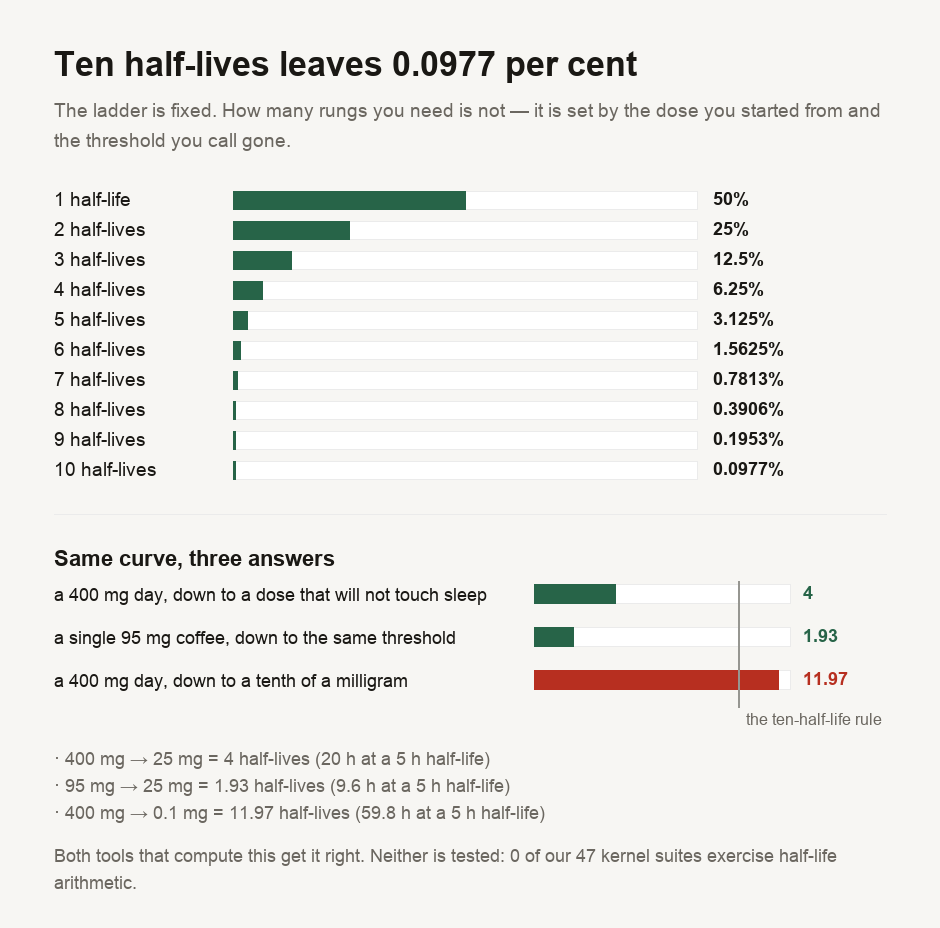
Each half-life halves what is left, so the arithmetic is fixed and unarguable. One leaves 50 per cent, four leaves 6.25, seven leaves 0.78. Ten leaves 0.0977 per cent — under a tenth of one per cent of where you started.
That last figure is why the rule exists. A thousandth of a dose feels like nothing, so somebody rounded "vanishingly small" up to a round number of halvings and it stuck.
The rule works by equating "0.0977 per cent remains" with "it is gone". Whether that is a reasonable leap depends on the size of the dose and your definition of "none" — two numbers the rule ignores.
Two coffees, two answers
Take the ceiling the FDA names for healthy adults, 400 mg a day, and ask when it falls below 25 mg — roughly a quarter of a small coffee, and low enough that most people would stop worrying about it at bedtime. That takes 4 half-lives. On a five-hour half-life, about 20 hours.
Now start from a single 95 mg cup instead. Falling to the same 25 mg takes 1.93 half-lives, under ten hours. The curve is identical; you simply began nearer the finish.
Both hour figures assume a five-hour half-life, which is a mid-range illustration rather than anyone's actual rate. Caffeine half-life varies several-fold between people, so treat the hours as showing the shape of the thing rather than telling you when to stop drinking coffee.
If we move the goalposts and ask when the same 400 mg dose drops below a tenth of a milligram, the answer is 11.97 half-lives, or about 60 hours. The ten-half-life rule does not get you there.
The rule, then, misses in both directions. It is a statement about the ratio between dose and threshold, dressed up as a statement about a drug.
Where the rule does earn its keep
The rule is not useless, though. In clinical pharmacology the threshold is usually implicit and constant enough. A dose is chosen to produce an effect, and “gone” means the level has fallen too low to do so. That puts most of these ratios in the same range, and five half-lives to negligible, ten to effectively absent, is a decent shorthand.
It goes wrong when it is carried out of that context and applied to a detection threshold, which can sit many orders of magnitude below a dose. A laboratory looking for traces is not asking the same question as a pharmacologist, and the same curve gives them very different answers.
The tools that compute this, and what they lack
We publish two of them, and both get the arithmetic right. Our caffeine calculator applies the standard exponential decay, and our general half-life tool both applies it and inverts it to solve for an unknown half-life. We checked the implementations rather than assuming them.
What neither has is a test. Both compute in page-local JavaScript rather than in a shared kernel, which puts them among the grandfathered entries our own page-logic gate tolerates. Of this repository's kernel test suites, 0 exercise half-life arithmetic at all.
This is why the figures here come from a separate script rather than the tools themselves. Importing their logic would have made a guide about untested code depend on the untested code it describes.
What to ask instead
If someone says a substance is gone after a set number of half-lives, ask for their threshold. “Gone” can mean below what a receptor responds to, what an assay detects, or what a legal limit allows. Each is a different threshold, and each moves the answer.
Halve the threshold and you add one. Double the dose and you add one. The substance never enters into it.
Ten half-lives leaves 0.0977 per cent of a dose, which is where the rule of thumb comes from. But the step from that figure to "gone" needs the two numbers the rule never asks for. Run our own caffeine scenarios and a 400 mg day falls below 25 mg in 4 half-lives, a single 95 mg coffee reaches the same point in 1.93, and the same 400 mg day needs 11.97 to reach a tenth of a milligram. Same curve, same substance, three answers, because what is being measured is the ratio of dose to threshold. The rule is a reasonable shorthand inside clinical pharmacology, where the threshold is implicit and fairly stable, and it misleads the moment it is carried across to detection limits that sit orders of magnitude lower. The two tools we publish for this compute it correctly. Neither is covered by any of our kernel test suites.
Related reading
Our caffeine half-life calculator traces a stated dose down over the hours after the cup, and the half-life decay calculator does the general case for any substance. For more on numbers that look more precise than they are, the digits your calculator invents covers reading precision into a figure that has none, and the 90-minute sleep cycle rule takes apart another tidy number that describes an average rather than a person.
- Every figure comes from a script committed alongside this guide. The decay arithmetic is textbook — remaining = dose × 0.5 ^ (elapsed ÷ half-life) — and the script computes it independently rather than importing our tools, for the reason given in the body.
- ⚠️ EVERY SCENARIO IS AN ASSUMPTION AND IS STATED SO YOU CAN ARGUE WITH IT. The doses and thresholds — 400 mg, 95 mg, 25 mg, 0.1 mg — are chosen to be recognisable, not authoritative. Change either number and the half-life count changes with it, which is the entire point of the guide.
- ⚠️ NOT MEDICAL GUIDANCE, AND NOT ABOUT YOU. Caffeine half-life varies several-fold between people with genetics, pregnancy, liver function and medication, and the five-hour figure used for the hour conversions is a mid-range illustration rather than a personal estimate.
- ⚠️ THE ARITHMETIC IS NOT A FINDING. That each half-life halves what remains is textbook and belongs to nobody. What is measured here is how many half-lives our own worked scenarios need, which the rule of thumb cannot answer because it ignores both dose and threshold.
- ⚠️ THE TWO TOOLS ARE CORRECT — the gap reported is test coverage, not arithmetic. Both implement exponential decay properly; both compute in page-local JavaScript rather than a shared kernel, sit among the grandfathered entries in our page-logic baseline, and are exercised by none of our kernel test suites.
This article uses our own published tools to explain where a common rule of thumb comes from and what it leaves out. It is not medical, pharmacological or laboratory guidance, and should not be used to judge whether any substance has cleared anyone's body.

View author profile → · Editorial policy