
The complaint is annual and identical. The bonus lands, the payslip looks wrong, and somebody explains that bonuses are taxed at a higher rate.
They are not. We ran the arithmetic through the same engine our own Singapore calculators use, and the tax on an extra dollar is the same whether that dollar arrives as salary or as a bonus. Something else is going on, and above a certain salary it is worth real money.
The same money, delivered two ways
Take an extra $1,200 a year. Give it to somebody as a $100-a-month raise, then give it to somebody else at the same salary as a one-off bonus, and compare what reaches the bank.
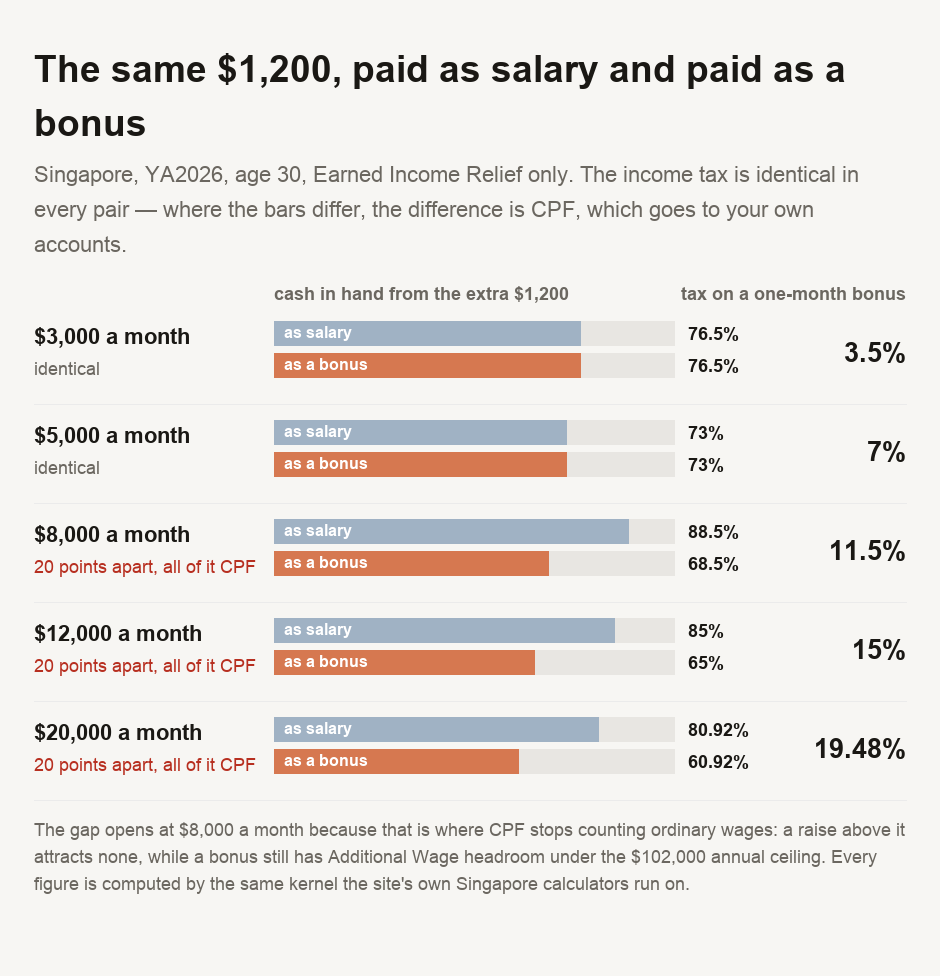
At $3,000 and $5,000 a month the two are indistinguishable — same tax, same CPF, same cash.
From $8,000 a month upward they diverge sharply. The salary version puts 20 percentage points more cash in hand than the bonus version. And the tax is identical in both. Every dollar of the difference is CPF.
Why the gap opens exactly there
Because $8,000 a month is where CPF stops counting ordinary wages. Above that ceiling a raise attracts no CPF contribution at all.
A bonus counts as an Additional Wage rather than an ordinary one, and it has its own ceiling: $102,000 a year minus your ordinary wage contributions. Someone on $8,000 a month has used $96,000 of that, leaving $6,000 of headroom — so the first $6,000 of bonus attracts full CPF even though a raise at the same salary would attract none.
This mechanism works the opposite way to the folklore. The bonus is not taxed more. It is contributed on more, and the contribution goes to your own CPF accounts rather than to the government.
Whether that is good or bad depends on what you need. It is money you will get, in a form you mostly cannot touch before 55. What it is not is a tax.
What the bonus actually costs in tax
The effective tax rate on a one-month bonus, at each salary level, is just your marginal rate: 3.5 per cent at $3,000 a month, 7 at $5,000, 11.5 at $8,000, 15 at $12,000 and 19.48 at $20,000.
The tax tables have no bonus rate because a bonus is simply income. A bonus is income, it stacks on top of the rest of your income, and it is taxed at whatever band that lands in.
Which does mean a large bonus can straddle two bands. At $3,000 a month, a one-month bonus is taxed at 3.5 per cent and a three-month bonus at 5.06 — the second and third months pushed into the next band up. That is progressive taxation at work rather than a penalty on bonuses.
And in Singapore, nothing is deducted anyway
The bonus payslip is also confusing because Singapore does not withhold income tax. There is no pay-as-you-earn deduction on any payslip, bonus month included. You are assessed on the year and you pay afterwards.
So if your bonus payslip looks short, income tax is not the reason — it cannot be. It is CPF, at up to 20 per cent of whatever part of the bonus sits under the Additional Wage ceiling.
In a withholding system, by contrast, a bonus month can look brutal, because the deduction is calculated as if the extra pay were your new normal. Malaysia's PCB works that way, which our guide to PCB covers. The Singapore version of that experience does not exist.
What we found checking our own calculators
Since this guide is arithmetic, we ran the same question at our own tools: do they handle a bonus, or do they quietly ignore it?
They handle it. The CPF contribution calculator takes an annual bonus and applies the Additional Wage ceiling automatically. The Singapore take-home calculator takes one too, applies the ceiling to CPF and counts the bonus toward taxable income. The income tax calculator has no separate bonus field and does not need one — it asks for annual gross income, described as total employment income before deductions, which is where a bonus belongs.
No defect found, which is a duller result than the last few of these audits produced and is still worth stating. An audit that only gets reported when it finds something is not an audit.
A bonus is not taxed at a special rate. The tax on an extra $1,200 was identical whether it arrived as salary or as a bonus, at every salary level we computed. The difference is CPF, and only above $8,000 a month: a raise at that salary escapes CPF while a bonus still attracts it. That 20-percentage-point difference in cash goes to your own CPF accounts, not to tax. Since Singapore withholds no income tax on any payslip, a short-looking bonus month is CPF and never tax. If the effective rate on your bonus seems high, it is likely that the amount crossed a band — a one-month bonus at $3,000 a month is taxed at 3.5 per cent, a three-month bonus at 5.06.
Running your own
Every number here comes from the same engine behind our calculators, so you can reproduce any of it. Put your salary and bonus into the take-home calculator for the whole picture, or the CPF calculator if you only want the Additional Wage ceiling. To see where a bonus lands you in the bands, the income tax calculator runs both Singapore and Malaysia. And how to read your payslip covers the month-by-month version of this, including why the bonus month looks different in the first place.
- Every figure is computed by a committed script that calls
asean-payroll-kernel.js— the same module our Singapore calculators run on. No rate is restated in this guide: if the kernel's brackets or ceilings move, the script's output moves and the guard fails until the prose follows. - ⚠️ EMPLOYEE CPF IS REPORTED SEPARATELY FROM TAX throughout, and never folded into a single "deduction" figure. It leaves the payslip but arrives in the employee's own CPF accounts. Combining the two would overstate what a bonus costs, in the direction that makes the story better.
- ⚠️ SINGAPORE DOES NOT OPERATE PAY-AS-YOU-EARN. No income tax is withheld from any payslip. Every tax figure here is what is eventually assessed on the year, not what goes missing when the bonus is paid.
- ⚠️ ONE SET OF ASSUMPTIONS: tax resident, age 30, YA2026, Earned Income Relief only and no other reliefs, no rebate — none is announced for YA2026. Reliefs you actually claim will move your figures, and a different age changes the CPF rate band. The shape of the result does not depend on any of that; the specific percentages do.
- ⚠️ The comparison uses $1,200 a year because it is both a round $100-a-month raise and a plausible small bonus. A larger amount would cross more bands and produce a larger tax figure — the point being made is about the CPF gap, which does not depend on the size.
- The tool audit was read from the widget sources on 11 August 2026 and describes what each tool does rather than asserting a defect, because an audit written as a complaint goes stale the moment somebody fixes it.
This is an explanation of how Singapore's income tax and CPF treat a bonus, computed for one set of assumptions. It is not tax advice, and it does not model reliefs, allowances or arrangements specific to you. IRAS and the CPF Board are the authorities on your own case.

View author profile → · Editorial policy